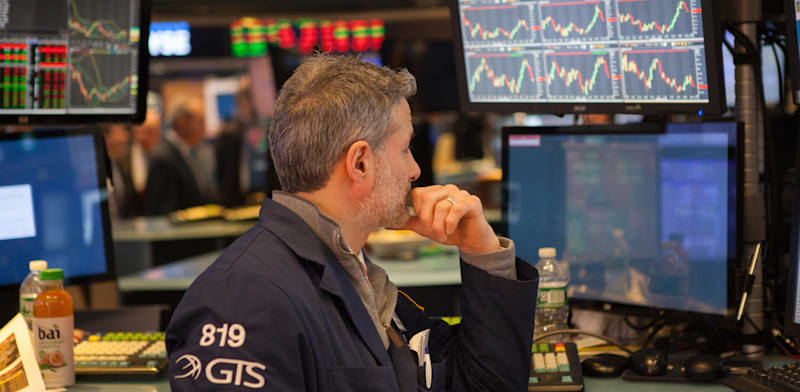
Wall Street ended Friday with sharp declines, led by technology stocks, and concluded a particularly negative week for the Nasdaq. The question that preoccupies investors is whether this is a temporary correction – or a sign that the pressure on artificial intelligence stocks may continue.
The Dow Jones fell about 0.3% on Friday, the S&P 500 lost about 1.1% and the Nasdaq fell about 2.1%. On a weekly basis, the Nasdaq lost more than 4%, completing its worst week since June, amid weakness in technology stocks and companies related to AI infrastructure.
One of the indices that illustrate the increase in concerns is the volatility index VIX, also known as the “fear index”. The index, which reflects the volatility that investors expect in the American stock market during the next 30 days based on the prices of options on the S&P 500, jumped about 21% on Friday and closed at 19.99, after reaching 22.31 during trading – its highest level since the end of July. A level of around 20 does not in itself indicate a crisis, but the sharp jump within one day shows that investors are preparing for the possibility of further upheavals.
At the same time, transactions amounting to millions of dollars were recorded in options on the fear index. According to a CNBC report, one trader purchased 9,200 call options at a strike price of 20 and expiring on November 18, for approximately $1.7 million. In another transaction, he purchased 12,500 options at an exercise price of 23 and at the same expiration, for approximately $1.1 million. The trades may yield a profit if volatility rises according to the terms of the options, but they do not prove that the trader is anticipating a crash: such options may also be used to protect against losses in an investment portfolio.
The bonds of the AI infrastructure companies signal distress
The concern in the markets does not only concern volatility in the short term. At the same time as the declines in technology stocks, questions are mounting about the extent of the debt accumulated to finance the establishment and expansion of the artificial intelligence infrastructures – and the ability of the companies to generate income and profits from these investments at a rate that will justify the costs.
A prominent example of this is CoreWeave a cloud computing and artificial intelligence infrastructure company supported by Nvidia. According to a Reuters report, the company’s stock lost more than 15% during the week, while its bonds also suffered sharp declines. Bonds issued in June with a yield of 9.675% traded later in the week with an abnormal yield of about 15%. The increase in yield reflects the decrease in bond prices and the higher premium that investors demand to hold the company’s debt.
The drop in bond prices is not only important for investors in the company itself. It may reflect a broader change in relation to financing AI infrastructures through debt: investment-intensive projects may require years to generate significant income, and in the meantime companies are exposed to high financing costs and changes in demand.
The macro environment also does not provide the market with much breathing space. Stronger than expected American inflation data increased the fear that interest rates will remain high for a long time. However, it cannot be concluded from the data alone that the Federal Reserve is expected to raise interest rates soon, and the forecast for the continuation of monetary policy also depends on the economic data that will be published later.
The next test for the market will come in the coming week, with the publication of the reports of large companies including them Tesla andMeta which are expected to publish their results on Wednesday, October 21. Their results and forecasts may provide investors with an additional indication of the demand for AI products, the scope of the planned investments and the ability to turn them into revenues.
For your attention: The Globes system strives for a diverse, relevant and respectful discourse in accordance with the code of ethics that appears in the trust report according to which we operate. Expressions of violence, racism, incitement or any other inappropriate discourse are filtered out automatically and will not be published on the site.