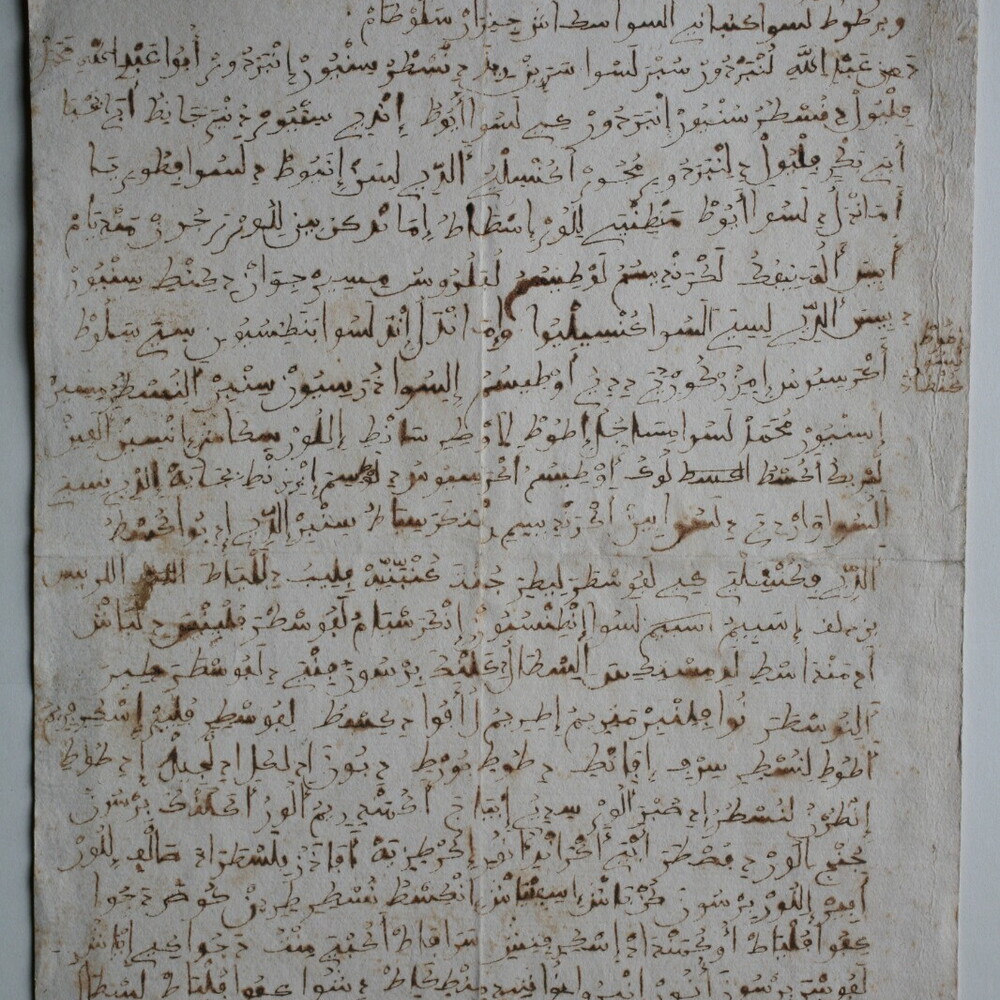
Hebrew, Greek, Arabic, Armenian, Ethiopian, Syriac. Besides obviously Latin. They are the six different alphabets with which, in medieval and modern Italy, people wrote in a script not conventionally linked to that language. That is, it happened that ethnic and religious minorities also resorted to their own scripts to write local vernaculars and Italian. This phenomenon is known as “allografia“. In Italy there were six alphabets with which Italian was written for centuries, used in texts, glosses, translations, even poetic and literary texts, dictionaries, love lyrics, including some of the oldest testimonies of the Italian vernaculars. A very rich and varied corpus, which covers a broad chronological period ranging from the year 1000 to 1800, even if the majority of the texts are concentrated between the 1300s and 16th century. In this context, Italy is truly a case study: Italy is characterized by a variety of “allographic” traditions (allography is in fact the name of this practice) which has no counterpart in the rest of Western Europe.
“This can be explained for various reasons – explains Professor Daniele Baglioni, Director of the Department of Humanistic Studies of Ca’ Foscari University – the geographical position of Italy, at the center of the Mediterranean; the long-lasting presence of ethnic-religious and linguistic minorities who, unlike what happened in other countries, have not been expelled; the influence of the Italian powers in the Levant and North Africa, with the contacts between languages and writings that have resulted from it; the role of the Church of Rome, of reference for the Catholic churches of the Eastern rite. This privileged observatory allows not only to compare different scriptures and traditions, but also to follow the entire “life cycle” of the allographies, from the moment they were born and, very slowly, established themselves, until their progressive exit from the scene. In other European countries that boast quantitatively much greater allographic traditions, such as Spain, for example, the phase of decline is not observable, because the expulsions of Jews and Muslims at the end of the fifteenth century did not occur. allowed that slow process of integration which is responsible for the obsolescence of these practices”.
The Ca’ Foscari University project
The European Research Council (ERC) has announced that the project of the Ca’ Foscari University of Venice “ConScrIt – Concurring Scripts. Allography in Italy (1000-1800)” by Professor Daniele Baglioni has been awarded the prestigious European ERC Advanced Grant funding (for the 2025 call) intended for the best European research projects. It is the most coveted grant at European level (319 winners) and for the university it is a result not seen since 2010: 2 million and 250 thousand euros, for a team of 7 people including researchers and doctoral students and a duration of 5 years.
The project applies a not yet attempted (cross-scriptal) approach that brings together linguistics and philology of different languages, supported by digital humanities disciplines that provide for the automatic transcription and transliteration into the Latin alphabet, also automated, of a corpus of texts, among which the Haggadah of Venice stands out, in its Judeo-Italian version. The professor’s project made use of the precious collaboration of the research team of the Venice Center for Digital and Public Humanities of the Department of Humanistic Studies of Ca’ Foscari.
“The project aims – continues Baglioni – to provide a theoretical framework for the origin, evolution and decline of allographic traditions, as well as for their functions, to propose a unitary classification of the adaptation strategies of a script to a language usually written in another writing system; to create, finally, the first thesaurus based on a ‘cross-scriptal’ allographic corpus”.
“Furthermore – explains Baglioni again – among the allographic documents we have some of the first testimonies of Italian vernaculars: the oldest attestations of Sicilian and Sardinian are in the Greek alphabet, the oldest testimony of Salento is in Hebrew characters. And there is also the very interesting case of allographic texts written by foreigners, which offer precious attestations of what today we would call Italian L2: a fine example of this is a manual for the construction of ships, written in Venetian but in Greek alphabet from a Greek from overseas, which is among the most important evidence of how the Greeks must have spoken Venetian in the Renaissance era”. For the history not only of language but also of culture, the allographic corpus includes literary texts (especially poetic ones), translations of the Bible and the Gospels, dictionaries, scientific and philosophical treatises, sermons, prayers, even nursery rhymes, spells and conjurations, which due to the fact of being written in “other” scriptures have remained on the margins of studies.
“Dedicating a five-year project to these documents – concludes Professor Baglioni – means taking them out of the margins, making them accessible to everyone and preventing them from continuing to be, so to speak, children of a lesser God”.
Blank Slate
هل يعتقد اللاعبون حقاً أن الطقوس تجلب لهم الحظ؟
ما هي أغرب طقوس لاعبي كرة القدم التي سمعتم عنها؟ – Experts123
Les joueurs de football ont vraiment des habitudes bizarres avant les matchs – Casino Pub | Best Online Casino Review & Listing in Malaysia
Les superstitions des footballeurs sont-elles vraiment efficaces ou juste pour le mental ? – Ezega Forums
Viewtopic.Php
PaperCall.io – Quels sont les rituels les plus marquants des joueurs de foot avant les matchs ?
Gendou.com Forum: Other: Rituels de joueurs surprenants ?
Vous avez des anecdotes sur des rituels de joueurs de foot ?
SrananComForum – A Bravenet.com Forum
Ctoun67's Blog – Community – The Sims 3
Blank Slate
التنس والمراهنات: هل تؤيدون الشراكة؟ – The Dnfinance Forum
هل هناك تطبيقات مفيدة للمراهنات الرياضية؟
كيف تختارون موقع مراهنات رياضية جيد؟ – Experts123
هل برامج شراكة المراهنات حقيقية؟ – Islamic Research and Information Center (IRIC)
%D8%A3%D9%81%D8%B6%D9%84 %D8%A7%D9%84%D9%85%D9%88%D8%A7%D9%82%D8%B9 %D8%A7%D9%84%D9%84%D9%8A %D8%Aa%D9%82%D8%Af%D9%85 %D8%A7%D8%Ad%D8%Aa%D9%85%D8%A7%D9%84%D8%A7%D8%Aa %D8%Ac%D9%8A%D8%Af%D8%A9 %D9%84
I was thinking of trying sports betting. What's your experience been like? – Ezega Forums
T16168.Html
ما زال البعض يفضل الأخبار القصيرة على التحليل المطول؟
أي نوع من الأخبار يشد انتباهك أكثر شي في الصباح؟
في عصرنا الحالي، ومع التطور السريع لوسائل الإعلام الرقمية، أ
هل الأحداث المحلية والعالمية تهمكم بنفس القدر؟
أحد التحديات التي أواجهها عند متابعة الأخبار هو اختيار المنص
ما عناوين الأخبار التي تشدك للقراءة فوراً؟ – Casino Pub | Best Online Casino Review & Listing in Malaysia