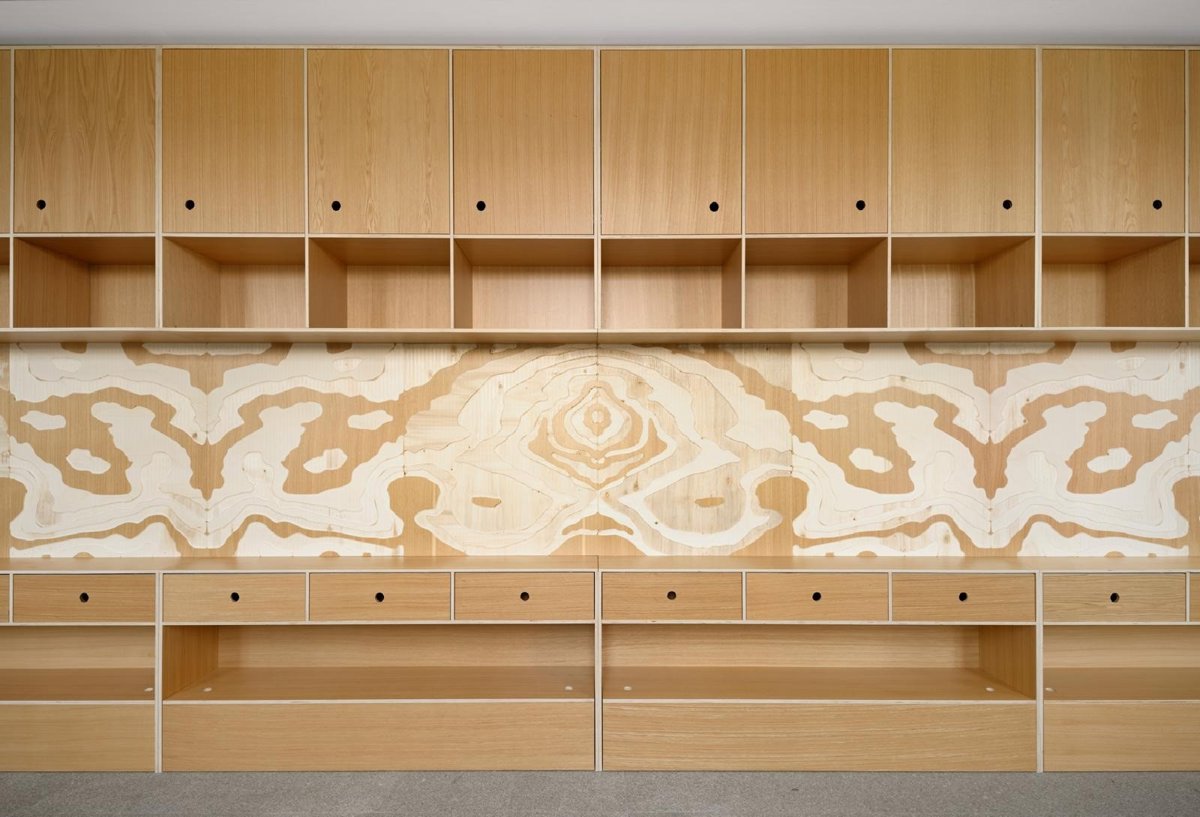
The Reina Sofia Museum has incorporated into its collection tour ‘Contemporary art: 1975-present’ a new space called Alhacena, designed by Jorge Penadés, which the museum director, Manuel Segade, has defined as a room “for public use” intended for the reception and rest of visitors whose furniture has been made with “defective woods“.
“It is a room for public use, a multipurpose room for presentations, for reading, for educational sessions, talks…”, indicated the director of the museum in the presentation of the space this Tuesday. Located on the 4th floor of the Sabatini Building, Alhacena has been conceived by Penadés after winning the call promoted by the Reina Sofía Museum and MANERA Magazine to create a new space that accompanies the visiting experience and offers “a pause” within the exhibition tour, as Segade has specified.
Segade has explained that the museum “does not have a reception hall that serves to welcome groups or that serves as a starting point“and recalled that, upon inaugurating the fourth floor, they decided to “lose an exhibition room to create a living space, what this Alhacena is now.”
“La Alhacena is a declaration of intent, something that makes the public feel at home“, stated the director of the museum, who has pointed out that if when you go to a museum the rest room “looks like a waiting room at a health center or Treasury” something is being “done wrong.”
Furthermore, the person in charge of the art gallery explained that “the public that enters a contemporary art museum also has a body” and that, “in a museum like the Reina, you are made to measure yourself with the pieces and to move between sculptures”, a function that, in his opinion, the Alhacena also fulfills. “The people who are sitting here are going to be exposed, sitting in a piece by Jorge“, he pointed out.
Segade has described the initiative as “a sustainability project” that comes after the plant has transitioned to LED lighting and explained that it is “built with surplus defective wood boards.” Likewise, he pointed out that, although there is no regular wooden space in the museum, there is one on the ground floor of the Sabatini Building, in reference to “eco, memory, inspiration.”
The intervention incorporates a 29-meter-long cabinet built with Garnica wood boards from surplus production, manufactured by Carsan Ebanistería with hardware from Häfele. According to Segade, it is a “giant piece of furniture” that is a single piece and, at the same time, “multiple”, since it has storage spaces that are hidden in its design.
BASED ON AN IDEA OF “DOMESTICITY”
The designer of the project, Jorge Penadés, has based his proposal on the idea of ”domesticity” with the aim that “the museum becomes a house”, taking as a reference the very concept of a storehouse, “a space where food was stored so that it is preserved for as long as possible”, as he explained.
Regarding the materials used, the designer explained that the wood received, “more than defective”, is assimilated “to the kitchen for use.” “Just as an apple that has a peck in it can be eaten, wood with minimal defects can be used, Furthermore, the failure is something that confirms that something is made by a human, something important in the times we live in,” he added.
Penadés has also detailed that the furniture leaves the textures and grains of the oak and poplar wood visible, a decision made when considering “why the oak has to be seen and the poplar does not“, finally choosing to leave visible the material with which the majority of the board is made, traditionally “less noble”, as he has pointed out.
The space also has curtains developed by Grupo Lamadrid that, as the designer has explained, can be collected and extended according to the needs of the museum, allowing subdivisions within the room and generating dark conditions for audiovisual activities.
The rest furniture is completed with a special edition of Vibe sofas and armchairs produced by Sancal and intervened by Penadés, while Nanimarquina provides rugs designed from works by the artist Eduardo Chillida. The lighting, for its part, is resolved with a selection of Marset lamps.