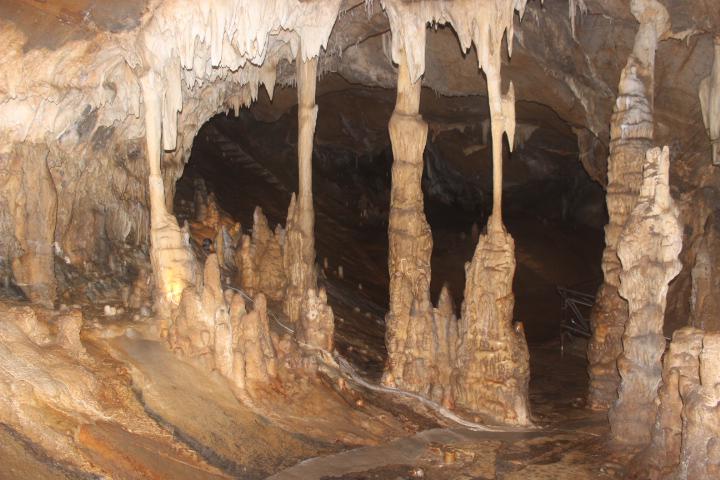
The stalagmites of the Bàsura cave in Toirano (Savona), one of the most important karst and archaeological complexes in Liguria, have made it possible to reconstruct one of the most rapid rises in sea level in the recent history of the Earth. It is the result of a study published in the journal “Nature Communications”, the result of collaboration between the Chinese Academy of Sciences of Xi’an, the National Taiwan University of Taipei and a large international partnership, in which the University of Pisa also participated.
By analyzing the speleothems, i.e. the limestone concretions that form in the caves and which preserve traces of past climatic variations, and by comparing them with data from the North Atlantic, researchers have reconstructed the mechanism which, around 340 thousand years ago, during the so-called Termination IV, led the sea level to increase up to around five meters per century, one of the highest values ever documented.
The study shows that the origin of this exceptional rise was a long slowdown in the Atlantic ocean circulation (Amoc), which lasted about 13 thousand years. During this period heat accumulated in the deep oceans. When circulation resumed, the stored energy was rapidly released, accelerating the melting of the large ice sheets and causing sea levels to rise sharply.
“The Bàsura cave represents a natural archive of extraordinary value for reconstructing the climate of the past – explains Elisabetta Starnini, professor of Prehistory and Protohistory of the Department of Civilization and Forms of Knowledge at the University of Pisa – The research we conduct on this site demonstrates how a context known above all for its exceptional archaeological heritage can also offer a fundamental contribution to the reconstruction of the history of the climate. Understanding how oceans, ice and atmosphere interacted during the great climatic transitions of the past is essential to interpret ongoing changes and refine the tools with which we study the evolution of the Earth’s climate system, especially in light of the weakening of the Atlantic ocean circulation observed today in the context of global warming”.