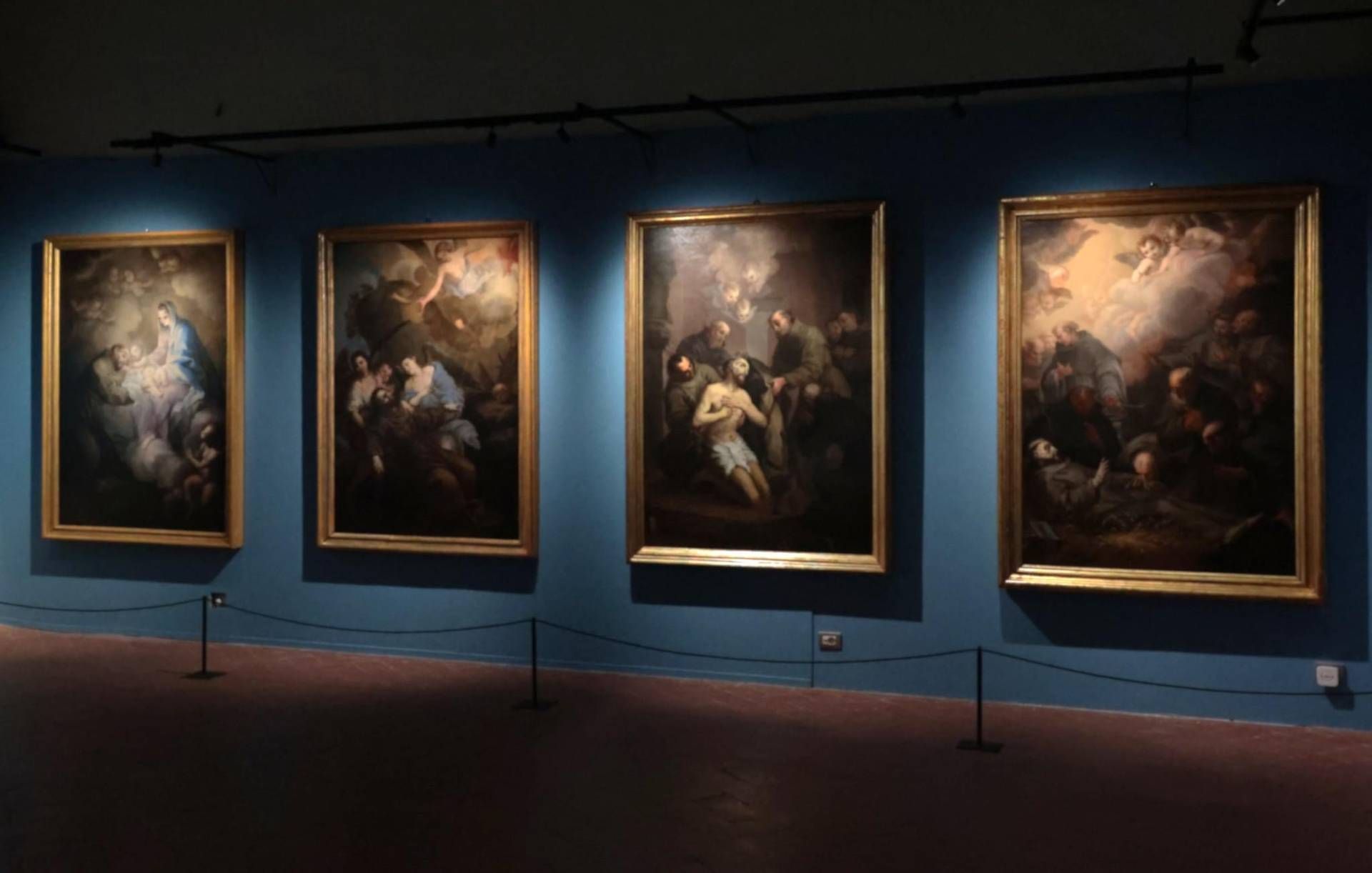
A pilgrimage to Assisi, a precious gift received from the Franciscans and, in response, an extraordinary artistic commission. Eight hundred years after the death of Saint Francis, Palazzo Medici Riccardi reconstructs a significant page of devotion and patronage of Cosimo III de’ Medici, bringing back to Florence, over three centuries after their creation, four large canvases by Giuseppe Nicola Nasini dedicated to the life of the Saint.
From 24 September to 31 January 2027 the Fabiani Rooms of Palazzo Medici Riccardi will host “St. Francis of Assisi and Giuseppe Nicola Nasini. An episode of Medici commissions”, an exhibition promoted by the Metropolitan City of Florence, organized by the Mus.E Foundation and curated by Riccardo Spinelli, with the patronage of the National Committee for the celebration of the eighth centenary of the death of St. Francis of Assisi, of the Papal and Sacred Basilica Convent of San Francesco in Assisi, of the Conventual Friars Minor of the Basilica of Santa Croce in Florence. The project delves into the figure of Giuseppe Nicola Nasini, his privileged relationship with the grand ducal court and the particular connection between Medici and Riccardo patronage in Florence at the end of the seventeenth century.
The heart of the exhibition are the four large surviving paintings from the cycle commissioned in 1695 by the Grand Duke of Tuscany Cosimo III de’ Medici to Giuseppe Nicola Nasini: Saint Francis receives the stigmata, Saint Francis, dying, dons the habit, Saint Francis, dying, blesses Friar Elias and Vision of Saint Francis to whom the Virgin offers the Child Jesus. A fifth work, dedicated to the Miracle of the Thorns and the origin of “Forgiveness of Assisi”, is now lost.
“Eight hundred years after the death of Francis of Assisi – said Sara Funaro, Mayor of the Metropolitan City of Florence – his testimony and his words are rich in perspective to redesign that “magnifica humanitas” evoked by Leo Cosimo III for the Sacred Convent of Assisi as a sign of gratitude for the Franciscans who had hosted him. It is also an opportunity to rethink the importance of the Franciscan presence in the Florentine territory, which was the original place of mission for Francis and his brothers, a memory consecrated by the Basilica of Santa Croce and the convent of Ognissanti, to talk about Florence, but its traces are scattered in various localities of the territory, as an expression of his plan of evangelization and sharing with the most vulnerable. of all times.”
“Giuseppe Nicola Nasini’s paintings for the convent of Assisi retrace the last moments of the life of Saint Francis, restoring on the pictorial surface the intensity of a life and death that are still inspiring. The grand ducal commission valorises the Florentine religious dimension of the late seventeenth century and exemplifies the sensitivity and artistic qualities achieved in the city, of which Nasini was an appreciated interpreter. The project thus offers the public the reading of a new and evocative chapter of the late Baroque in Florence, also correlated to the interventions carried out by the same artist in the palace at the instigation of the Riccardi marquises”, declares Valentina Zucchi, scientific director of Palazzo Medici Riccardi.
“The exhibition – explained the curator of the exhibition Riccardo Spinelli – is a tribute that Palazzo Medici Riccardi pays to the patron saint of Italy on the eighth centenary of his death. On this occasion, an episode of Medici patronage is brought back to Florence and presented to the citizens, due to the initiative of Cosimo III de’ Medici who in 1695 commissioned one of his favorite painters, the Sienese Giuseppe Nicola Nasino, five canvases with stories of St. to the sacred convent of Assisi, where four of the five – one is unfortunately lost – have been preserved for over three centuries”.
The genesis of the cycle dates back to the pilgrimage made by Cosimo III to Assisi in 1695. Hosted by the friars of the Sacred Convent in the rooms reserved for the pontiff, the grand duke received a precious relic upon departure, a fragment of the hair shirt of Saint Francis. Returning to Florence, he entrusted Nasini with the creation of five canvases destined for the Sacred Convent as a sign of gratitude for the welcome received. The paintings were sent to Assisi at the beginning of January 1696 and placed in the apartment where the sovereign had stayed, within special stucco frames financed by Cosimo III himself.
This story is intertwined with that of Palazzo Medici Riccardi. At the time of the commission of the Franciscan paintings, the palace no longer belonged to the Medici: it had been purchased by the Riccardi family in 1659 and had become their Florentine residence, which underwent a vast expansion and renovation program in the second half of the seventeenth century. Born in Castel del Piano in 1657, Giuseppe Nicola Nasini trained between Rome and Venice thanks also to the direct support of Cosimo III. The Grand Duke followed his career carefully: after the years spent at the Medici Academy in Rome and his stay in Venice, in 1689 Nasini was appointed assistant to the chamber of honor and the following year superintendent of drawings for the Gallery of Florence. The Franciscan commission therefore arrived at the moment of full maturity of the relationship between the painter and his main Medici client. At the same time, Nasini’s activity for the Marquis Francesco Riccardi testifies to the close relationship existing between the grand ducal court and one of the most influential families in Florence of the time. The Riccardis, owners of the ancient Medici palace in Via Larga since 1659, promoted a profound renovation involving some of the major artists active in the city and close to the court environment.
Around the four canvases from the Sacred Convent of Assisi, the exhibition reconstructs the protagonists and context of the story through paintings, portraits, sculptures, medals and documentary evidence.
Ideally opening the Franciscan story is the stigmatized Saint Francis in prayer before the cross by Lodovico Cardi known as Cigoli, coming from the Convent of San Francesco dei Frati Minori of Tuscany. This presence is accompanied by images of Giuseppe Nicola Nasini and various effigies of Cosimo III, which allow us to restore the face and identity of the protagonists of the story. A particularly significant nucleus is made up of the five letters exchanged between Florence and Assisi between January and May 1696, capable of documenting almost directly the shipment of the paintings, their arrival at the Sacred Convent, the creation of the frames and the satisfaction of the Franciscans and of Cosimo III himself. The papers thus allow us to reconstruct not only the artistic genesis of the cycle, but also the symbolic meaning attributed from the beginning to the grand ducal gift. The itinerary also presents a facsimile of the refined preparatory drawing for Saint Francis, dying, wearing the habit, preserved in the Chigi Saracini Collection in Siena, testimony to the care with which Nasini elaborated the composition before its translation into the large canvas. Added to the works directly linked to the 1695 commission is the Reliquary of the Robe of Saint Francis, coming from the Company of the Stigmata of the Basilica of San Lorenzo. The precious case preserves relics of the Saint’s robe donated in 1710 by Cosimo III to the Florentine brotherhood and expands the exhibition’s narrative on the relationship between the Grand Duke, Franciscan spirituality and the city of Florence.
The five works commissioned by Cosimo III remained for a long time in the Sacred Convent of Assisi. In the second half of the nineteenth century, following the suppression of the religious corporations and the transformation of the conventual environments, they were removed from their original location and set aside; in this phase one of the canvases was lost. The four survivors, recovered from the studies and restored starting in 2017, were subsequently relocated to the Chapter Hall of the Sacred Convent, a central place in the life of the Franciscan community. Their temporary return to Florence today allows us to recompose the historical context in which they were born and to reread, after more than three centuries, an emblematic page of Cosimo III’s patronage and the career of Giuseppe Nicola Nasini. The project is accompanied by the catalog published by Edifir Edizioni Firenze.