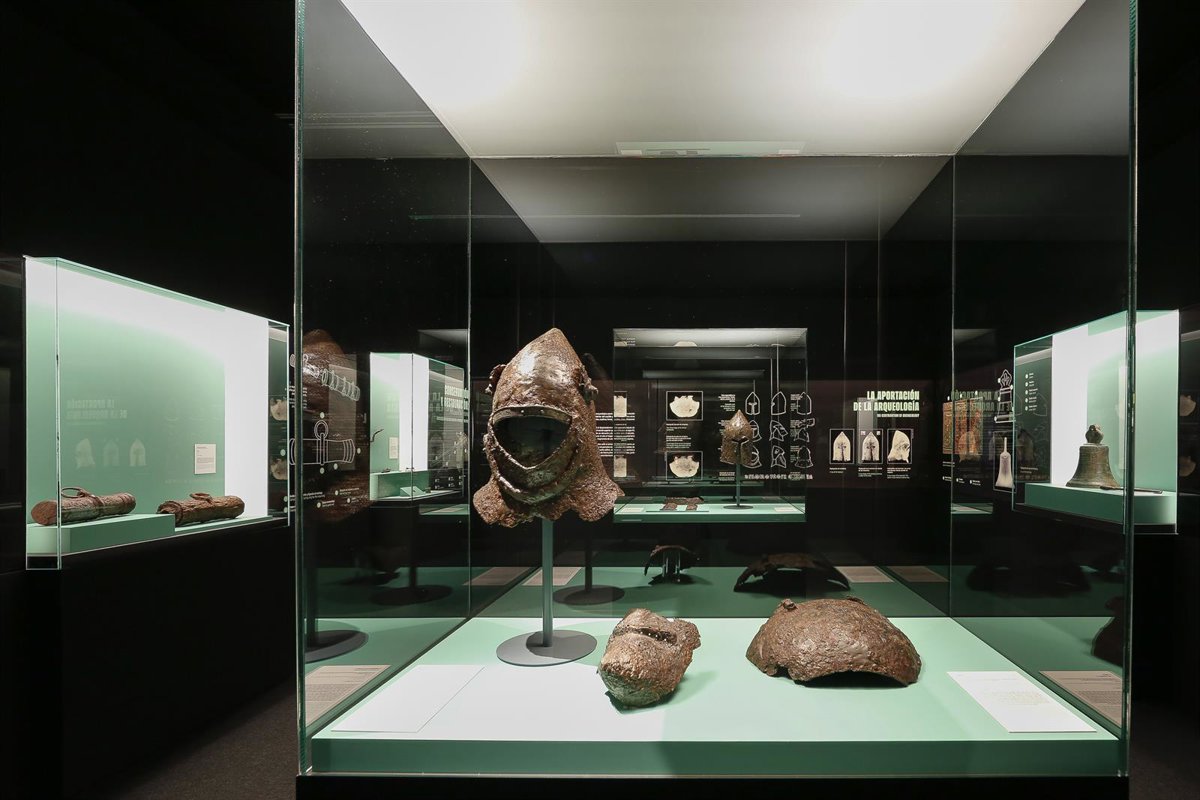
The archaeologist Javier Ibáñez González has argued that “the best“for archaeological pieces it is to show them”as close as possible to the place where they were found”although it has warned that these spaces must have adequate means both to guarantee their safety and to ensure the conservation of the materials.
This is how Ibáñez spoke when asked about the custody of pieces of archaeological value after the recent wave of heritage thefts in Spain.
“It is best to show the pieces as close as possible to the place where they were found, but logically what it must be provided very well with securitybut not only protection security, but also safety of materials conservation”, said the archaeologist, who presented this Monday the exhibition ‘Life on the border. Finds from the Monreal de Ariza Castle (Zaragoza) that houses the National Archaeological Museum (MAN).
Javier Ibáñez has focused on the fact that not all pieces present the same economic value or the same risks. Thus, he pointed out that while materials such as gold present great stability and do not degrade, other bronze or iron objects need “greater care and better environmental conditions“.
“The gold pieces of Villena They were not going to degrade because gold is very stablebut any type of bronze or iron piece requires greater care and better environmental conditions”, has stated. “These, for example, I’m sure no one was going to steal them. because they don’t have a great value, they won’t be able to melt them,” he said in reference to the pieces in the exhibition.
Regarding these pieces, the curator and archaeologist of the Spanish Cultural Heritage Institute (IPCE) Durgha Orozco has assured that “there is no better place right now“that the National Archaeological Museum (MAN) to guard the archaeological pieces found in the castle of Monreal de Ariza (Zaragoza).
“It is a national institution that meets everything necessary in terms of security,” he defended during the presentation of the exhibition.
A TIME CAPSULE
About the exhibition ‘Life on the border. Findings from the castle of Monreal de Ariza’ (Zaragoza), the curators have explained that the exhibition brings together a unique set of metal objects recovered during the archaeological interventions carried out in this Aragonese fortress.
The exhibition can be visited until February 28 and brings together iron and bronze pieces dated mainly to the 15th century.
The exhibition reflects the results of an archaeological intervention carried out during the restoration work of the Monreal de Ariza castle.
The complex was sealed by a collapse that allowed a series of objects to be preserved for centuries that, under normal circumstances, would hardly have been recovered. Ibáñez has explained that the collapse acted as a kind of “time capsule”, when the objects were encapsulated under tons of stone after a quick and unexpected event. Among the finds are elements of weapons, artillery pieces, remains of crossbows, helmets and other objects related to the military life of the fortress.
The restoration work included previous studies, radiographs and analysis by x-ray fluorescence, in addition to mechanical and chemical cleaning and reintegration processes. The x-rays allowed, among other things, to identify interior reinforcements in the helmet or to know details of the cracks in the bell and one of the artillery pieces.
For his part, the archaeologist José Francisco Casabona Sebastian He has especially highlighted the artillery pieces, which he considers unique because they correspond to an early moment of the generalization of this type of weaponry in medieval warfare. Among them is an artillery chamber, the part where the gunpowder was placed before incorporating the cane and projectile.
The set includes a barbuta, a bacinete, remains of a brigantine and a cuirass, remains of crossbows and a bell, among other materials. The exhibition is the result of the collaboration of the MAN with the Cultural Heritage Institute of Spain and the Government of Aragon, through the Zaragoza Museum.