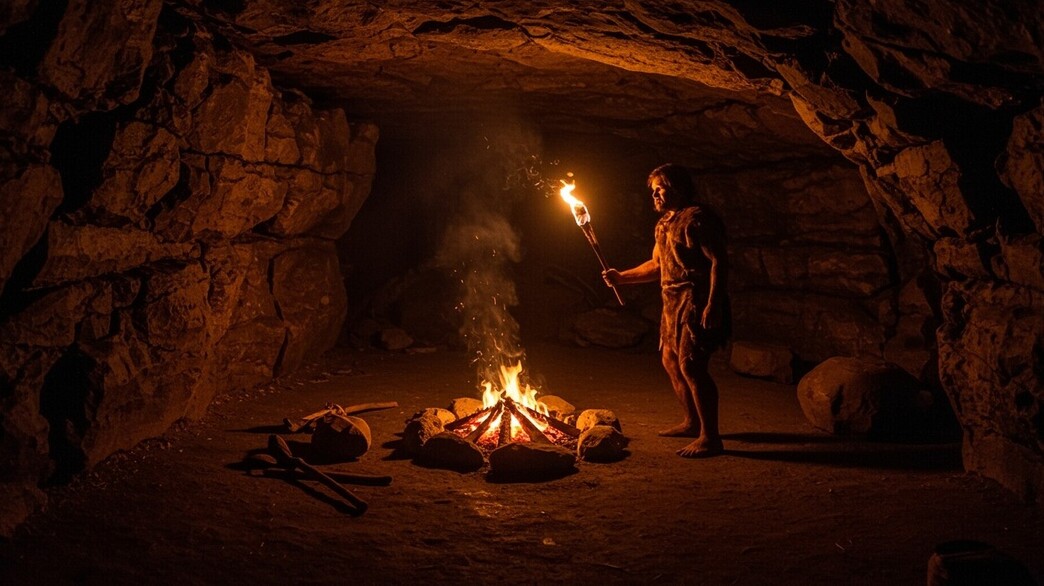
About two hundred thousand years ago, or maybe a little less, a group of humans left Africa to explore the continents around it. These people belonged to the species Homo sapiens, and came from the same population that also included our ancestors, the population that paleontologists call “anatomically modern man”. They were the first to leave the continent where they developed, and in Asia they met people from another population, who were similar to them but also somewhat different: The Neanderthals. Whether the Neanderthals are a subspecies of Homo sapiens or a separate species is still a disputed question, but in any case they were close enough to our ancestral population to to be able to produce offspring With each other, and so they did. Additional waves of migration from Africa, which arrived afterwards, also multiplied with the Neanderthals, and with other populations. To this day, most of the world’s population carries in their cells some DNA that came from those ancient Neanderthals.
dictation Originally published on the Davidson Institute for Science Education website
The Neanderthal genetic material is not uniformly distributed along the chromosomes, those long DNA molecules found in the nucleus of almost every cell in our body. There are areas called “Neanderthal deserts”, long stretches along the various chromosomes where there is no trace of Neanderthal DNA in any of the modern humans tested.
What caused the Neanderthal genetic material to completely disappear from certain places? The hypothesis is that the cause of this is the genetic difference between the populations. We and the Neanderthals are indeed very similar, but we still have genetic differences. Some Neanderthal genes may be different enough from ours that they would not work well in the modern human body, causing health problems. A modern man who received the same harmful Neanderthal genes would have a low chance of surviving and reproducing, and therefore a low chance of passing these genes on. Eventually they disappeared from the human genetic material.
This is a very logical explanation, which gives an answer to the question of why the same “Neanderthal deserts” are found along all the chromosomes. These deserts are especially common on the X chromosome, one of the chromosomes of the species, which is almost entirely “Neanderthal desert” – it has very few regions that contain Neanderthal DNA.
Why did the Neanderthal genetic material disappear in this chromosome? One possible answer is that the X chromosome that had Neanderthal genes disappeared, because they are harmful, leaving only X chromosomes without such genes.
Another possible answer to this has to do with the fact that the X chromosome is a sex chromosome, and in mammals there are almost always two of it for females but only one for males. The mother transmits an X chromosome to all her children, while the father transmits an X chromosome only to his daughters, and a Y chromosome to his sons. So when a Neanderthal male interbreeds with a female from our population, she passes on twice as many X chromosomes to the next generation as he does. If this was the case in most of the cases where there was reproduction of Neanderthals with our ancestors – the father is a Neanderthal and the mother is from the modern human population – this can explain the situation we see today, where only a small part of the X chromosome comes from Neanderthals.
Which of the two options is the solution to the puzzle? To answer this, it is not enough to examine the genetic material of modern people – you have to look at the other part of the picture, that is, the DNA of the Neanderthals themselves. This is exactly what researchers from the United States did In a new study.
Neanderthal mirror image
The exchange of genes between the Neanderthals and our ancestors that left their mark on us, in the form of the few percentages of Neanderthal DNA in their hair, took place about 45 thousand years ago. Only a few thousand years later the Neanderthals became extinct, and we have no DNA from fossils that lived after that gene exchange.
Fortunately, this was not the only time anatomically modern humans and Neanderthals swapped genes. Genetic material from early Neanderthal fossils showed that they also contained some modern human DNA, the result of other reproductive events that occurred more than 100,000 years ago.
The researchers tested the DNA that came from modern humans in three Neanderthal fossils, from two sites in Siberia and Croatia. If the cause of the lack of Neanderthal DNA on our X chromosome is genetic differences that cause health problems, we would expect our genes to cause problems in Neanderthals as well. In that case we would expect to see a situation similar to ours: much less modern human DNA on the X chromosome. But that is not what was found.
“What we found was a surprising imbalance,” explained Daniel Harris, one of the leaders of the study. in a press release. “While modern humans have almost no Neanderthal X chromosome, Neanderthals had 62 percent more modern human DNA on their X chromosomes, compared to their other chromosomes.”
This finding is much more suitable for the second possibility: “When Neanderthals and modern humans reproduced, there was a preference for Neanderthal males and females from the modern human population, and not the other way around,” concluded Alexander Platt, who also led the study. In an interview with the Science Alert website. This led to us having very little Neanderthal X chromosome, but a lot of our DNA on the Neanderthal X chromosome.
There could also be other explanations for the findings – for example, it is possible that for some reason the children of a man from our population and a Neanderthal woman did not survive well and did not pass their genes on. But the simplest and most logical hypothesis, Platt argued, is that modern females prefer Neanderthals – or perhaps it was Neanderthal males who preferred modern females. This is also, in his opinion, the more interesting possibility: that the lack of Neanderthal DNA in the X chromosome “is not a result of pure Darwinism, of the survival of the fittest, but a result of the way in which we manage relationships with each other, and of our culture, society and behavior.”
https://canacar.com.mx/arranca-canacar-plan-armonizacion-nueva-ley-movilidad/
https://www.arsenalfc.com.ar/index.php/el-club/novedades?start=115
https://khacdauviettin.com/khac-con-dau-dong-len-bia-can-bong.html
https://elcargol.com/index.php/societat/inquietud-al-barri-de-la-barceloneta-pel-futur-del-parc-de-gossos
https://sport7.dnes24.sk/109772/hlasy-hracov-a-trenerov-po-zapase-slovensko-nemecko
https://www.populertarim.com/professions-from-the-mochi
https://www.silviocilloco.it/index.php/analisi-matematica-3/i-limiti/funzioni-continue-e-discontinue/discontinuit%C3%A0-di-terza-specie
https://donyipolobedcollege.org/
https://donyipolobedcollege.org/about-us/
https://donyipolobedcollege.org/contact-us/
https://donyipolobedcollege.org/cookies-policy/
https://donyipolobedcollege.org/kyc-aml-policy/
https://donyipolobedcollege.org/licence/
https://donyipolobedcollege.org/privacy-policy/
https://donyipolobedcollege.org/responsible-gaming/
https://donyipolobedcollege.org/terms-and-conditions/
https://aviator-crash-india.com/en-in/
https://aviator-crash-india.com/en-in/1win/
https://aviator-crash-india.com/en-in/1xbet/
https://aviator-crash-india.com/en-in/4rabet/
https://aviator-crash-india.com/en-in/aviator-app/
https://aviator-crash-india.com/en-in/batery/
https://aviator-crash-india.com/en-in/betwinner/
https://aviator-crash-india.com/en-in/dafabet/
https://aviator-crash-india.com/en-in/lucky-star/