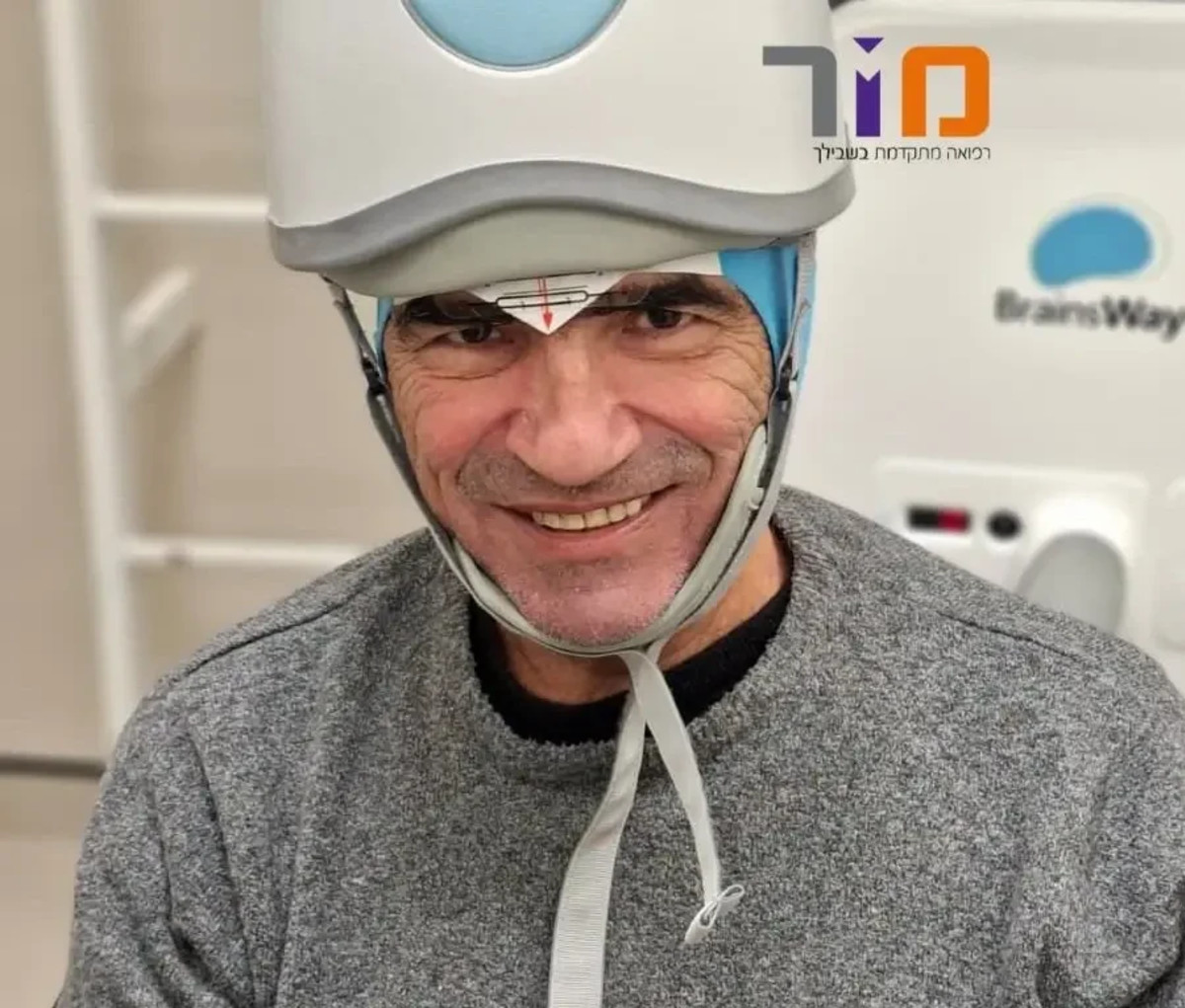
Today, at the age of 68, Bernstein from Kiryat Yam tells in detail for the first time about the long journey that has passed since the attack, a journey that included severe post-trauma, deep depression, divorce, prolonged seclusion at home and six suicide attempts.
For the first few seconds he did not understand what had happened. “I didn’t understand what was happening. There was smoke everywhere. Then I saw that the bus that exploded had deteriorated and hit other people on the way. I stayed in the bus with no windows, no front. Everything was destroyed, I saw black in my eyes.”
But the most difficult moment came precisely after the explosion. “I stood there stunned. A policeman came and asked me to come and give testimony. On the way I passed among all the bodies. I saw everything. In retrospect it was completely unnecessary, but those scenes were engraved in me forever.”
Bernstein was later recognized as a work victim with a 45 percent mental disability. According to him, the first signs that something deep was broken in him appeared almost immediately.
“The attack was on Sunday. Already at the end of that week I realized that something bad was happening to me. I would walk around the house and not be able to leave it. I had a house with a garden, and I just walked in circles. I didn’t dare go out into the street.”
About six months later he tried to return to work.
“I got to drive only once. While driving, I had an anxiety attack. I left the bus with the passengers and ran home. I couldn’t take it anymore. I didn’t trust anyone. Every person seemed suspicious to me. Fear ruled me.”
At that time, his wife was dealing with cancer, one of his daughters was in the military, and he felt that his whole world was collapsing.
“My little girl once told me: ‘Thursday was my most fun day, and now you’re busy with mom and everything that’s going on.’ It broke my heart.”
Over the years he underwent psychological treatments, support groups and various treatments in the public system.
According to him, none of them managed to bring about a significant change. “The wound was too big. I slowly got worse. At first I wasn’t depressed at all. Then I got deeper and deeper depressed.”
Later he divorced, distanced himself from people and shut himself up in his house. “I got up in the morning and waited for the evening. When the evening came I waited for the morning. I felt that I had nothing to live for. I was convinced that I was unnecessary in the world.”
Over the years he tried to end his life six times. “There were divorces, there were wars, there were anxieties. But mostly there was a feeling that no one was really able to help. You feel completely alone.”
Even today he does not hide that the trauma is still there. “I can’t forget the sights. They are always there. The difference is that today I learned that I have to live with them.”
About six months ago, Bernstein arrived at the Moore Institute, where he began undergoing treatment with TMS technology, a non-invasive brain magnetic stimulation used to treat depression and other mental disorders.
“I arrived through internet advertising. I had already tried so many things, so I told myself I had nothing to lose.”
The treatment is based on attaching a magnetic coil to certain areas of the brain and transmitting controlled magnetic pulses, with the aim of influencing neural activity related to depression and mental distress.
At the beginning he came to treatment several times a week. Later, he switched to a maintenance format of once a week.
“In the beginning, they kept asking me how I felt, and I didn’t feel any change,” he says. “But after a month and a half or two months, I suddenly noticed that I was laughing. That I wanted to meet friends. That I was thinking about how to put the house in order. Nothing else had changed in my life, so I realized that this was the treatment.”
About six months ago, Bernstein arrived at the Moore Institute, where he began undergoing treatment with TMS technology, a non-invasive brain magnetic stimulation used to treat depression and other mental disorders.
“I arrived through internet advertising. I had already tried so many things, so I told myself I had nothing to lose.”
The treatment is based on attaching a magnetic coil to certain areas of the brain and transmitting controlled magnetic pulses, with the aim of influencing neural activity related to depression and mental distress.
At the beginning he came to treatment several times a week. Later, he switched to a maintenance format of once a week.
Despite the difficulty, he felt that something was beginning to change. “Somehow the brain started to react differently. If I hadn’t come to this treatment, I probably wouldn’t be here.”
Today he continues to receive maintenance treatments.
“You have to keep looking for help. The system is sometimes difficult and exhausting, but you must not give up. I have been fighting for 25 years to receive treatment.”
According to him, even when it seems there is no way out, it is important to keep looking for solutions. “If there’s anything I’ve learned, it’s that even after years of darkness, you can still find some light. I’m not a healthy person. There are still hard days, anxieties and memories. But for the first time in many years, I feel like I’m alive, and not just surviving.”
Dr. Niki Lieberman, the medical director of the Moore Institute, explains that patients diagnosed with post-traumatic stress disorder who were referred for TMS treatment following a psychiatrist’s recommendation, in many cases experienced a significant improvement in their condition.
According to him, continuing TMS treatments alongside other technologies may help patients reach an optimal level of functioning and improve their quality of life, even after many years of dealing with trauma.
https://elixir-hedgedoc.rahtiapp.fi/s/2iSq4WlFJ
https://codimd.mim-libre.fr/s/XEraAnMiT
https://pad.lassul.us/s/8FWTqJP3C1
https://hedgedoc.musikinformatik.net/s/MeNxKoQiu
https://pad.lassul.us/s/q3M81z_QhH
https://rivieraclean.es/como-elegir-una-empresa-de-limpieza-de-oficinas-en-malaga/
https://www.sortlist.com/agency/cloudy-knights
https://codimd.infn.it/s/e7f6YZBKx
https://pad.aleph.world/s/r32ucvqX7
https://notes.rabjerg.de/s/ByXInwQeGx
https://md.cortext.net/s/i17XqT7-St
https://docs.snowdrift.coop/s/EUPJeua_F
https://doc.projectsegfau.lt/s/mY8HTpBp-2
https://pad.aleph.world/s/j3W1SyBN0
https://op.pai.wtf/s/GL_2BfO4K8
https://notes.openpower.foundation/RCnCvb2pTPylf-0bPP60sg
https://op.pai.wtf/s/s1ZWKAmehd
https://md.emile.space/s/ApPtpR8CGV
https://md.mainframe.io/s/iQQsEEEEZ1