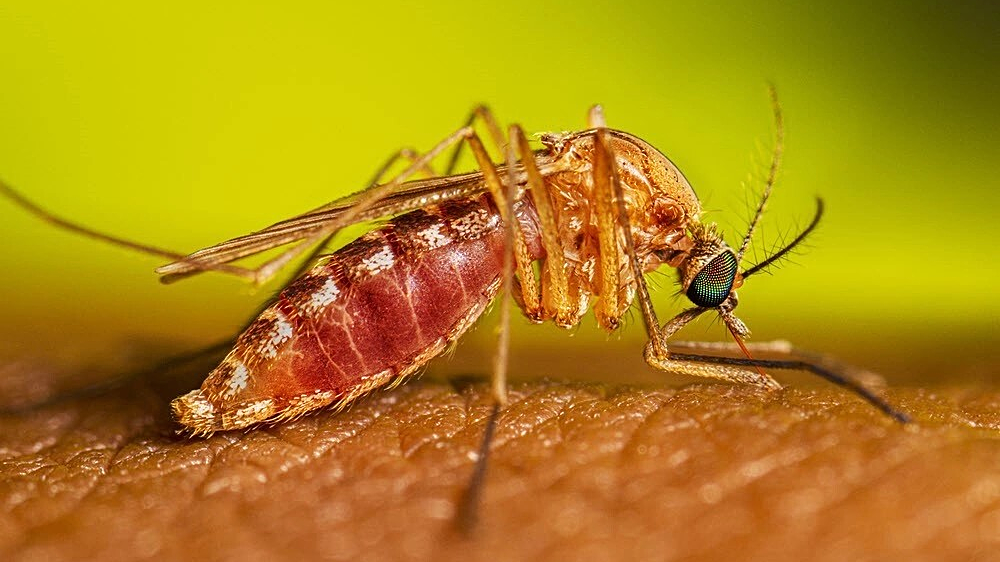
Mosquitoes that transmit Japanese encephalitis are usually active at night, fly up to 3.2 km away and can carry the virus through many hosts before spreading to humans.
From the beginning of the year until now, Children’s Hospital 2 in Ho Chi Minh City has received 6 cases of Japanese encephalitis, of which 2 cases had brain sequelae, requiring tracheostomy and prolonged mechanical ventilation. City Children’s Hospital also treated 7 cases of Japanese encephalitis, most cases became severe, requiring intubation and mechanical ventilation.
Doctor Le Thi Gam, Medical Manager, VNVC Vaccination System, said the disease is spread by Culex mosquitoes that suck the blood of animals infected with the virus and then bite humans. There are several characteristics of this mosquito that make them a vector for transmitting diseases.
Culex mosquitoes are sucking human blood. Image: CDC
Long flight path, wide dispersion range
Culex mosquitoes are vectors of Japanese encephalitis virus and can travel long distances. The US Centers for Disease Control and Prevention (CDC) records that some Culex mosquito species can fly up to 3.2 km.
According to Dr. Gam, Culex mosquitoes have the ability to fly sustainably. When supported by air currents, they can spread to areas far from their breeding grounds. A flight evaluation experiment published in 2022 in Japan recorded that the Culex tritaeniorhynchus group could fly continuously for up to 38 hours. Meteorological analysis also suggests they may follow wind currents from the mainland to Japan.
Therefore, mosquitoes appearing in residential areas do not necessarily breed there. They can spread from rice fields, livestock farms or stagnant water many kilometers away. Killing mosquitoes around the house is necessary, but not enough to control the source of disease transmission.
Active at night
Unlike the Aedes mosquito that transmits dengue fever, which often bites humans during the day, the Culex mosquito mainly searches for hosts from evening until the next morning.
A 2021 study in rural Cambodia, where the Japanese encephalitis virus is endemic, found that the mosquito species that transmit the disease are active year-round, including the dry season. Operating hours last from 6:00 p.m. to 6:00 a.m.
This is the time when many families are outdoors or sleeping, so it’s easy to lose vigilance. Children who play in the yard at night, people who do not sleep under mosquito nets or live near rice fields or livestock barns are at higher risk of exposure to mosquitoes.
The sting may be difficult to detect
According to Dr. Gam, Culex mosquito bites are not always red, swollen or itchy. Skin reactions depend on each person’s immune response to proteins in mosquito saliva.
Medical documents StatPearls It is said that mosquito saliva contains substances that help dilate blood vessels, anticoagulate and prevent platelet aggregation, supporting the blood sucking process. The bite may therefore be just a small spot that quickly disappears, causing the person being bitten to not realize they have come into contact with a mosquito.
After an infected mosquito bites a person, the Japanese encephalitis virus enters the body through the mosquito’s saliva. The incubation period is usually 4-14 days. Most infected people have no symptoms or only have fever and mild headache.
Some cases can progress to severe encephalitis, with high fever, severe headache, stiff neck, seizures, impaired consciousness, paralysis or coma. The death rate in people with signs of encephalitis can be up to 30%. Many survivors suffer long-term sequelae such as epilepsy, weakness, memory loss, behavioral, language or movement disorders.
Reproduces quickly in places with stagnant water
Culex mosquitoes often breed in rice fields, irrigation ditches, stagnant ponds, flooded areas and livestock areas. Some species can also grow in drains, wastewater or water containers around the house.
According to the CDC, each time she lays, female mosquitoes can create rafts of about 100-300 eggs floating on the water. When conditions are favorable, mosquitoes only take 7-10 days to develop from eggs into adults.
The ability to lay many eggs, have a short life cycle and have many breeding places makes it easy for mosquito populations to increase rapidly, or recover after chemical sprays.
People living near rice fields, ponds, ditches, flooded areas or livestock areas should clear bushes, clear drains, cover water containers and remove items that can collect water around the house. Families should install mosquito nets, sleep under mosquito nets, wear long clothes and use mosquito repellent products according to instructions.
Mosquitoes transmit viruses through many hosts
Culex mosquitoes not only suck blood from humans but also suck the blood of many animals. This helps the Japanese encephalitis virus maintain in the wild.
Wild birds, especially water birds such as storks and herons, are reservoirs of viruses. When sucking blood from birds carrying viruses, mosquitoes become infected with pathogens. They can then transmit the virus to pigs during subsequent blood meals.
Pigs are important amplification hosts because the virus can replicate to high concentrations in the blood. Other mosquitoes that suck the blood of infected pigs will continue to carry the virus, then transmit it to pigs, birds or humans. Thanks to this, the virus circulates through many hosts and creates a persistent cycle of transmission.
Young children receive Japanese encephalitis vaccine at VNVC Vaccination System. Image: Hoang Duong
To prevent disease, Dr. Gam recommends that people be vaccinated fully and on schedule. After injection, the body creates antibodies that recognize and neutralize viruses before they enter the central nervous system, helping to reduce the risk of disease and complications of severe encephalitis.
Vietnam circulates many types of Japanese encephalitis vaccines for children and adults. Jevax vaccine (Vietnam) is included in the Expanded Immunization Program and vaccination services. After the three basic shots, children need a booster shot every three years.
Jeev vaccine (India) is administered in two injections one month apart, used for children from 12 months old to adults 49 years old. Vaccines may need to be re-administered during an epidemic or before entering an epidemic area.
Imojev vaccine (Thailand) for children from 9 months old and adults. Children from 9 months to under 18 years old get two injections one year apart; People 18 years of age and older get one shot. The vaccine does not need to be re-injected. People who have difficulty complying with the three-year reminder schedule with Jevax can switch to the new generation to finish the schedule.