Mr. Hanh, 57 years old, had difficulty urinating and nocturia, thought to be due to prostate enlargement, but tests confirmed cancer, and underwent radical surgery using a robot.
Mr. Hanh’s blood test results at Tam Anh General Hospital in Ho Chi Minh City recorded a prostate-specific antigen (PSA) index of up to 9.2 ng/mL, more than double the normal threshold (less than 4 ng/mL). MSc. Nguyen Tan Cuong, Deputy Head of the Department of Urology, Head of the Urological Oncology Unit, Center for Urology – Nephrology – Andrology, prescribed magnetic resonance imaging (MRI) of the prostate, high suspicion of malignancy. A prostate biopsy later determined that cancer appeared in both lobes, with a moderate level of malignancy.
According to Dr. Cuong, with cancer still localized in the prostate, patients can consider treatment methods such as active monitoring, radical prostatectomy or radiotherapy. For middle-aged patients with good overall health, radical prostatectomy assisted by the Da Vinci Xi robot is one of the optimal treatment options. The goal is not only to control the disease but also to limit the impact on the ability to control urination and male physiological function.
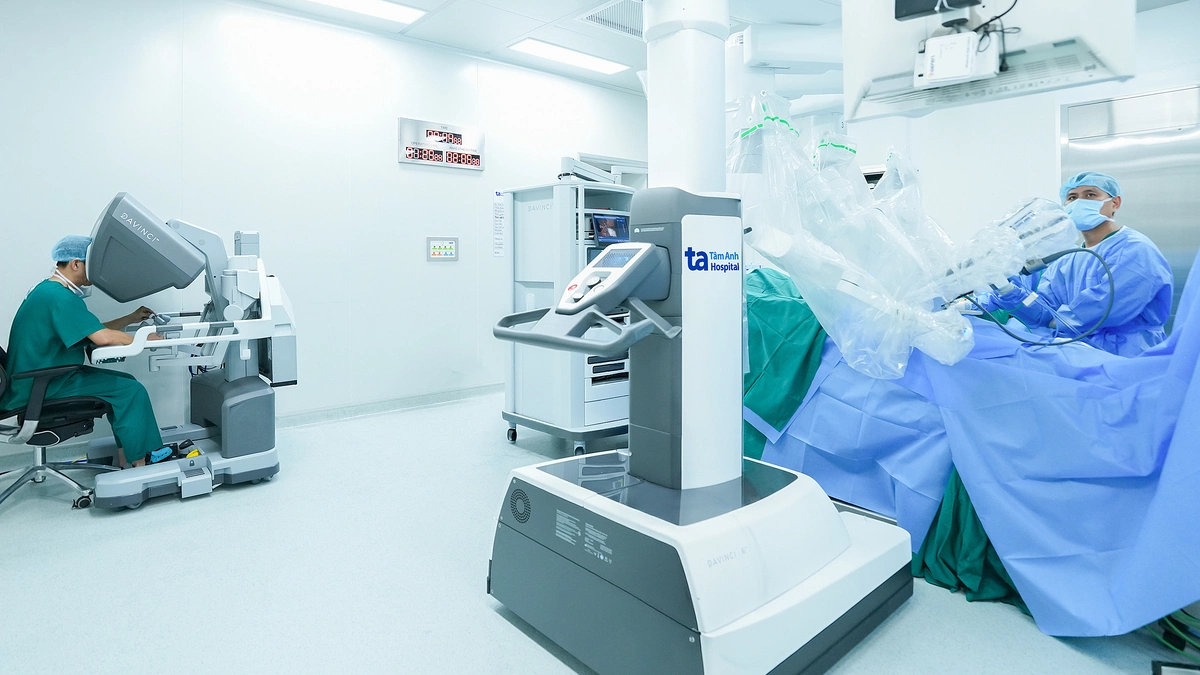
Doctor Cuong controls the Da Vinci Xi robot to thoroughly treat Mr. Hanh’s prostate cancer. Image: Tam Anh General Hospital
The robot with a 3D camera system with 10-15 times magnification guided Dr. Cuong and his team to approach the tumor through the preperitoneum. Robotic arms closely dissect the outer layer of the prostate to limit damage to the vascular bundle – erectile nerves, reduce bleeding, and help patients quickly restore sexual function and control urination after surgery.
Mr. Hanh’s surgery took about 2.5 hours, shortening about 1/3 of the time compared to conventional laparoscopic surgery. Patients regain the ability to control their bladder about 6 weeks after surgery, while traditional open or laparoscopic surgery usually takes 3-6 months.
Robot supports prostate cancer surgery for Mr. Hanh. Image: Tam Anh General Hospital
Prostate cancer often progresses silently in the early stages. Symptoms can be found in many benign diseases, especially prostate enlargement, so they are easily overlooked. Doctor Cuong recommends that middle-aged men, especially after 50 years old or with risk factors such as family history, age, sedentary lifestyle, obesity… should have regular health checks combined with prostate cancer screening, to detect abnormalities early and receive timely treatment.
Prostate cancer can be treated with traditional laparoscopy or robotic laparoscopy when the tumor is still localized and has not metastasized to other organs, usually applied to the early stages.