Yes, there may well be people who Nordic combination are inherently critical. Who needs this sport? You’ll be happy to hear it. Combiner? These are the people who can neither ski jump well nor cross-country ski properly.
As has been known since Tuesday, many of these station wagon ignoramuses are sitting in the IOC committeeswhich will henceforth exclude the original Olympic sport from the Winter Games.
Since Chamonix 1924, Nordic combined has been a an integral part of the Olympic Gamesin 2030 the combiners will suddenly no longer be wanted in France.
But why exactly? What have they done?
Is the Nordic Combined really as bland as the IOC officials want to suggest? Does this traditional winter sport really no longer captivate anyone these days?
Anyone who, as a sports reporter, had the privilege of accompanying Austria’s golden generation of combined skiers and celebrating titles and triumphs together is heartbroken Swan song for a sport.
The legend
Die Nordic combination has produced sports greats in Austria whose appeal extends far beyond the ski jumps and cross-country ski trails. And not just in Austria.
Also in Norway (Fred Borre Lundberg, Bjarte Engen Vik, Jarl Magnus Riiber), Finland (Hannu Manninen, Sampa Lajunen), France (Fabrice Guy, Jason Lamy Chappuis), Deutschland (Björn Kircheisen, Eric Frenzel), Japan (Kenji Ogiwara, Akito Watabe), and USA (Todd Lodwick, Bill Demong) or the Switzerland (Hyppolit Kempf)
Steep climb
It was a steep rise that Nordic combined in Austria has experienced since the end of the 1980s: A man with a resounding name was responsible for it: Wilfried Vettorithe father of the Austrian ski jumping legend Ernst Vettorimade the combination socially acceptable in this country and paved the way for later success.
Klaus Sulzenbachertwo-time overall World Cup winner (1987/’88, 1989/90) and four-time Olympic medalist, was the first ÖSV star in the combination.
Open/close copyright notice
© FOREIGN / Bissuti Kristian
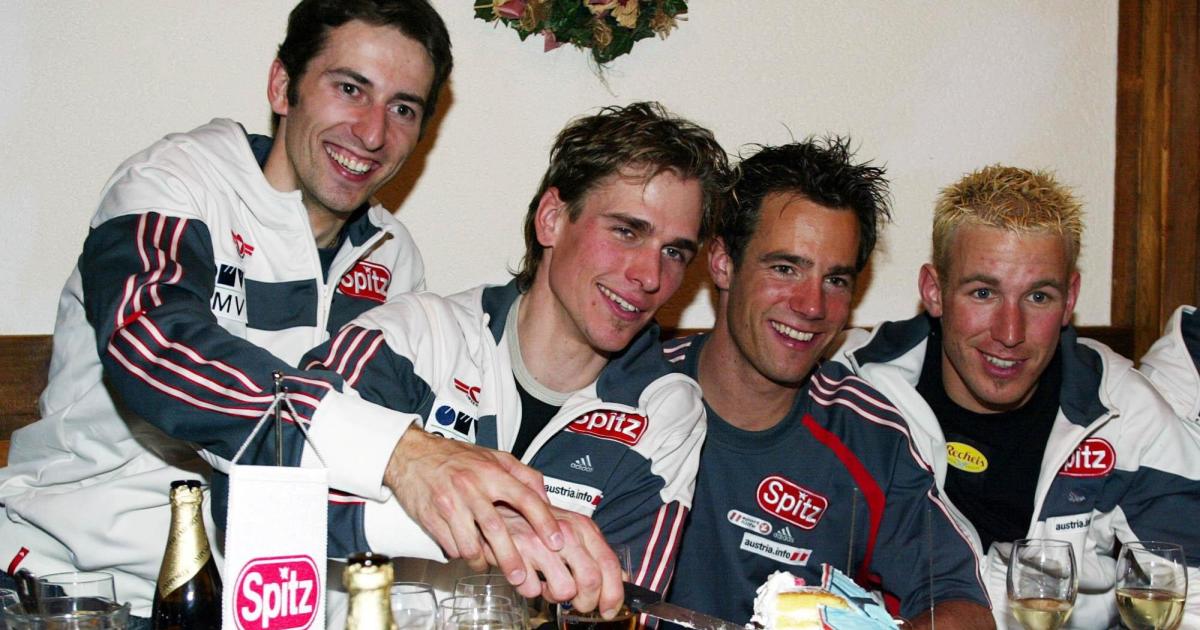
Felix Gottwald, Christoph Bieler, Mario Stecher and Michael Gruber (from left).
Boy-Group
What followed was a generation that not only achieved brilliant success at world championships and the Olympic Games, but also had the highest popularity ratings. Who doesn’t remember Mario Stecherwho won the World Cup at the famous Holmenkollen in 1994 at the age of 16 – to this day, the current ÖSV sports director is the youngest winner in Oslo.
Mario Stecher ushered in the era of the red-white-red boy group. As a young journalist you were envied if you talked about the Austrian combiner was allowed to report. They were young, they were different and they went with coach Günther Chromecek their own path, they lived their lives and let everyone participate.
Cheerful
At the shared dinners, the insults flowed and the wine also flowed. Not in abundance, of course, but what’s the point of drinking a glass of wine before a competition in Val di Fiemme?
Especially when team gold can be celebrated the next day. Just like in 2003 at the World Cup Michael Gruber, Willi Denifl, Christoph Bieler and Felix Gottwald triumphantly won.
The Nordic combined athletes, at least the Austrian ones, were always different. They mastered the combination of lightheartedness and determination. And they were just really good and gave me goosebumps.
Like, for example Felix Gottwald At the 2006 Winter Games in Turin, he left the German Georg Hettich standing and won the first Olympic gold medal for Austria. To follow up with the next gold medal a few days later alongside Michael Gruber, Christoph Bieler and Mario Stecher in the team competition.
Target sprinter Stecher
The team competition became something like that The Austrians’ parade discipline: The finish was almost always against Germany, and the ÖSV combined teams were almost always ahead.
Because in Mario Stecher they had a final runner who was very good and who cooked the opponents in rows on the home straight.
Double gold in Oslo
In 2010 in Vancouver the next Olympic gold medal was won by Bernhard Gruber, David Kreiner, Felix Gottwald and Mario Stecher. In 2011, the emotional highlight followed for everyone with two World Championship gold medals in the two team competitions at Holmenkollen. The final sprints between the German Tino Edelmann and Mario Stecher, which today’s ÖSV sports director cleverly and smartly won, were legendary and extremely exciting.
Open/close copyright notice
© Fremd / Stefan Sigwarth
Austria’s combined athletes at the 2003 World Cup in Val di Fiemme
Gruber’s gala appearance
No less spectacular was Bernhard Gruber’s furious finish at the 2015 World Cup in Falun, when he made history and the first individual gold medal for Austria fetched.
A feat that was to be imitated six years later by a young Tyrolean who is now considered the best Nordic combined athlete of the moment:
Johannes Lamparterdouble world champion in 2021 and two-time overall World Cup winner, is the last charismatic representative of a sport that has produced unmistakable types and characters, especially in Austria.
It’s a shame that some people don’t appreciate it.
Rhode Island Medcards on BizBangBoom
Listingdisplay.Aspx
Rhode Island Medcards on Brownbook.net
Rhode Island Medcards on Cargo Directory .CO
South Dakota Medcards
Meet South Dakota Medcards | Health & Medicine in
Listingdisplay.Aspx
South Dakota Medcards on BizBangBoom
South Dakota Medcards on golocalezservices.com
Texas Medcards in Del Valle – Texas – Contact Us, Phone Number, Address and Map
Texas Medcards on VirtualMall®
Texas Medcards | medical
Texas Medcards on HomePros411
Listingdisplay.Aspx
Utah Medcards
Utah Medcards on BlogBangBoom
Utah Medcards in Cedar Fort – Utah – Contact Us, Phone Number, Address and Map
Utah Medcards on BizMaker
Utah Medcards on Local Home Service Pros
Listingdisplay.Aspx
Vermont Medcards on Mediics Healthcare Directory
Vermont Medcards 2
Vermont Medcards on Local Home Service Pros
Vermont Medcards 0
0110A8E28407