NASA’s new generation spacesuit is not yet ready, which could delay the Artemis lunar landing by three years.
A report from the NASA Office of Inspector General (OIG) shows that the design and testing process of a new space suit for NASA’s Artemis program is behind schedule. This may prevent demonstrations and verification of the suit, which is being developed by private company Axiom Space, from taking place before 2031. Meanwhile, NASA plans to land humans on the Moon in 2028 under the Artemis program.
OIG believes that NASA’s strategy has some unreasonable points, causing slow progress in developing the suit. For example, the agency hired services for spacewalks when the market was not ready, implemented staged payments and other forms of risky contracts, requiring suppliers to simultaneously submit proposals for both lunar suits and microgravity environments at the same time – which was considered burdensome.
“We found the initial performance schedule to be overly optimistic and unrealistic. Both suits are at least a year and a half behind schedule,” said Deanna Lee, assistant director of audit at OIG.
This could lead to further delays in future lunar missions. “NASA is taking proactive steps to support Axiom’s success, but they may have to significantly adjust Artemis’s schedule if Axiom fails to meet requirements,” Lee added.
Why does NASA need a new spacesuit?
NASA began looking for a new spacesuit in 2007, conducting a number of internal studies as well as separate projects with outside contractors. According to SpaceNASA’s process of developing its own Moon suit initially encountered many difficulties and delays. Therefore, in 2022, this agency signed a contract with two companies Axiom Space and Collins Aerospace to develop suits for microgravity environments such as on the International Space Station (ISS) and the lunar environment.
Collins Aerospace withdrew after two years, leaving Axiom as the sole supplier. However, this same company is also behind schedule, causing the Moon suit and microgravity to not be completed on time, 2025 and 2026 respectively.
NASA astronauts wear spacesuits on the lunar surface during the Apollo 17 mission in 1972. Photo: NASA
During the Apollo program (1961-1972), astronauts’ suits were heavily modified to suit the lunar surface, including gloves and boots to protect against sharp rocks and dust. But they are tailored to the wearer, are now outdated, and are not designed for long-term use, so they are not suitable for the Artemis program, which aims to establish a long-term human presence on the Moon. The new Artemis suit will need to communicate with multiple systems, including the Human Landing System (HLS), developed by SpaceX and Blue Origin, which is also behind schedule.
Meanwhile, the Extravehicular Mobility Unit (EMU) suit that NASA uses for spacewalks on the ISS was originally designed for the space shuttle program (1981-2011). They have performed relatively well during more than 200 spacewalks but have not undergone any major modifications in the past two decades. They also had design flaws like water leaking into the helmet and some temperature regulation issues.
According to the OIG report, if Axiom does not produce a new microgravity suit in time, astronauts on the ISS may have to continue using the EMU until the ISS stops operating, expected around 2030. Regarding the Moon suit, this company’s delay may cause the Artemis program to not take place as planned.
If the Moon suit is not completed by 2031, China can bring humanity back to the surface of this celestial body before the United States. Both countries are planning to establish a permanent presence at the lunar south pole as part of a new space race, with China aiming for a landing before 2030.
NASA and Axiom are committed to landing on the Moon on schedule
Jonathan Cirtain, CEO and President of Axiom Space, said that the OIG report accurately reflects the technical challenges and progress in the development of the new Moon suit, and points to the progress Axiom has made since signing the contract in 2022. The company learned from the design experience of the xEMU spacesuit prototype that NASA developed in-house, “vertically integrating” necessary components such as valves and batteries, collaborating with a number of companies such as Nokia, Prada, Oakley, KBR. Axiom also raised $350 million to support space station and spacesuit development in February.
Cirtain said the company is committed to delivering new spacesuits on time. “Our goal remains to provide safe and effective spacesuits, allowing American astronauts to return and explore the lunar surface in 2028,” Cirtain affirmed to Live Science.
“We are aiming to conduct spacesuit evaluation demonstrations in 2027 and are actively collaborating with NASA,” Cirtain said. A key design review process will take place later this year, he added.
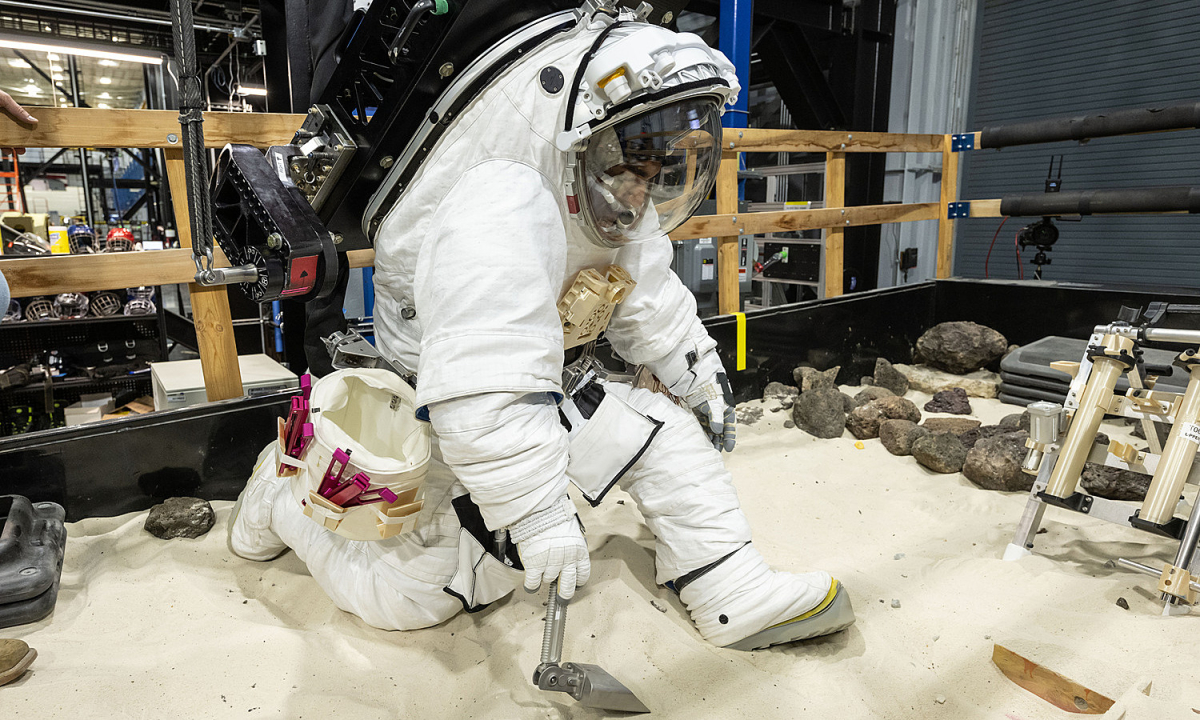
NASA astronauts wearing AxEMU, a space suit developed by Axiom Space for the Artemis III mission, practice using tools to collect lunar geological samples during testing at Johnson Space Center. Image: NASA
Jared Isaacman, NASA Director, also wrote on X after the OIG released the report: “I firmly believe that when NASA is ready to land on the Moon in 2028, astronauts will wear Axiom suits.” NASA plans to consider ways to reduce burdensome requirements where appropriate, he added, and expand capabilities over time to complete spacesuits sooner rather than later.
The Moon is in the spotlight this month when the Artemis II mission took place successfully, sending humans to lunar space for the first time in 54 years. Previously, in November 2022, the Artemis I unmanned mission also took place successfully after many delays and cancellations. After Artemis II, NASA will test the Orion spacecraft and lunar landing stations in Earth orbit during the Artemis III mission in 2027. The agency aims to perform a surface landing in 2028 with the Artemis IV mission. By the 2030s, NASA expects to begin developing settlements, autonomous robots and cargo landing stations, aiming to establish a sustainable presence on the lunar surface.