Deputy Minister Le Xuan Dinh said that Vietnam does not approach quantum according to the movement, but builds real capacity starting from the basic scientific foundation, forming strong research groups.
The message was said by Deputy Minister of Science and Technology Le Xuan Dinh when talking to scientists within the framework of the international scientific conference “New advances in research on strongly correlated electronic systems”, held at the International Center for Interdisciplinary Science and Education (ICISE), Quy Nhon, from June 1-5. The event attracted many of the world’s leading scientists such as Professor Charles Kane (University of Pennsylvania), Professor Subir Sachdev (Harvard University), Professor Philip W. Phillips (University of Illinois Urbana-Champaign), Professor Dr. Dam Thanh Son (University of Chicago), and many international scientists.
Also attending were Professor. Dr. Tran Tuan Anh, Vice President of Vietnam Academy of Science and Technology and Mr. Lam Hai Giang, Vice Chairman of Gia Lai Provincial People’s Committee.
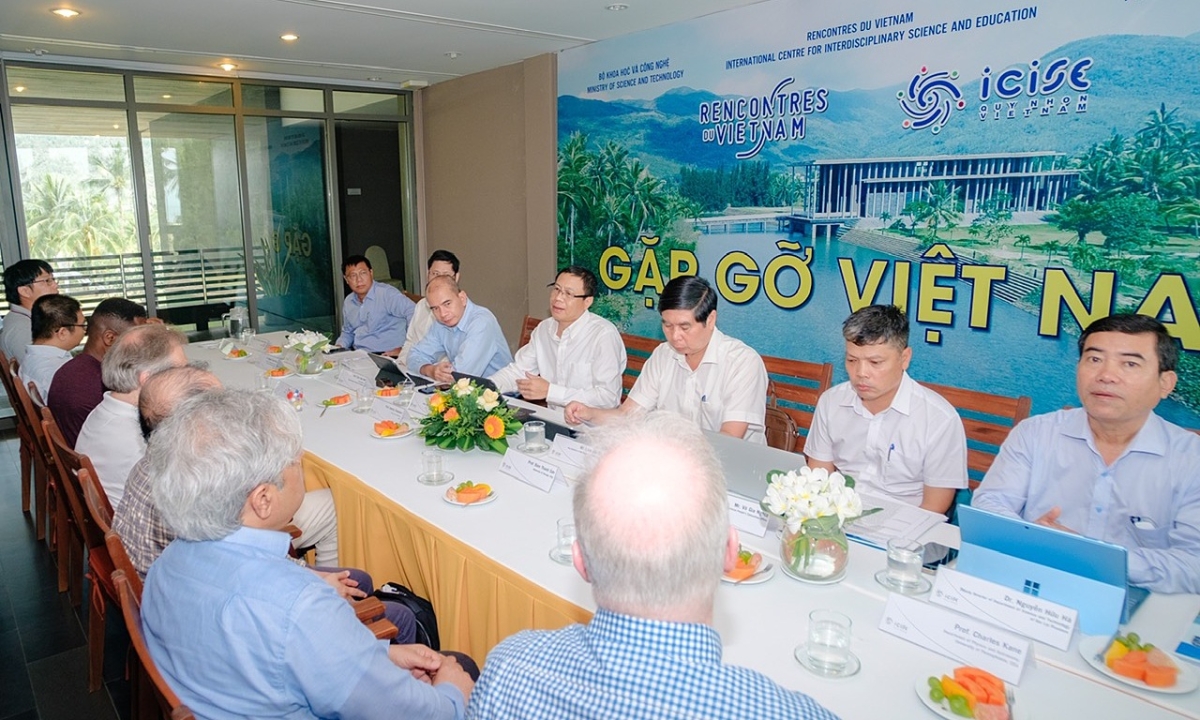
Deputy Minister Le Xuan Dinh worked with scientists within the framework of the conference at ICISE. Image: ICISE
According to Deputy Minister Le Xuan Dinh, Vietnam identifies quantum technology as a long-term strategic technology direction, not approaching a movement, but wanting to build substantive capacity. Accordingly, it is necessary to start from the basic scientific foundation, train human resources, form strong research groups, invest in shared infrastructure and choose a number of application directions suitable to domestic conditions.
Experts recommend that Vietnam start with human resource education and training, through organizing short-term training courses on quantum technology, inviting international scientists to present overview lectures, and update development trends in the field. These activities will create an environment for students and young researchers in the country and region to meet and exchange academically.
Along with sending young students for long-term training at strong research centers around the world, Vietnam needs to have a mechanism to attract internationally reputable experts, giving strong enough resources to build research teams, lead key research directions and train on-site human resources.
Delegates and scientists attending the international scientific conference “New advances in research on strongly correlated electronic systems” held from June 1-5. Image: ICISE
Many opinions suggest that Vietnam develop international cooperation in the field of quantum by taking advantage of the network of Vietnamese intellectuals abroad, connecting with scientists working at universities, research institutes and large technology enterprises.
Scientists recommend that Vietnam strengthen and connect existing research institutes and universities to consider investing in shared laboratories for quantum materials, quantum simulation and fundamental research directions. The investment needs to be linked to a specific problem and a team capable of operating it. Many opinions emphasize that quantum technology needs a long-term vision, which may take 5 to 15 years to create clear capabilities and applications.
Information exchanged at ICISE opens up opportunities to form a long-term cooperation network between Vietnam and international scientists in training human resources, building a strong research team and identifying fundamental research directions for Vietnam’s quantum technology.