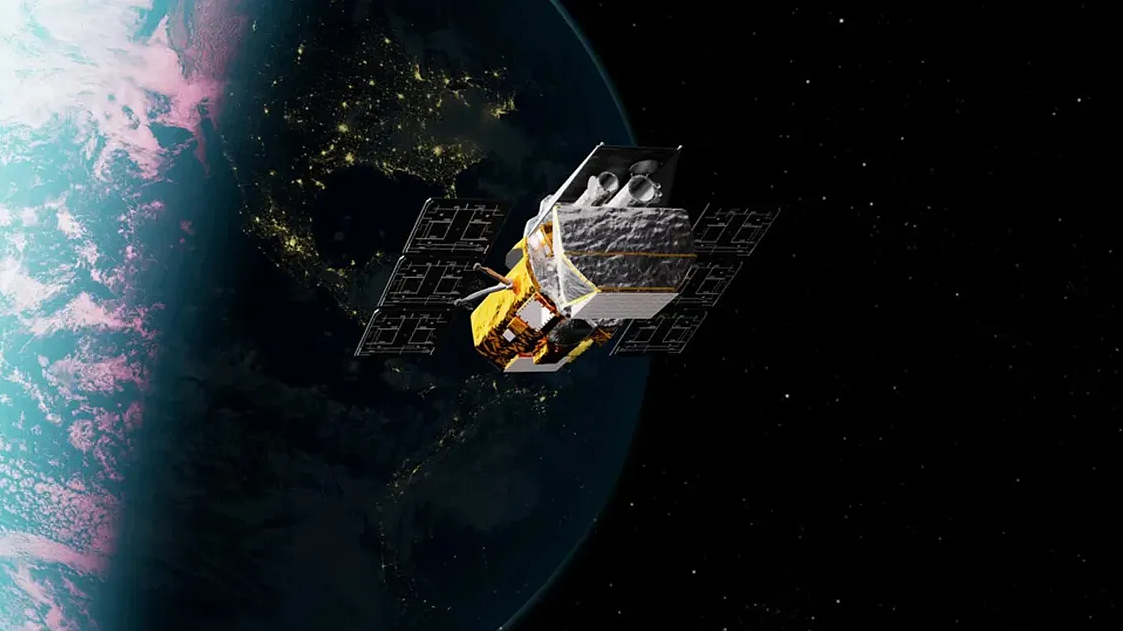
Swift, NASA’s $250 million, more than 20-year-old space telescope is falling back to Earth, possibly about to be saved by a small spacecraft.
NASA is researching the deployment of Swift Boost – a daring rescue mission that has never been tested in space. Accordingly, Katalyst Space Technologies’ Link ship will have to approach and pair with the Swift space telescope, which is not designed for this activity. If all goes well, this 425 kg spacecraft will lift Swift into a higher, safer orbit, extending its operating life by many years.
Link is expected to launch into space from Kwajalein Island, South Pacific, on June 27 using Pegasus XL – a booster rocket manufactured by Northrop Grumman Corporation. The ship will undergo a series of checks to ensure basic systems are operating properly. “We will have a test period lasting a few weeks, then start implementing the sequence of operations approaching Swift,” said Kieran Wilson, a researcher on the Link project.
Once in Swift’s orbit, Link will approach, dock, then gradually raise the telescope to its initial orbit over a period of several months. If all goes as planned, Swift could return to scientific research this fall and extend her life by at least five years. Meanwhile, Link will detach and reenter the atmosphere, ending the mission.
Space commented, the speed of implementing the rescue mission was very impressive. NASA chose Katalyst to build a spacecraft capable of lifting Swift with a budget of 30 million USD in September 2025. Now, after only 9 months, the Link ship, complete with three robotic arms, three main thrusters and a series of other equipment, fits inside the Pegasus XL rocket, mounted under the L-1011 Stargazer transport belly to fly to the launch site.
If successful, Link will demonstrate that a relatively small vehicle can extend the life of much more expensive telescopes that are not designed for maintenance. “You can move spacecraft when they run out of fuel or raise orbit when they are at risk of falling back into the atmosphere. We see this as the foundation of the development of the aerospace industry in the next few decades,” Wilson told Mashable.
Engineers at Katalyst put the Link spacecraft into the vibration chamber at NASA’s Goddard Space Flight Center on April 15, 2026. Image: NASA
The $250 million Swift space telescope was launched by NASA in 2004 to study gamma-ray bursts and other high-energy astrophysical phenomena. Gamma-ray bursts are short-lived bursts of high-energy light, but the amount of energy released in a few seconds is even greater than the Sun releases in its entire lifetime.
“In this regard, Swift was extremely successful, detecting more than 2,000 gamma-ray sources stretching to the edge of the visible universe,” explains Brad Cenko, principal investigator on the Swift project. He also emphasized that the telescope has helped scientists confirm that the heaviest elements known to humans, including gold and platinum, formed from these explosive cosmic events.
Swift, which operates in a high orbit of about 600 km, can quickly change direction to observe new targets. It was initially scheduled to operate for two years, but remains in good condition more than two decades later, save for gradually re-entering the atmosphere. Last year, experts noticed that Swift was descending faster than expected, possibly falling to Earth later this summer.
Simulation of NASA’s Swift space telescope. Image: Goddard Space Flight Center
Katalyst is betting on the future need for spacecraft maintenance and longevity. This week, the company raised $12 million to develop Nexus, a spacecraft more advanced than Link. “Katalyst was born to end the disposable space vehicle model and start a new one,” said Robert Lamontagne, Katalyst’s Vice President of Strategic Partnerships.
The first test flight of Nexus could take place next year with the target being Rooster, a US Space Force satellite flying in a geostationary orbit 35,786 km high, much higher than the Swift telescope. This mission is called Nexus-1, expected to be deployed using an Ariane 6 rocket.
How To Register
How To Withdraw
How To Withdraw
How To Withdraw
How To Withdraw
How To Withdraw
How To Withdraw
How To Withdraw
How To Withdraw
How To Withdraw
How To Withdraw
How To Withdraw
How To Withdraw
Inloggen
Juego Responsable
Juego Responsable
Juego Responsable
Juego Responsable
Juego Responsable
Juego Responsable
Juego Responsable
Juego Responsable
Juego Responsable
Kasyno
Kasyno