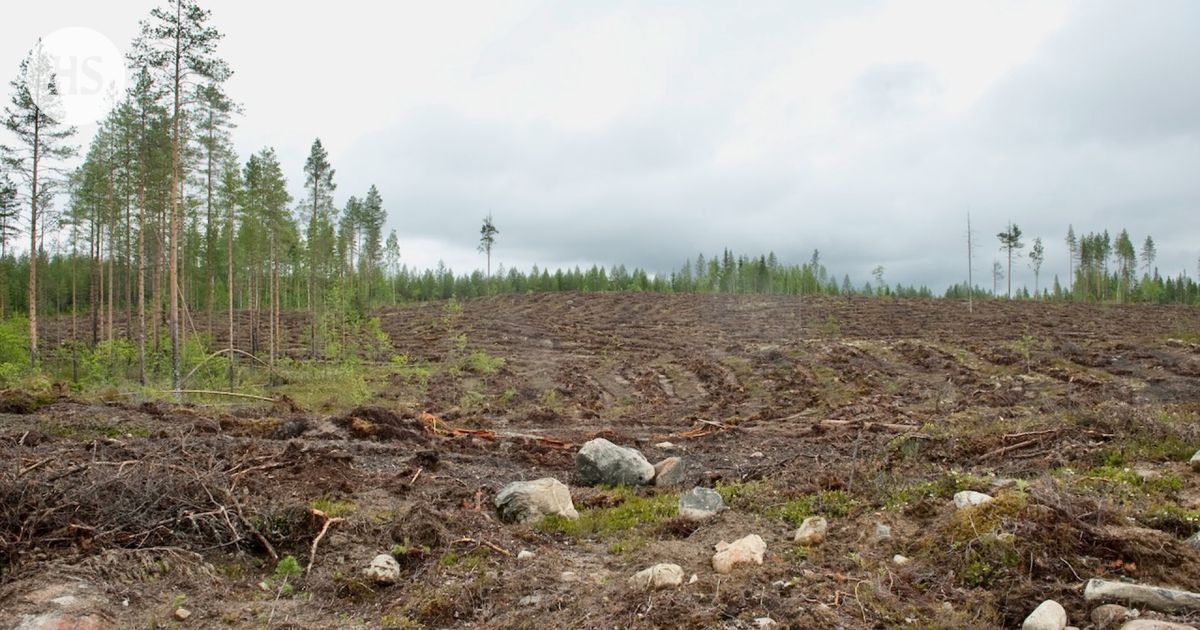
Avohakatun forest recovery should not be judged only on the basis of living trees. It is worth looking closely at other features of the forest, says Metsäekologian professor Jari Kouki.
Are there thick rotten trunks lying on the ground, are there dead trees standing up, and are there naves hanging from the old trunks? If not, many old-growth forest species are likely to be missing.
In an old spruce, the surface of the trunk remains shady, moist and cool for a long time. When the forest is cut down, the trunk is suddenly exposed to sun, wind and drying. Then the microclimate important for the lichen disappears, even if a new generation of trees grows there.
Hooked is involved in two recent studies, according to which the diversity of a cleared forest decreases for decades, even a hundred years.
I survived According to Kouk, a sign of the decline in forest diversity is the lichen species living on the trunks. If it is missing, the forest has not really recovered from logging.
“For example, the banded woodpecker has completely disappeared from Finland. The brown woodpecker is extremely endangered.”
The species of old forests is being built up Biological Conservation -according to a review in science magazine, about features that arise slowly. Such are old living trees, decaying trees and various small habitats.
Therefore, the recovery of living trees does not mean that the species of the forest has recovered.
Yellow-knotted lichen on the trunk of an old tree.
Now published studies show how long-term clear-cutting changes the biome communities of forests in the coniferous forest zone.
Part of the diversity recovers in 30 years, but especially in coniferous forests, the return of lichens, mosses and species dependent on dead wood can take even longer.
Osa species groups did not recover at all during the follow-up period, states the study Nature Sustainability in the journal. Recovery was especially slow in coniferous forests.
It took more than 100 years for mosses to recover, about 95 for lichens, about 85 for tube plants and more than 55 years for small mammals.
Beetles dependent on rotting wood did not show a clear recovery during the follow-up period.
Recovery was clearly faster in deciduous forests than in coniferous and mixed forests. In them, the biological communities either tolerated the disturbance better or recovered in 12–25 years.
“An important new observation is that the effects of clear-cutting do not only affect rare and endangered species, but they are also visible in common and common species of forests and in entire biological communities,” says Kouki.
If decomposers dwindle, nutrients no longer circulate normally in the forest.
“If pollinators decrease, the reproduction of many familiar forest plants, such as blueberry and lingonberry, will also become difficult,” says Kouki.
After clear-cutting, the nursery and new trees can grow quickly. However, many species do not only live in trees, they need, for example, sturdy trunks, dead wood, decayed wood, the surface of tree trunks, shade and moisture.
In addition, the old forest has a stable microclimate: shady, humid and more evenly heated.
“The loss of such traits explains why it takes so long for the species to recover.”
Therefore according to Kouk, the question is not only whether the forest will grow back, but how the clearing should be done.
Felling should not be done vigorously. In practice, more saving trees should be left in the felling area, i.e. trees that will not be removed later.
Now, according to Kouk, there are often few trees left, and they are not enough to protect the species in the long term.
According to Kouk, forests should grow longer than they do now between clear-cutting, because the current cycle times are too short for the recovery of rotting wood and other features of the old forest. One way, according to him, could also be incineration combined with a larger number of saving trees.
Clear-cutting should also be done in such a way that everything important to the species is not taken from the forest at once. Then there would be trees left in the forest, from which, over time, rotten wood will be created for the needs of many species.