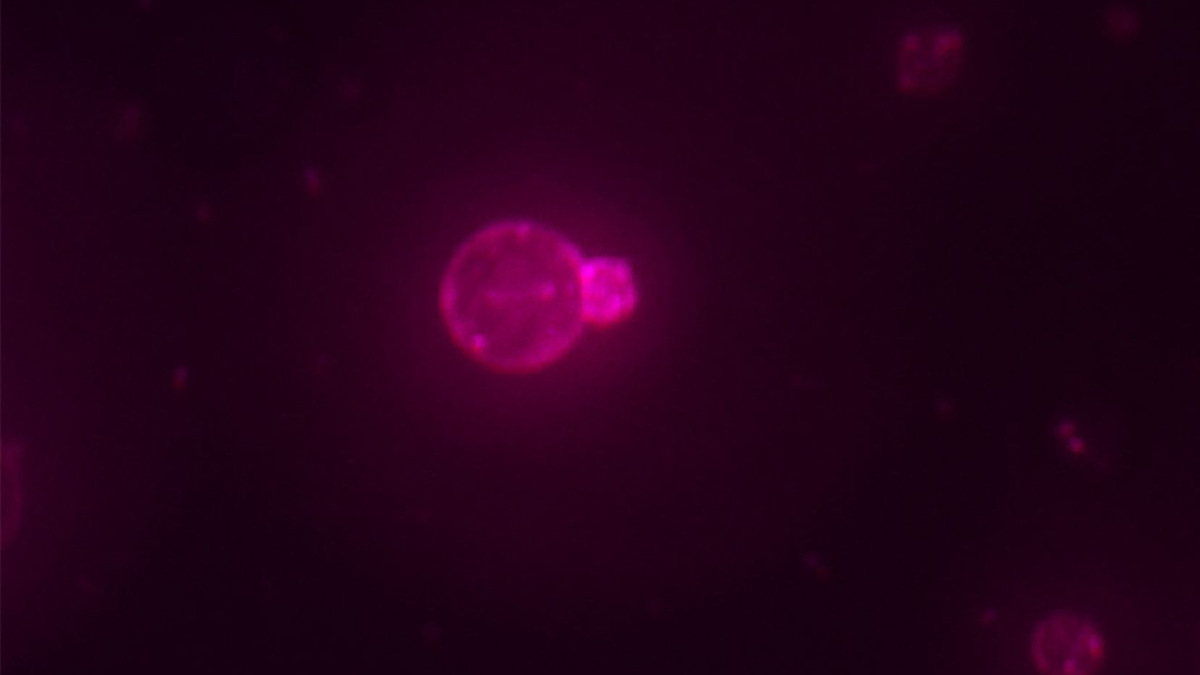
American scientists use inorganic compounds to create complete cells, capable of growing and dividing like natural cells.
Kate Adamala, a synthetic biologist and professor at the University of Minnesota in the US, and her team build each part of an artificial cell from inorganic chemical components. This breakthrough could open a new era, allowing the creation of living entities according to specific requirements, with activities similar to natural organisms.
Professor Adamala’s cell prototype is currently quite limited and vulnerable, but can help scientists understand the origin of life, as well as adjust to solve some major biological problems. This cell has no specific characteristics, is neither animal nor plant, but resembles a simple sample of bacteria.
“I know the full formula for creating cells, including each type of compound and their ratio. It’s all clearly defined, allowing for production and adjustment,” she said.
SpudCell with cell membrane stained red. Video: Adamala Lab
For decades, scientists have used engineered natural cells to solve many problems. One of the prominent examples is that the human insulin gene is loaded into E. coli bacterial cells to produce insulin to treat diabetes.
Scientists say artificial cells are the next step, helping to develop new cancer countermeasures, as well as develop chemical production options and reduce carbon emissions.
Cells are considered the basic structures to create life, but have a very complex structure. The human body has about 37 trillion cells. Until now, scientists have not been able to clearly determine how each cell type and their composition work.
“The artificial cell built by the Adamala team is not real life, but is an important milestone on the path towards this goal,” said Yuval Elani, associate professor of biochemical engineering at Imperial College London in the UK.
“Building cells from scratch helps them not be bound by the limitations of natural biology, opening up the possibility of designing entities capable of doing things that are difficult, even impossible, with natural cells,” Mr. Elani added.
Synthetic biology is a field separate from stem cell research, in which scientists seek to modify existing cells from biological sources.
‘Extremely weak entity’
Professor Adamala calls his product “SpudCell”, partly a play on words based on Sputnik – the world’s first artificial satellite launched into orbit by the Soviet Union in the 1950s and ushering in the space age.
“We hope this will kick off the era of bioeconomy,” she said.
SpudCell under a microscope. Image: Adamala Lab
SpudCell is made up of 150-200 molecules, which can grow and divide into new cells in about 5 generations. It is much simpler than natural cells with millions to billions of molecules.
Adamala describes SpudCell as “an extremely weak entity that basically does nothing but eat and occasionally give birth to daughter cells”. Each generation needs to be provided with nutrients and about 12 hours to reproduce in conditions of 30 degrees Celsius, compared to 30 minutes for E. coli.
SpudCell’s genome is also smaller than natural cells, with about 90,000 base pairs compared to 4.6 million pairs in E. coli. SpudCell has the ability to divide and reproduce like natural cells, but uses a different mechanism.
Artificial cells cannot make their own ribosomes – microscopic “factories” that are mainly responsible for assembling and synthesizing proteins in cells. It must use the E. coli ribosome, provided through digestion.
“This is just the beginning. It is the framework for us to continue to develop,” said Professor My.
Associate Professor Elani said that SpudCell does not actually mimic natural cells, but emphasized that it was not a fault. “Some behaviors are achieved through ways other than normal biological mechanisms. Synthetic biology doesn’t always revolve around mimicking nature, sometimes it allows us to do things differently and take shortcuts,” he said.
Several scientists not involved in the project described the team’s results as an “exciting step forward”.
“SpudCell is on the line between a mass of inorganic compounds and naturally evolving cells. This research is very important and impressive, and can bring great benefits,” said Elizabeth Strychalski, group leader at the Cell Engineering Agency of the US National Institute of Standards and Technology (NIST).
Tom Ellis, professor of synthetic genetic engineering at Imperial College London, calls SpudCell “the biggest recent breakthrough in the field of synthetic cells,” saying it will help scientists understand how life arises from inorganic chemical compounds.
Is it a real living entity?
American researchers note that one of the key achievements is showing that artificial cells also undergo a selection process, in which certain characteristics become more common or gradually disappear.
When they changed the gene to speed up the production of growth proteins, cells carrying the gene grew and divided faster. However, this change was introduced into the cell instead of being a spontaneous gene mutation, so it cannot be confirmed that SpudCell is a cell capable of evolution.
Drew Endy, associate professor of biological engineering at Stanford University, believes that SpudCell cannot yet be considered a living entity. “We are still far from understanding life, nor are we able to intervene in matter to create new things. I think Kate has built a cell, but she has not been able to create actual life,” he said.
SpudCell undergoes division. Image: Adamala Lab
Endy also reassured that SpudCell in its current state does not pose any biological threat, and cannot be used to create biological weapons. “It only divides when it is supplied with food and everything else, including ribosomes. It is completely incapable of reproducing itself outside this environment,” he said.
Professor Adamala affirmed that SpudCell is built from scratch, so it is possible to install protective measures into its genome to prevent safety threats if the cells are released into the environment.
Adamala and Endy are among the founders of Biotic, a public interest organization with the goal of making SpudCell the global standard for synthetic cell biology, serving as the open source Linux operating system.
Laurie Zoloth, a professor of religion and ethics at the University of Chicago, said that Biotic could help solve some of the problems when new technology emerges, such as who will benefit, who will decide how to use it and who will put in place safety measures.
Professor Adamala says the goal now is to ensure SpudCell’s technological core is open to everyone who wants to study it. She added that research institutes and non-profit organizations will have free access, while commercial activities will need to pay licensing fees.
“SpudCell can’t do anything useful right now, it’s not efficient enough. What’s exciting is that we’re building the international community to accelerate the process to help it bring benefits,” she said.
Profilo pubblico – lathegirdle5 – apunto.it
somervillematthews901452 – PukiWiki
Member Profile: massspear9 | Blurb Books
bailgirdle2 » AtomCraft – Майнкрафт сервера с модами
Doherty Steensen's Profile page
cornadult7 » DataLife Engine
creekvessel2 » A-TAXI служба таксі Великий Березний | +380951206000
Penzu
Accessibility and Convenience Define Urgent Care in Seminole, FL
primary
Finding Prompt Care: The Rise of Urgent Care Centers
Immediate Medical Attention in Seminole: A Growing Necessity
Accessing Prompt Medical Care: The Need for Urgent Care near Seminole — EcoUrgentCare
Finding Immediate Medical Attention: The Rise of Urgent Care Centers — UrgentCareBox
Urgent Care in Seminole, FL: Meeting Immediate Healthcare Needs
Accessing Timely Healthcare: The Role of Urgent Care in Seminole
Accessing Timely Care: Urgent Care Near Seminole – HackMD
82.1 KB file on MEGA
Urgent Care in Seminole Meeting Community Health Needs Swiftly.pdf
Understanding the Growing Demand for Urgent Care in Seminole, FL
Penzu
TGH Urgent Care powered by Fast Track on Brownbook.net
tghurgentcaresouthtampa Publisher Publications – Issuu
TGH Urgent Care powered by Fast Track Reviews
User birthoffice02 – Kitchenanswershub Q&A