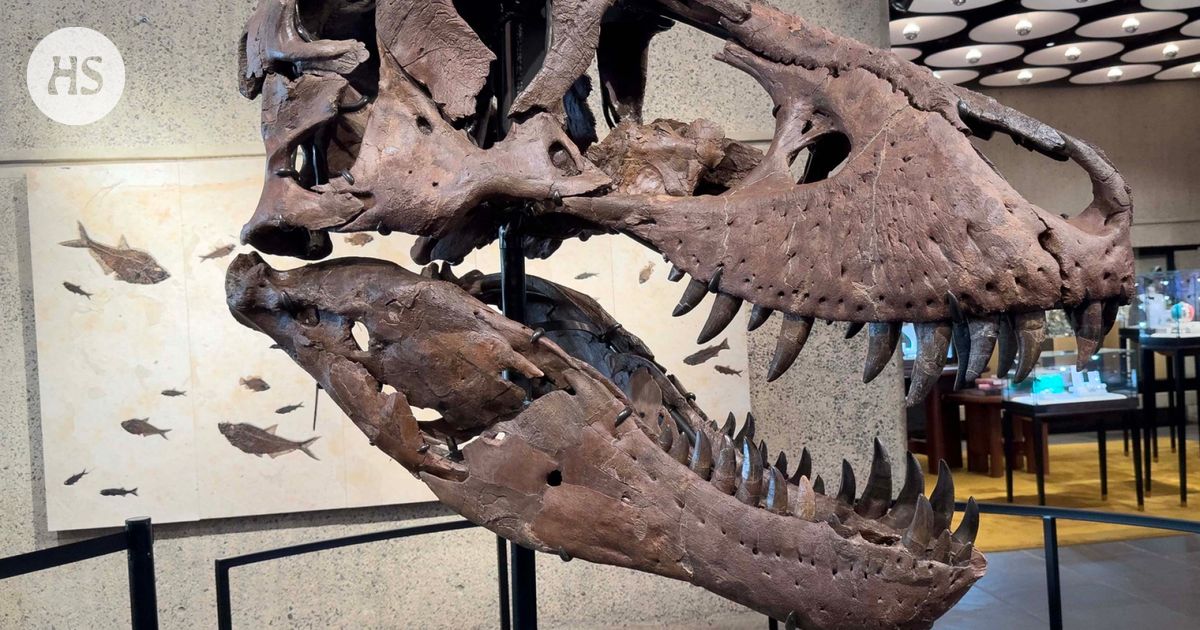
In New York historic deals were made on Tuesday, when the skeleton of a Tyrannosaurus rex was auctioned for a good price of 50 million dollars, or about 44 million euros.
The remains found in 2021 became the most expensive auctioned fossil in history. It is known as Gus because the skeleton was found Gary “Gus” Lickingin from countries.
At least the buyer was not immediately known to the public.
The previous record was set a couple of years ago, when the billionaire Ken Griffin bought stegosaurus for $44.6 million.
Sotheby’sin the Tyrannosaurus rex, now given a new owner at the auction, was unearthed in South Dakota. The 11 meter long and 3.8 meter high animal fossil is one of the largest animals ever found.
Compared to the original, the approximately 67 million-year-old fossil has 61 percent more bones and approximately 75–80 percent more mass.
According to Sotheby’s, the fossil now being sold is one of the most complete ever found. About 82 percent of the skull’s bones were preserved. It is rare that both legs were preserved in the skeleton.
The fossil was on display before the Sotheby’s auction.
Fossils collecting has become a hobby of the sundry, such as the actor Leonardo DiCapriona hobby.
Paleontologist, professor at the University of Birmingham Richard Butler said the British newspaper The Guardianille that they find the development worrying.
“A fossil that is not in a recognized museum collection cannot be studied. It is lost to research. Fossils have been bought and sold for hundreds of years, but prices are increasingly beyond the reach of museums, to the detriment of science,” Butler said.
The stegosaurus purchased by Griffin has been loaned to a natural history museum in New York for four years, but scientists also consider such a procedure problematic.
Assistant Professor, Carthage College, Wisconsin, Paleontologist Thomas Carr points out in the Guardian story that it is the role of public foundations to maintain, preserve and curate their collections indefinitely.
“Fossils must be available to test previous observations and make new insights.”
Carr characterized museum loans as problematic because the owner could withdraw their fossils at any time.
Many scientific publications today require that studies be based on fossils held in public archives. In this way, the studies can be replicated and the objects are available to scientists.