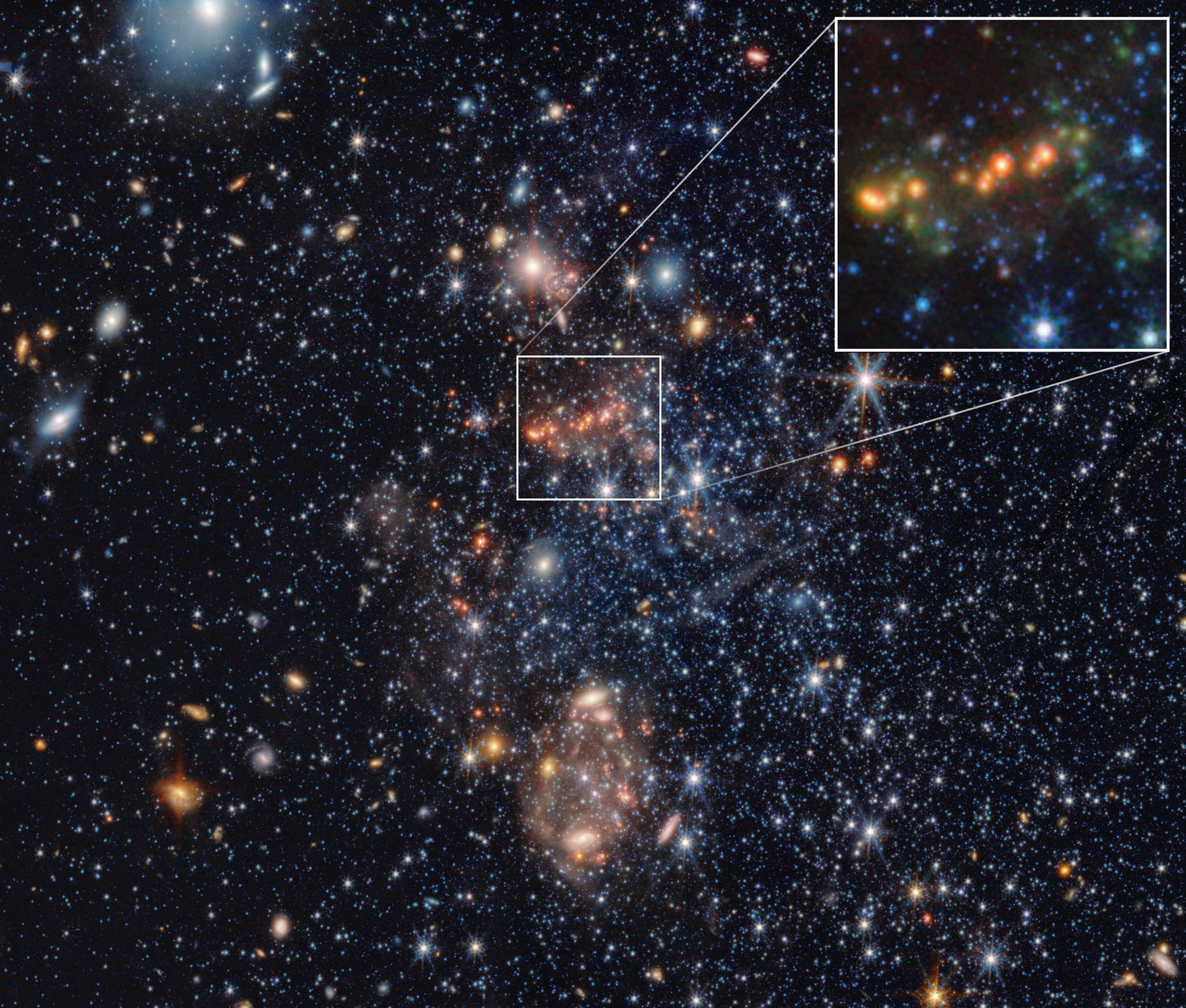
Research led by the National Institute for Astrophysics (INAF) and based on observations from the James Webb Space Telescope (JWST) has investigated mechanisms of cosmic dust formation in the early Universe. The study, published on The Astrophysical Journal and coordinated by Claudio Gavetti, PhD student at INAF and Roma Tre University, examined the Sextans A dwarf galaxy, located on the edge of the Local Group and characterized by a metal concentration between 1% and 7% compared to the solar one.
This chemical composition makes the system an ideal model for studying the young Universe, allowing the study of evolutionary dynamics that would otherwise be difficult to observe at very large distances. As highlighted by Claudio Gavetti: “Directly studying the galaxies that populated the early Universe is still very difficult; for this reason, observing a nearby galaxy like Sextans A, which presents similar chemical conditions, offers us a precious opportunity to understand how the first generations of stars evolved and what role they had in transforming the interstellar medium».
The combined use of the NIRCam and MIRI instruments on board the JWST made it possible to map with high resolution the population of stars belonging to the asymptotic branch of red giants, comparing empirical data with theoretical models of dust formation in circumstellar winds. Flavia Dell’Agli, INAF researcher and co-author of the work, underlined:”The James Webb allows us to observe with an unprecedented level of detail environments that until a few years ago were out of our reach. The value of these data is not only in the images, but in the possibility of comparing them with theoretical models and verifying how correctly they describe the evolution of stars“.
The Sextans A dwarf galaxy observed by the James Webb Space Telescope. By combining the telescope’s observations with cutting-edge theoretical models, the team reconstructed the galaxy’s population of evolved stars and identified the main sources of cosmic dust in an environment that reproduces the conditions of the first galaxies in the Universe. Credits: NASA, ESA, CSA, STScI, Janice Lee (NOIRLab). Image processing: Alyssa Pagan (STScI).
The data collected indicates that, although over ninety percent of the giant stars examined are devoid of significant dusty envelopes, a limited group of twenty stars is surrounded by dense shells of dust. The chronological and mass analysis has highlighted that these structures were generated between two and three billion years ago starting from stars with initial masses equal to approximately one and a half times that of the Sun. This discovery provides unprecedented observational data on the ability of evolved stars to synthesize interstellar dust in contexts poor in heavy elements, a determining factor for the cooling of the gas and the subsequent genesis of new stellar and planetary generations.