The Vietnamese gene decoding project helps improve the ability to compare martyrs’ DNA with the genetic database of relatives in genetic testing technologies that Vietnam is using.
The data set of more than 1,000 genomes (VN1K) was published by scientists on July 22 on Nature Communications. Dr. Vo Sy Nam and Prof. Vu Ha Van, Big Data Research Institute, VinUni University – the project leaders – said this is a genetic data platform that serves as a reference for a series of genetic research and applications related to Vietnamese genes. One of those applications is DNA analysis to identify martyrs.
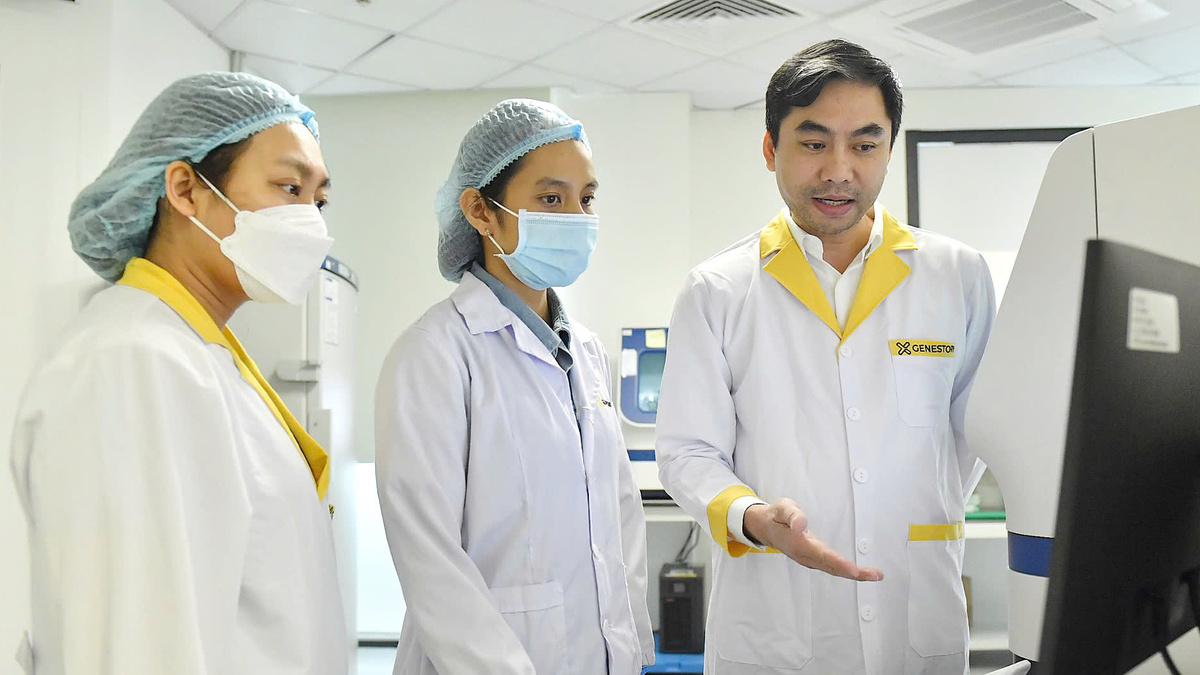
Professor Vu Ha Van, the project’s initiator, said that since July 2024, when the Government launched the Gene Bank project for martyrs and their relatives, GeneStory, a spin-off company from the VN1K project co-founded by Professor Vu Ha Van and Dr. Vo Sy Nam and a number of other members with main investment from Vingroup, was chosen as a partner to participate in building the gene bank for martyrs’ relatives.
Since April this year, a 500 day and night campaign to search, collect and identify martyrs’ remains was launched, this company has collected more than 100,000 thousand samples. “The total number of samples collected so far is about 100,000,” according to Professor Van.
Based on VN1K, researchers have developed VinGenChip, a technology that effectively decodes relatives’ genetic data so that it can be compared with the DNA of remains to determine the identity of martyrs. The chip is able to identify gene variations specific to Vietnamese people more effectively than imported products, while the price is much lower.
VinGenChip is currently one of the technologies being used in the gene bank project for martyrs and their relatives implemented by the State in association with the 500 days and nights campaign. Image: VinUni
Currently, the new generation gene sequencing technology NGS-SNP, which aims to read multiple positions (SNPs) on the nuclear DNA sequence on remains instead of just reading data from mitochondrial DNA as before, has been deployed to be able to analyze DNA from severely decomposed remains. This technology also helps to effectively determine blood relationships between distantly related individuals, along both the paternal and maternal lines.
According to Dr. Vo Sy Nam, the advantage of NGS-SNP technology is that it has a high level of comprehensiveness, but it is still difficult to read the data in cases where the remains sample has many damaged DNA fragments due to strong decomposition. VN1K data helps overcome this weakness, providing the frequency of all readable gene points in the Vietnamese genome and identifying positions with high information value in kinship analysis as well as helping to partially restore lost positions. Thereby, remains with partial loss of genetic data can still be matched with the gene bank of relatives to determine the identity of martyrs with high accuracy.
More specifically, current NGS-SNP gene testing panels are designed to be able to read thousands or even tens of thousands of variants (SNPs) on the genome for identification purposes. However, under the conditions of burial and preservation of martyrs’ remains in Vietnam over a long period of time, the DNA from the remains has decomposed so strongly that in many cases only a few hundred SNPs can be read. At this point, reference data from VN1K can be used to predict unread positions, as well as provide gene variant frequency information for read positions to help algorithms compare genetic data of remains and relatives to work more accurately on the Vietnamese population.
GeneStory Company has also built a laboratory capable of performing large-scale genetic testing. Vietnam currently has more than 175,000 martyrs whose remains have not been found and over 300,000 unidentified graves. “The number of tests that need to be performed on the remains of martyrs and their relatives is up to millions, requiring a large laboratory and this is the infrastructure we can provide,” Professor Vu Ha Van said.
In just over the first month of implementation, GeneStory and the authorities collected DNA from more than 200,000 people and decoded more than 50,000 gene samples. From this data, scientists have identified more than 30 martyrs, out of a total of just over 100 remains samples for comparison. “Previously, we had to test dozens or hundreds of remains samples to identify a few cases,” Dr. Vo Sy Nam said, adding that thanks to larger relative genetic data and better analysis technology, the identification rate has increased significantly.
The research team expects VN1K will continue to be the foundation for many new applications in precision medicine, preventive medicine and personalized health care, contributing to bringing the achievements of genetics closer to the Vietnamese people.