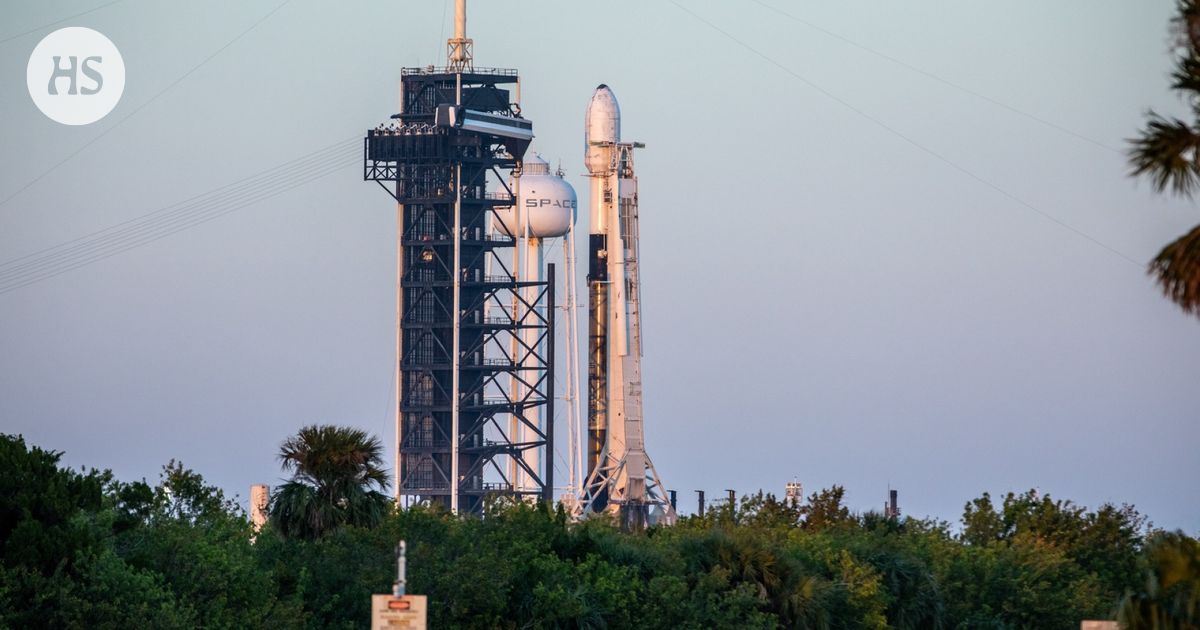
A space company A part of SpaceX’s old abandoned launch vehicle will crash into the Moon next week, astronomers estimate.
It is about the Falcon 9 rocket that the company will send into space in January 2025, and more specifically about its upper part, i.e. the upper stage, says the American magazine Sky & Telescope.
The rocket sent various research equipment and one rover towards the moon, which, however, disintegrated on landing.
The upper stage is 13.8 meters long and 3.7 meters in diameter. It could be compared to a bus, for example.
Item with tag 2025-010D followed harrastetähtitieteilijä Bill Gray estimates that it will hit the moon on Wednesday of next week around 9:35 a.m. Finnish time.
The track will have a speed of no less than 8,700 kilometers per hour.
There is no risk of a collision.
From the collision the resulting flash or the resulting dust cloud may be detectable by astronomers if conditions are favorable.
However, the collision is above all a sign that similar events will probably become more common. In particular, in the future, more and more equipment will travel towards the Moon, as Nasa, China and the European Space Agency, among others, are heading towards the Moon.
In low Earth orbit, satellites and larger pieces of space debris are monitored, among other things, by research. The Starlink satellite system alone currently includes more than 10,000 satellites.
In the high orbits of the Earth and the distance from the Moon, it is more difficult to track objects.
The radar echo weakens strongly as the distance increases. Roughly estimated, the echo returning from a body at the distance of the Moon can be tens of billions of times weaker than from a corresponding body in low Earth orbit.
“It is difficult to track the space debris in the space between the Earth and the Moon and around the Moon,” he says Marco Langbroek from Delft University of Technology to Sky & Telescope.
“There is no dedicated observation network built to monitor these objects. The data is based on random observations from programs that map asteroids coming close to the Earth,” says Langbroek.
Human pieces sent into space have collided with the Moon before.
It happened for the first time already in 1959, when the Luna 2 probe sent into space by the Soviet Union hit the Moon.
Several parts of the Apollo space program were crashed into the Moon over the years, and in 2009, Nasa deliberately crashed the upper stage of one of its rockets into the Moon while searching for water.
Also in 2022, SpaceX’s rocket was estimated to crash into the Moon, but later it turned out that it was a Chinese rocket’s upper stage.
At that time, Nasa was able to photograph the crater created by the collision afterwards. Photos are expected this time as well.