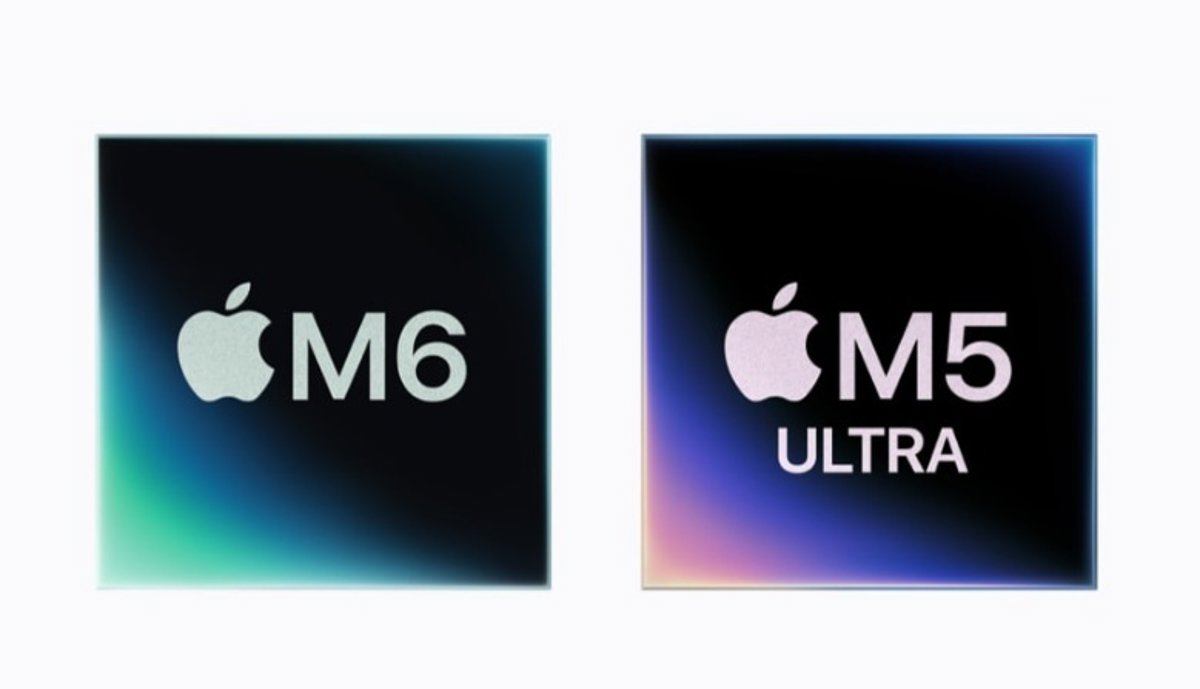
Apple has updated its processors with the new M6, its first 2-nanometer chip, and the M5 Ultra, its most powerful chip to date, with which it claims to make a leap in performance and artificial intelligence (AI) processing locally.
The technology company has unveiled the first member of its new family of computer processors, the M6, which is manufactured with a 2 nanometer process, which allows the integration of a higher density of transistors in a smaller size, thereby improving performance and energy efficiency.
It consists of a twelve-core CPU module (two super cores, four performance cores and six efficiency cores) that offers better single-threaded and multi-threaded performance so that demanding tasks such as image editing, code compilation, indexing new files and executing agentic AI processes run quickly.
For its part, the GPU consists of twelve cores, each of them with a Neural Accelerator, which, according to the company, increases the maximum computing capacity for artificial intelligence by almost 30 percent compared to the M5.
It also debuts a dual 16-core Neural Engine that enables greater performance for artificial intelligence processes. With this component, system environments can automatically use both engines simultaneously, allowing apps to run models more quickly.
The M6 supports up to 32GB of unified memory to run multiple demanding apps at once and large language models on the device. It also offers up to 170 GB/s of unified memory bandwidth, 10 percent more than the M5.
According to Apple’s vice president of chip engineering, Sri Santhanam, this processor, integrated into the new Mac mini, “offers the ideal balance between performance, energy efficiency and on-device AI processing.”
M5 ULTRA, APPLE’S “MOST POWERFUL” CHIP
Along with the M6, Apple has also introduced the M5 Ultra, which it considers “the most powerful chip” it has created to date and which, through the new Mac Studio, addresses professionals who need to accelerate workloads that demand maximum CPU, GPU performance and unified memory bandwidth, such as complex 3D rendering, visual effects and running cutting-edge AI models on the device.
The M5 Ultra uses UltraFusion to connect two dual-die M5 Max to form a quad architecture. Together, these low-latency, high-bandwidth interconnects allow all four chips to operate as a single unified processor.
The processor has a CPU with up to 36 cores, made up of twelve super cores and 24 performance cores, offering up to 1.25 times higher single-thread performance and up to 1.3 times higher multi-thread performance compared to the M3 Ultra.
Regarding the GPU, this component integrates up to 80 cores, with a Neural Accelerator in each of them, which multiplies the maximum processing capacity for AI by up to 4.5 compared to the M3 Ultra.
The M5 Ultra also includes a 32-core Neural Engine and a multimedia engine with hardware H.264 and HEVC, four ProRes encoding and decoding engines, and hardware-accelerated AV1 decoding.
In addition, it offers up to 512 GB unified memory and 1.2 TB/s of unified memory bandwidth, which is 50 percent more than the M3 Ultra. This allows you to store huge data sets in local memory, increase the rate of tokens per second, and run large language models with hundreds of billions of parameters on the device itself.