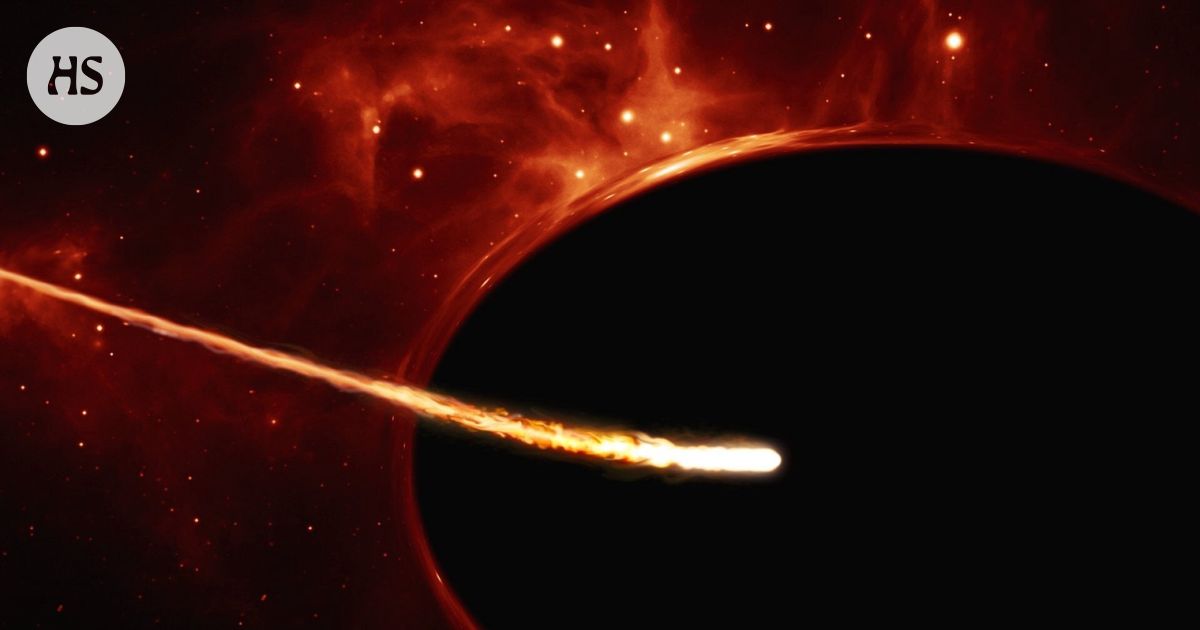
Right at the center of our own galaxy is a massive black hole millions of times the mass of the Sun.
Now, a star has been tracked that orbits this black hole at its fastest speed of 25,000 kilometers per second. It is the fastest known star in the Milky Way.
The speed is more than 8 percent of the speed of light. A star flies in its orbit 100,000 times faster than a passenger plane flies.
Galactic the central black hole is known as Sagittarius A*. Its mass corresponds to about four million Suns.
The observed star S301 moves close to Sagittarius A*, which explains the star’s highest speed.
S301 orbits Sagittarius A* in just 8.7 years in a very oval orbit. It is slightly more massive than the Sun.
It orbits very close to the black hole, as the shortest distance is only 12 times the distance between the Earth and the Sun.
It is “unprecedented”, says ESO in the bulletin fresh research one of the authors is a doctoral student Felix Mang. The study was published Naturein the journal.
S301:n allows astronomers to directly determine the rotation speed of a massive black hole for the first time. Researchers must first follow S301 for two full revolutions.
A rotating black hole drags space-time with it. It affects the orbits of surrounding stars, such as S301. of ESO animated shows how a massive gap distorts space-time:
S301 was likely part of a binary pair torn apart by the gravitational tumult of Sagittarius A*.
S301 was likely captured by the black hole’s gravity. Its companion, on the other hand, was ejected at such a high speed that the star left the Milky Way completely.
The star was discovered by S301 European Southern Observatory system of four large telescopes (VLT). They can work togetherwhere the resolution is many times better than with a single telescope.
Sagittarius A*:ta orbiting stars have been monitored for decades. Astronomers Reinhard Genzel and Andrea Ghez got Nobel Prize in Physics in 2020 just from discovering Sagittarius A*.
Genzel was involved in a recent study. He heads the Max Planck Institute for Space Physics in Germany and was founding the team for this research.
Sagittarius A* is about 27,000 light years away. An international research group published about it picture in 2022. The Event Horizon Telescope program uses several radio telescopes that work together like a huge telescope.
An image of the black hole in the center of the Milky Way was compiled with radio telescopes and published in 2022.