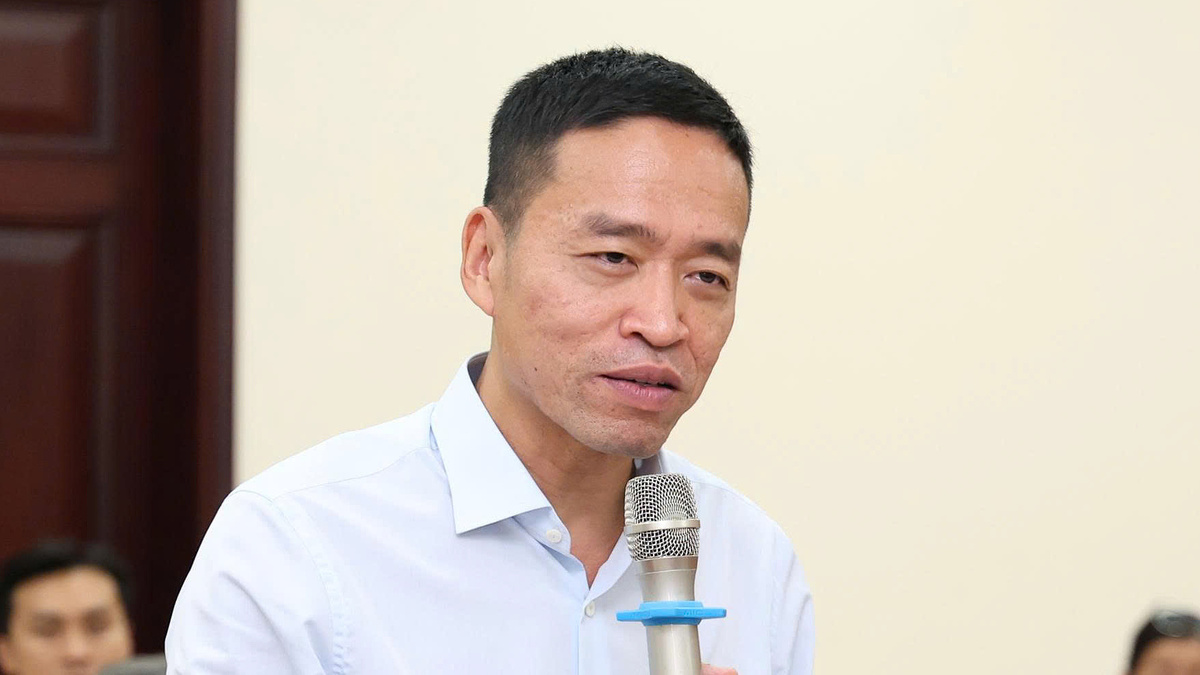
According to VNG Chairman Le Hong Minh, science and technology resources need to be linked to the city’s actual problems, have clear output goals, and avoid spreading out.
The opinion was expressed by Mr. Le Hong Minh at the discussion session of the thematic session of the People’s Council of Ho Chi Minh City, on the afternoon of September 21, related to the groups of issues of urban development, budget, energy to science, technology, education and health… The discussion was attended by Chairman of Ho Chi Minh City People’s Committee Nguyen Van Duoc, Standing Vice Chairman of the City People’s Council Nguyen Van Tho and more than 30 delegates and leaders of departments and branches.
At the beginning of the comments, he said that this was the first time he expressed his opinion as a City People’s Council Delegate, so he had “no experience” but the top goal was “a constructive spirit” from the perspective of a technology business.
Commenting on the policy of developing research centers that meet international standards, VNG Chairman said that the biggest problem is that the output target is not expressed clearly enough compared to the expected resources spent.
VNG Chairman Le Hong Minh spoke at the discussion session of the Ho Chi Minh City People’s Council meeting on the afternoon of September 21. Image: An Phuong
According to the report, the city plans to select about four organizations each year, each with at least one science, technology and innovation program, with an average of about 100 billion VND per program. Total cost after 5 years is about 2,000 billion VND.
“When spending such a budget, I think it is necessary to clearly answer what the city wants to get back, what results it hopes to achieve? That needs to be clearly expressed in the resolution,” VNG Chairman said.
He believes that setting targets on the number of articles, reports or research products is necessary, but not enough. The city should use scientific and technological resources to solve its own practical problems such as traffic congestion, electric vehicles, digital urban areas…
“Research and technology programs should set specific goals for the city’s problems,” he said. Therefore, the approach needs to shift more strongly from spending money on each project to focusing resources on a few large problems.
“Instead of allocating small resources to many projects, I think the city should focus resources on a few large projects,” he said, adding that with research, if you invest a little money, you can create a report, but to create real results that can be applied to life, you need concentration and should not be spread out.
“Ho Chi Minh City is starting a bit cautiously”
After reading two draft Resolutions on corporate income tax and personal income tax exemption policies for creative start-up activities and incentive mechanisms to support the formation and development of research centers meeting international standards, Mr. Minh assessed that “Ho Chi Minh City is starting a bit cautiously”. According to VNG Chairman, the Urban Development Law opens up a huge mechanism space for the city, but the drafts currently focus on solving many detailed issues, such as spending levels, spending mechanisms, that is, “how to spend money”. Meanwhile, the Resolution does not clearly show what major results the city wants to achieve after spending resources.
“From a business perspective, I would ask: What is the end result of all these policies? I don’t see that clearly enough,” he said.
With the tax incentive policy for creative startups, Mr. Minh believes that the city should not only look at the policy from the perspective of supporting newly established businesses but also in the competition to attract technology businesses and high-quality human resources.
Through practical exchanges with many large technology enterprises, especially in the semiconductor field, he realized that they are concerned about personal income tax policies for people working in strategic technology industries. The Law on Science, Technology and Innovation has preferential regulations, but implementation in Ho Chi Minh City still needs specific instructions. Meanwhile, according to him, Da Nang has guidelines for application from July 2025.
VNG Chairman said that the goal of the resolution needs to be larger. The city should look at competitive localities so that when implementing a national legal framework, at least Ho Chi Minh City’s policies must be equally competitive, if they want to attract businesses and talent.
Semiconductor Laboratory, Research and Implementation Center, Ho Chi Minh City High-Tech Park. Image: Quynh Tran
Another content mentioned by Mr. Minh is the remuneration policy for science and technology human resources. According to him, the city’s draft stipulates a maximum of 150 million VND/person/month for some positions, while the new Central regulations allow remuneration of up to 300 million VND/person/month for general engineers in strategic technology problems.
Commenting on this content, Mr. Minh said that Ho Chi Minh City is already the largest economic, science and technology center in the country, while we will need to attract a lot of good people to solve the city’s difficult problems. If the Central Government has chosen a level, the city should be at least equal to that level.
“I think the city needs to be more bold in these policies, because we will need to attract a lot of good people to solve Ho Chi Minh City’s difficult problems,” Mr. Minh concluded.
Also at the discussion session, Ms. Tran Thi Minh Hanh, Secretary of the Party Committee, Chairman of the People’s Council of Chanh Phu Hoa ward, said that the actual implementation of previous policies to support science, technology and innovation showed that the order, procedures and documents were still complicated and cumbersome. This makes it difficult for organizations, individuals, and businesses to complete their documents to receive support.
Therefore, with the new resolution, the city needs to design a simple, compact and quick process, especially for organizations and individuals with scientific, technological and innovative initiatives and solutions.
Delegate Hanh suggested that the city should focus on communicating policies to the right beneficiaries, helping organizations, individuals and businesses know, register and access support policies.