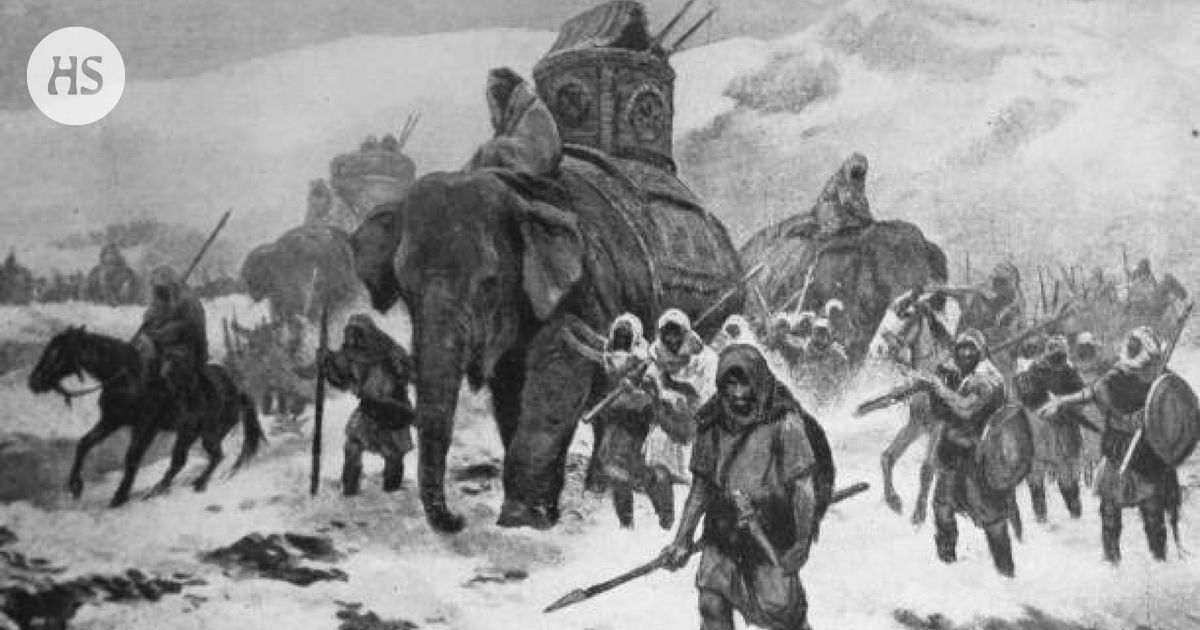
In October in 218 B.C. there was a 28-year-old Carthaginian general Hannibal Barka faced with a difficult choice.
The two great powers of the Mediterranean region, Carthage and Rome, located in present-day Tunisia in North Africa, struggled of European domination in antiquity.
Hannibal, planning the conquest of Rome, had advanced with his army to the foot of the Alps. There were two options: lead the troops over the snowy mountains or set up a winter camp to wait for more favorable spring weather.
The army had already been out of southern Spain for five months. Fierce battles against Rome’s allied tribes had exhausted the forces.
Recovering in a winter camp would be worth its weight in gold, advancing into an increasingly freezing mountain would be a risky leap into the unknown. On the other hand, wintering would take away the crucial advantage of surprise: no one in Rome considered an attack over the Alps possible.
At first Hannibal was also helped by the shock effect of the war elephants.
we know how did it go In one of the most daring operations in military history, Hannibal marched almost 40,000 infantry soldiers, 8,000 cavalrymen with horses and 37 war elephants across the Alps.
The troops advanced to a height of almost three kilometers through an icy mountain pass from present-day France to the valley of the Po river in northern Italy in just 15 days.
According to a Greek historian, almost half of Hannibal’s troops perished on the tough alpine journey Polybios.
Still, the Carthaginian army advanced from one crushing victory to another in what is now Italy, because Rome had grouped the bulk of its legions elsewhere.
At first Hannibal was also helped by the shock effect of the war elephants: the strange giants sowed confusion in the Roman ranks.
Success climaxed Cannae in southern Italy 216 BC.. The greatest battle of ancient times was Hannibal’s war strategy masterpiece, whose pincer movements and siege tactics are still taught in military academies.
Despite its clear male superiority, Rome suffered the worst defeat in its history: almost the entire military leadership and about 60,000 soldiers fell in one day. The Carthaginians lost less than 6,000 soldiers.
Elephants are reputed to be much better climbers.
Hannibalin much is known about the battles but The exact route of crossing the Alps is still shrouded in obscurity. Four passes led across the mountains, and scholars have debated since ancient times which one he chose.
A recent joint study by the universities of Oxford and Jena believes that they have found the answer to the riddle.
Until now, attempts have been made to define the route using archeology and unclear historical sources.
New research Proceedings of the National Academy of Sciences -in the scientific journal, elephants are given a key position, which no one before Hannibal or ever after him has marched across the Alps.
Most of them survived the ordeal: around 30 elephants participated in the first battle in Trebia.
The study compares the effect of different routes on the energy consumption and physique of Hannibal’s elephants.
It used data collected by the animal protection organization Save The Elephants on the movements of African elephants in Kenya. The modeling related this information to the weight of the elephants, the length of the routes and the height curves.
For elephants weighing three tons, the significance of differences in load has been decisive, the researchers emphasize.
Elephants the most favorable for energy consumption was the Col de la Traversette mountain pass.
The route was 19 percent lighter than the most popular option until now, the Col de Clapier, which proved to be physically tougher for a large army moving with heavy equipment.
According to the modelling, soldiers would have lost as much as 19 percent of their body fat mass while crossing the Alps, horses 11 percent, but elephants only four percent.
The elephants’ better performance is explained by their large fat stores and the fact that elephants are reputed to be much better climbers, the professor of biology at the University of Oxford and the director of the Save The Elephants organization Fritz Vollrath states.
The elephants were finally loaded because their advantage of surprise had already been used.
Traversesets ancient historians have also hinted at the route.
Polybios says that Hannibal chose the highest pass and encouraged his exhausted soldiers at the top by pointing to the valley of the Po river below. Marcus Terentius Varro mentions that he used the southernmost pass.
The Col de la Traversette is the southernmost and highest of the Sol and the only one from which the valley of the Po River can be seen.
Hannibal didn’t have computer modeling at his disposal. That doesn’t mean that perhaps the most skilled military strategist of antiquity didn’t know how to choose the cheapest route. All his movements were always based on thorough planning.
Hannibal prepared the crossing of the Alps with two years of negotiations with the Gallic tribes on both sides of the mountains who were dissatisfied with Roman rule. These have known the characteristics and differences of alpine passes, Polybios resemble.
A year after crossing the Alps, only his own steed Surus was left of Hannibal’s elephants.
The other elephants were finally loaded because their advantage of surprise had already been used and maintenance was a big burden.
On the other hand, a saying about the risky trip was etched in the memory of the ancient Romans for centuries, which always came up when great trouble threatened: Hannibal ad portasHannibal is already at the gates.
“You know how to win, but you don’t use your winnings.”
A statue of Hannibal in Tuileries Park in Paris. The original marble sculpture by Sébastien Slodtz is placed indoors in the Louvre.
Alps the crossing gave Hannibal an opportunity to decisively change world history, but he wasted it.
“You know how to win, but you don’t use your winnings,” summed up the sub-chief Maharbal, who, after Cannae, tried in vain to persuade Hannibal to attack the city of Rome itself.
Hannibal was held back by Carthage’s internal politics. The anti-war party had a stronger position in the Council of Powers and constantly rejected his requests to send the additional troops and equipment needed to take Rome.
After Cannae, the Romans avoided direct battles and resorted to attrition and guerilla warfare.
The scorched earth tactic drove Hannibal to roam around southern Italy for almost 15 years. In the end, the balance of power changed: he was forced to retreat to defend Carthage, which was forced into peace by Rome.
Hannibal continued in Carthage as a politician of the war party, but fled the country after Rome demanded his extradition. He ended up in Bithynia in what is now Turkey.
When the Romans demanded Hannibal from there too, he committed suicide at the age of 65 in 182 BC.
Before emptying his bowl of poison, Hannibal wrote a letter stating that he would now relieve the Romans of their fears, since they could not let the old man die in peace.