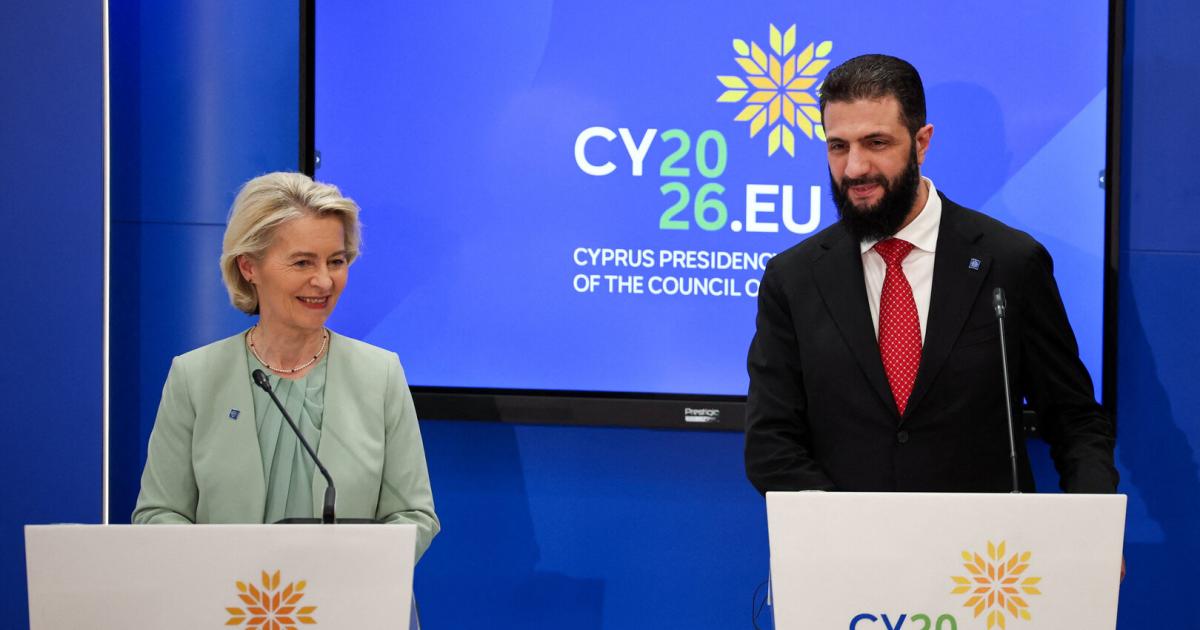
It was a remarkably confident performance by Syrian President Al-Shaara. With the EU leadership next to him and the assembled European press in front of him, he delivered once militant Islamist launched a violent verbal attack against Israel. Only when the country ends its aggression against Syria and other countries in the Middle East can there be peace, he explained: Israel must abide by valid UN resolutions.
He called on his hosts – the EU and its assembled heads of state and government – to work together: “Europe needs Syria, just as Syria needs Europe.”
The meeting with Al-Shaara, but also with Lebanese President Joseph Aoun and Egypt’s ruler Abd al-Fattah al-Sisi came at the end of the EU summit in Cyprus. No decisions were planned anyway, as it was a formal summit, but there was little other concrete information on Europe’s pressing problems, from the energy crisis triggered by the US attack on Iran to the dispute that had just opened over the next EU budget.
The EU only plays a minor role in the current efforts to end the war in the Middle East, but several EU leaders are signaling that they want to continue to be actively involved. German Chancellor Friedrich Merz made it clear that the EU could ease some of its sanctions against Iran if the regime in Tehran was willing to allow the opening of the all-important Strait of Hormuz.
Positive signals to Kyiv
The greatest success was announced right at the start of the summit in Nicosia. Ukraine will receive the EU loan of 90 billion euros, which has been overdue for months.
President Zelensky, who traveled in person, used the opportunity not only to thank the EU for its support, but also to remind the EU of his country’s future accession. The first accession chapters should now be opened as quickly as possible and negotiations should begin. However, the EU heads of state and government rejected Ukraine’s rapid accession – most recently there was even talk of 2027.
Instead, consideration is being given to integrating Ukraine more closely into the Union before it joins: participation in EU councils, representation in the EU Parliament, or collaboration in EU programs in business or research. Friedrich Merz spoke of a “bridge to a later full membership” that would certainly exist: “However, it is clear to everyone that this is not possible immediately.”