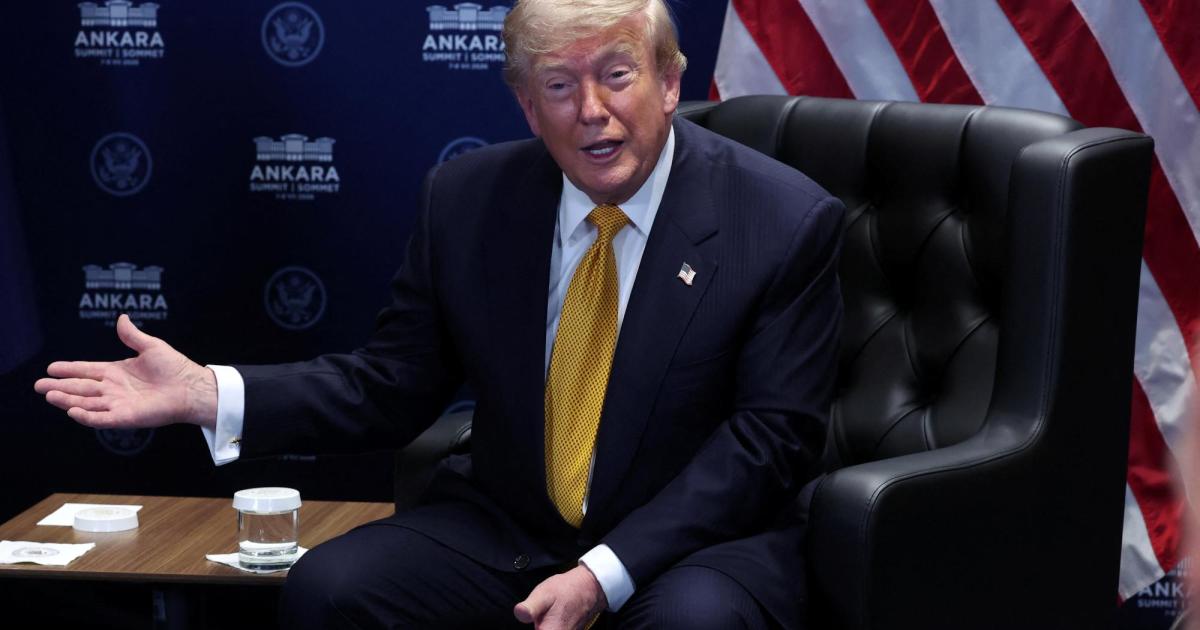
After the attacks by US forces on targets in Iran, US President Donald Trump has declared the ceasefire with the Islamic Republic to be over. “As far as I’m concerned, it’s over,” Trump said on Wednesday at the NATO summit in Ankara when asked by a journalist about the ceasefire that came into force in mid-June. “It’s a waste of time dealing with them,” Trump continued of the Iranian leadership.
Trump added: “They’re nasty guys, so they’re going after everyone, including probably me. I’ve been at the top of their list for years. And they’re a bunch of scum, to be honest with you. They’re scum.” Trump described the US attacks on Iranian targets on Wednesday night as “very violent” and added: “We hit them very hard last night, very hard.”
Further US attacks against Iran
After Iranian attacks on tankers in the Strait of Hormuz and on US bases in the Middle East, the USA again bombed targets in Iran. Iran’s Mehr news agency reported on Wednesday a series of explosions in the port city of Bushehr in the southwest of the country, where Iran’s only civilian nuclear power plant (nuclear power plant) is located. Meanwhile, Iran’s Revolutionary Guards reported the death of a member in the city of Mahshahr.
The Bushehr nuclear power plant has the country’s only operating nuclear reactor, which was first connected to the power grid in 2011, according to the International Atomic Energy Agency (IAEA). During the course of the Iran War, the nuclear power plant site was attacked several times. Bushehr is located off the oil island of Kharg, Iran’s main oil terminal, which normally handles 90 percent of the country’s crude oil.
The USA also said it attacked more than 80 targets in Iran on Wednesday night. The US Army justified the new wave of attacks with a previous shelling of three tankers in the Strait of Hormuz area, for which Washington blames the leadership in Tehran. The military hit, among other things, air defense systems, anti-ship missiles and more than 60 Revolutionary Guard boats in or near the Strait of Hormuz. This was announced by CENTCOM, the regional command of the US armed forces responsible for the Near and Middle East and Central Asia.
Iran said it attacked US bases in other countries in the region in retaliation. Air alerts were sounded in Kuwait and Bahrain. The Iranian armed forces attacked the US Sheikh Isa air base in Bahrain with drones “in retaliation for the aggression of the American enemy” and “for the violation of the agreement,” the Iranian army said in a statement carried by the state news agency IRNA. According to information from Bahrain, the air defense responded to several Iranian attacks. Iran’s “aggression” has been destroyed, said Nabil al-Ahmar, an adviser to the Gulf state’s royal court.
Explosions reported in southern Iranian cities
Iranian media reported explosions in the port city of Sirik on the Strait of Hormuz and on the island of Qeshm during the night. There were also reports of explosions in the area of the large city of Bandar Abbas. According to the Iranian broadcaster Press TV, several people were injured.
US President Donald Trump approved the plan to strike Iran while attending the ongoing NATO summit in Turkey, well-connected journalist Barak Ravid reported on X, citing a US government official. The renewed escalation took place during the ongoing funeral ceremonies for Iran’s slain head of state Ayatollah Ali Khamenei. Ceremonies are planned in neighboring Iraq on Wednesday before Khamenei is to be buried in his hometown of Mashhad on Thursday.
Sanctions on Iranian oil back in force
In addition, the USA reinstated the previously relaxed sanctions on Iranian oil. The US Treasury Department announced that an exemption granted a good two weeks ago will be revoked. New transactions with crude oil, petrochemicals and petroleum products of Iranian origin are once again prohibited. Iran will benefit from economic relief only if it meets its obligations, an official said. Iran’s behavior in the Strait of Hormuz is “completely unacceptable.”
As a result, oil prices rose again. The danger of a renewed military escalation in the region is growing. After weeks of fighting between the USA, Israel and Iran, a preliminary agreement was only reached last month that was intended to create space for intensive negotiations to end the war. These discussions are currently stalled.
Trump recently threatened Iran again and said there would either be an agreement or the US would “finish the job”. Iran’s Foreign Minister Abbas Araqchi then said negotiations on a final agreement would not begin as long as threats continued.
There has been a fragile ceasefire in the US-Israeli war against Iran since the beginning of April. In mid-June, Iran and the USA agreed on a framework agreement that provides for further negotiations to permanently end the war. The fighting that has flared up again and again has not yet led to the negotiations being broken off.
Louisiana MedCards on golocalezservices.com
Louisiana Medcards
Louisiana MedCards on VirtualMall®
Louisiana MedCards.
Maine MedCards on BizBangBoom
Listingdisplay.Aspx
53C684468858
Maine MedCards on Cargo Directory .CO
Maine Medcards
Meet Maryland MedCards | Business & Professional-Services in
Listingdisplay.Aspx
Maryland MedCards on Brownbook.net
Maryland MedCards on golocalezservices.com
64A0B4898Ff0
Massachusetts Medcards 0
Listingdisplay.Aspx
Massachusetts MedCards on TechDirectory
Massachusetts MedCards on https://massachusetts.medcards.org/
Massachusetts MedCards on Mediics Healthcare Directory
Michigan Medcards
Michigan Medcards
Michigan MedCards on BizMaker
Listingdisplay.Aspx
Michigan MedCards – Insertbiz
Minnesota MedCards on VirtualMall®