Lucas Gámez turns 9, but his party has no balloons or set tables. It only has dust, twisted irons and the noise of the bulldozers that have been trying to reach it for days among the collapsed floors of the building Miramar a La Guaira one of the areas most affected by the earthquake in Venezuela. The double earthquake of June 24th transformed that condominium into a pile of concrete; since then, the child has been officially missing, trapped under the rubble where he was with his aunt and uncle returning from a day at the seaside.
Born and raised in Argentina by Venezuelan parents, passionate about football and the youth teams of a club in Buenos Aires, he had been living in Venezuela for a few months when the earthquake tore up his daily life. His face has become, together with that of many other children, the symbol of a tragedy that has thousands of dead, missing and injured, but which needs names and biographies so as not to remain just a number.
A mother who does not leave the site of the tragedy
Next to the Miramar palace, since June 24th, there is a figure that never moves: it is Blancalida Martínez CoronadoLucas’ mother. During the day she follows every movement of the rescue teams, at night she remains nearby, as if her presence were an invisible thread that connects her to her son under the collapsed floors. For her, the building is not just a technical workplace, but a wounded body that could still hold life.
In this suspended time, Blancalida has learned the language of civil protection, of geolocators, of probe cameras. He knows how to distinguish the moments in which the bulldozers must stop so as not to further destabilize the structure and is clear which sectors of the building correspond to his son’s last known coordinates. Every detail, a number, a measurement, a trace, is a fragment of possibility that he tries to hold together.
Searches among the rubble
Lucas’ research is described as a race against time for those who have faith, but also as a surgery on the ruins. Rescuers used georadarheat detectors, cameras stuck between cracks in the concrete and sophisticated acoustic equipment capable of picking up imperceptible sounds and even heartbeats. One of the emotional turning points for the family was the geolocation of the child’s cell phone, turned off but still traceable. The experts managed to define the height and the approximate area under the collapsed floors, guiding the work of the rescuers.
In this technical scenario, the mother is not just a spectator, but is part of the operation. She was asked to participate in a “sound test”, approaching the rubble and calling out to her son while acoustic sensors recorded every vibration and every possible response from inside. Blancalida said she lives waiting for the results. Every noise, every settling perceived under the building can become, for a few moments, the signal that someone is still struggling down there.
The hope of the family
In repeating her story to journalists, Blancalida oscillates between absolute faith and extreme lucidity. He knows that time is against the survival of a child trapped without water or food, but he continues to speak of a miracle in terms that are not just spiritual. He asks for more resources, more volunteers, more experts and, at the same time, insists on the fact that his son could resist thanks to his small build, capable of “fitting” into minimal spaces between one beam and another.
The woman transformed every episode into a piece of hope. She told of the little turtle found alive under the ruins, a detail that for her proves that “there is still life, there is air there”. He recalled the rescue of another child, pulled out of the rubble days later, as a precedent that fuels the possibility that Lucas will also make it. His personal narrative mixes technical data and emotional images, because he needs both dimensions to withstand daily anguish.
In Venezuela, a rescuer tries to open another route to reach little Lucas, who turns nine today and is trapped under the rubble.
His parents do not give up hope of getting him out alive.
️@oscarmijallo pic.twitter.com/UsZjqu5J35
— TVE News (@telediario_tve) July 6, 2026
A birthday in the rubble
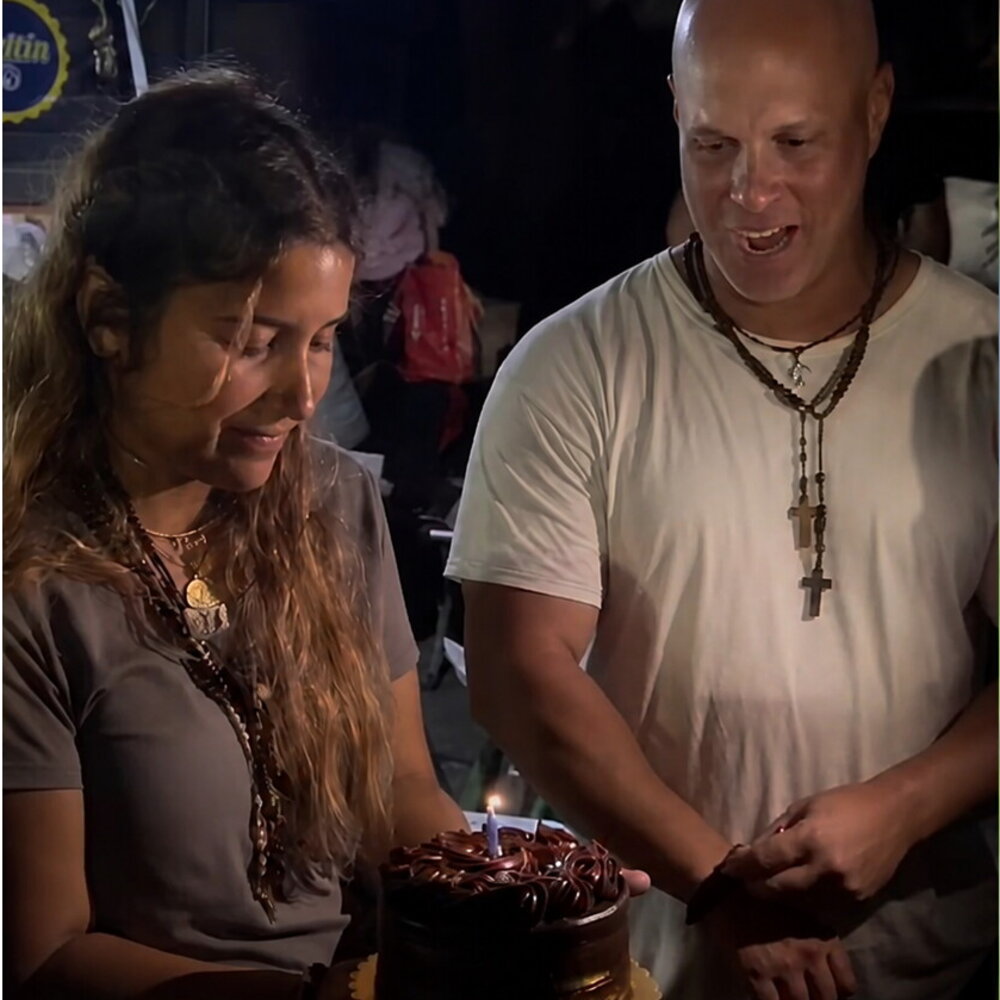
On his ninth birthday, the scene that made the rounds on social media and the media was that of a small cake brought next to the rubble. Placed near the search area, at the point where the mother imagines her son trapped, the cake becomes the center of a party that can’t really start because there are no children running, there are no songs, only helmets, jackets, dust and tools. The gesture, simple and almost discreet, breaks the logic of the place: an emergency space transformed for a few hours into a corner of the house, so that Lucas remains a child and not just a “missing person”.
It is a very strong image that tells without words the distance between childhood and catastrophe, between the reassuring ritual of the birthday and the brutality of a ghost building.
Mobilization on social media
On social media, Blancalida dedicated a message to Lucas that many media outlets picked up. He defines him as “a light that taught us that hope can remain alive even in the darkness” and writes that “the best gift of your 9 years is to return home alive”.
An important digital mobilization has arisen around the Gámez family. Sports clubs, journalists, influencers, emigrant communities and ordinary users relaunch appeals, hashtags and prayer chains. The posts about Lucas are intertwined with those that denounce the fragility of the Venezuelan structures, the lack of resources, the fatigue of the rescuers.
“Dad, I want to be a saint”: the moving story of Lucas Gámez’s father as he continues his search
The father of Lucas Gámez, the nine-year-old boy who remains missing after the collapse of a building in La Guaira during the earthquakes of June 24, shared… pic.twitter.com/e6FjDUFxrg
— NotiExpresColor (@NotiExpressColo) July 8, 2026
The symbol of a tragedy
The story of Lucas and his mother has taken on a strong symbolic value. In a context in which the earthquake is told above all with numbers, dead, missing, injured, collapsed buildings, the story of this child and this woman gives the disaster a concrete human dimension, with names, habits, interrupted dreams, birthdays celebrated in a way that no one would have imagined.
For those who read or watch from afar, Blancalida is the mother who, remaining next to the ruins, refuses to accept the word “end”. And Lucas is the child who, at 9 years old, involuntarily finds himself at the center of a story that speaks of responsibility, of fragile infrastructures, of crisis, but above all of how much a mother’s love can continue to keep hope open even under the rubble.
The Rising Interest in Peptides in Bali’s Wellness Scene
Discovering the Rising Popularity of Bali Peptides
Evernote
The Rising Popularity of Peptides in Bali’s Wellness Scene
Note : Unlocking the Potential of Bali Peptides in Modern Wellness
Unlocking the Potential of Bali Peptides in Modern Wellness
Peptides Bali A Rising Trend In Health And Wellness
Exploring the Rising Popularity of Bali Peptides – healthblogpro
Unlocking the Potential of Peptides in Bali – HackMD
Penzu
Bali Peptides: Revolutionizing Wellness and Longevity
Unlocking the Potential of Peptides in Bali’s Health Scene
MarlieiHenson
Bali Peptides: Unlocking the Future of Wellness and Recovery
The Rising Popularity of Peptides in Bali — healthNow
Exploring the Growing Trend of Peptides in Bali’s Wellness Scene — healthNews
The Rising Interest in Bali Peptides: A New Frontier in Wellness
Exploring The Growing Trend Of Peptides In Bali 396578Cac915803C8Ca5D7F76A31422E
The Rising Popularity of Peptides in Bali’s Wellness Scene
The Rising Popularity of Bali Peptides in Wellness Circles
Exploring The Rise Of Peptides In Bali S Wellness Scene
Exploring the Rising Trend of Peptides in Bali
Emerging Wellness Trends: Peptides in Bali's Health Scene
Post by @heart-barks · 2 images
Exploring the Rise of Peptides in Bali’s Wellness Scene