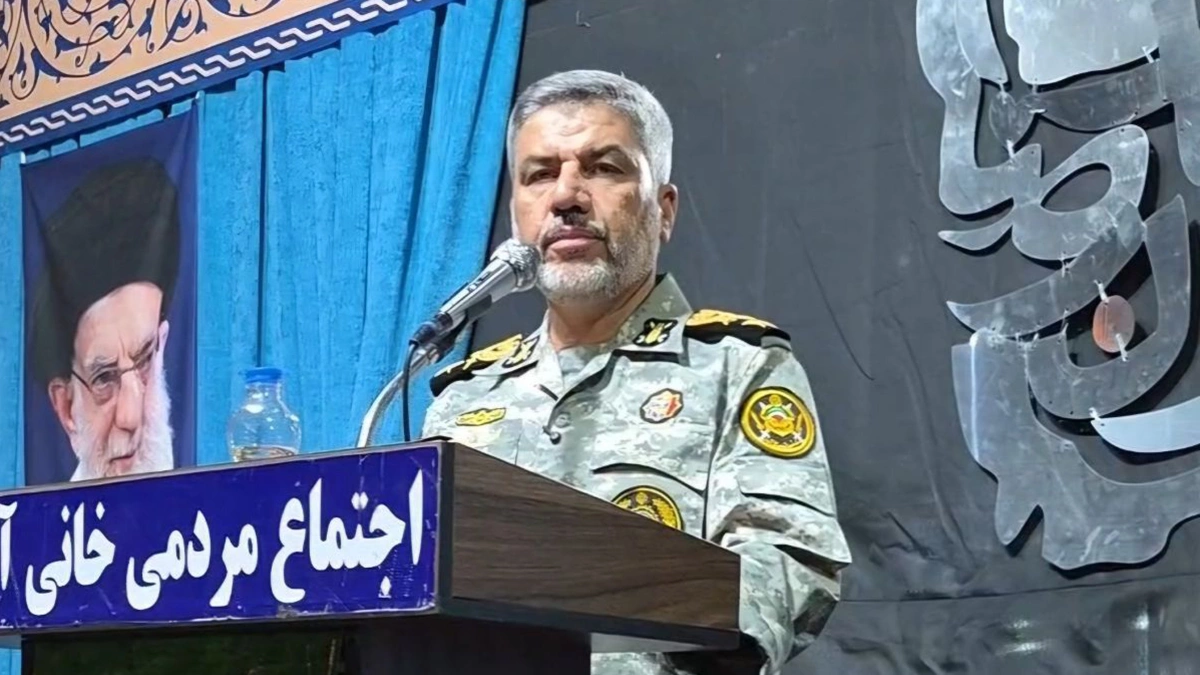
Iran says the Strait of Hormuz will never open thanks to America’s “hostile actions”, Tehran will protect its rights here until its “last breath”.
Brigadier General Mohammad Akraminia, Iranian military spokesman, on July 14 accused the US of violating the memorandum of understanding signed with this country by establishing a new maritime route in the Strait of Hormuz despite “accepting” Tehran’s arrangement for travel activities here.
“The Strait of Hormuz will never open through war, aggressive moves or hostile actions by the US,” he said. “The only way to reopen the Strait is to respect the rights of the Iranian nation and the United States to fully comply with the terms of the memorandum on ending hostilities.”
General Akraminia reaffirmed that the Iranian armed forces will continue to protect the country’s rights in the Strait of Hormuz until the “last breath”, not backing down even a bit. He added that the country’s forces have an obligation to avenge those who died, especially the late Supreme Leader Ali Khamenei.
Brigadier General Mohammad Akraminia spoke in Tehran, Iran on July 14. Image: IRNA
Mr. Khamenei and many Iranian officials and military commanders were killed when the US and Israel launched an airstrike campaign against the Muslim country in late February.
Meanwhile, Iranian national television (IRIB) said there were five explosions in the western area of Bandar Abbas, an important port city located on the country’s southern coast. The city has been targeted before, most recently on July 13 when a projectile hit the western area of the city, according to local officials.
Iran’s semi-official news agency Fars also recorded explosions in the cities of Bushehr and Choghadak in Bushehr province. Ehsan Jahaniyan, deputy governor in charge of security and politics in the province, said four locations in Bushehr city were hit by “enemy bullets” around noon today.
According to local officials, the US also attacked the Iranian cities of Abadan and Mahshahr in the early afternoon of July 14.
The US has not claimed responsibility for the above raids.
The situation in the region was quiet for about three weeks after the US and Iran signed a memorandum of understanding in mid-June. However, tensions increased when the US coordinated with Oman and the International Maritime Organization (IMO) to establish a new route south of the Strait of Hormuz, completely within Oman’s territorial waters, encouraging commercial ships to choose this option instead of using the northern route through Iran’s territorial waters.
Iran’s Islamic Revolutionary Guard Corps (IRGC) accused the US of “imposing its will” on the Omani government by trying to send many ships through the Strait of Hormuz along an “illegal maritime route” in the south of the region. Cargo ships passing through this strait have been attacked, leading to tit-for-tat attacks between Iran and the US.
Cruise routes pass through the Strait of Hormuz. Graphics: Guardian
Hormuz is an inverted V-shaped strait between Iran and Oman. Gulf countries, including US allies, rely significantly on this route for oil exports. Before the conflict, this was where about 20% of the world’s oil and gas supplies were transported.
Iran has repeatedly warned that it could close the Strait of Hormuz in response to pressure from the West. The country turned the above threat into reality when it was attacked by the US and Israel in February.
This development caused the global energy market to fluctuate, creating pressure for the parties to cease fire and move towards a peace agreement. Therefore, for Iran, the Strait of Hormuz is considered a strategic tool, directly linked to national security, that Tehran is not allowed to lose, whether at the negotiating table or in conflict.
Experiencia de juego en plataformas digitales | Cal.com
EmilyMcMahon
John McKnight | Concept2 Logbook
Golisimo casino i jednostavno igranje | Cal.com
https://pinterest.com/8bhi2/_profile/
https://www.scener.com/@matthewbeck
Enjoying Great Casino Fun in Canada — Steemit
Awwwards
Variedad de juegos y entretenimiento continuo — Steemit
YolandaDuran's Profile | Royal Road
Robin Howard | Concept2 Logbook
Bonos y promociones en casinos online – AlexStone
https://www.scener.com/@graceburman
Finding Reliable Online Entertainment – AlexStone
Magical Casino Vibes for Canadian Players — Steemit
Seguridad y confianza en el juego online
Awwwards
Juego móvil y acceso desde cualquier lugar – AlexStone
JosephBurnett's Profile | Royal Road
Top Quality Gaming and Betting Options – AlexStone
Lists (1) | Open Library
Brenda J Silver (derron1563) – Profile | Pinterest
Sports and Casino Fun Combined
Rabona casino i moderna digitalna zabava – AlexStone
Evolución del entretenimiento digital — Steemit