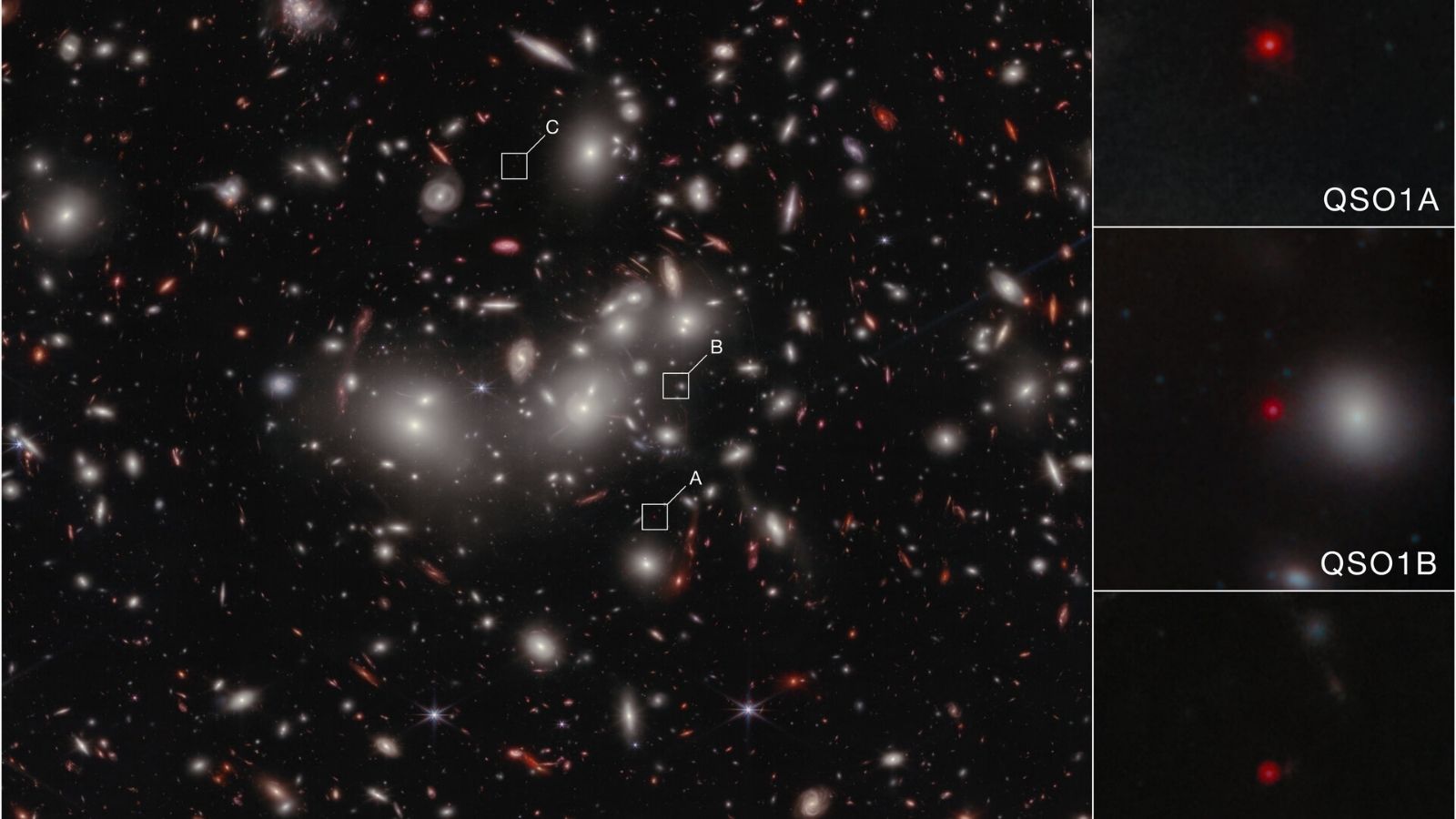
The James Webb Telescope has detected a dormant black hole in the galaxy MRG-M0138, more than 10 billion light-years from Earth. The discovery, revealed today (20), uses the phenomenon of gravitational lensing to observe an invisible object with a mass 6 billion times that of the Sun.
What defines a black hole as dormant?
Typically, black holes are found when they are ‘eating’ gas and dust, a process that generates a lot of light and energy. A dormant black hole is one that has stopped actively consuming matter. As it does not currently attract new materials, it does not emit a glow, making it practically invisible to common telescopes.
How was it possible to see something that doesn’t emit light?
Astronomers used a natural ‘cosmic magnifying glass’ called a gravitational lens. It works like this: a galaxy halfway between Earth and the black hole used its gravity to deflect and magnify the light back there by 30 times. As a result, scientists did not see the black hole itself, but observed how its strength affected the movement of the stars around it.
How big is this cosmic giant?
This black hole is colossal, with a mass estimated at 6 billion times that of our Sun. What impresses scientists most is the fact that such a heavy object already existed when the Universe was still very young, in the first billion years after the Big Bang, which challenges some current understandings about the time needed for these structures to grow.
Why is this discovery important for astronomy?
It functions like a cosmic fossil. By studying this object, we better understand how galaxies age. It is believed that, in the past, this nucleus was so active that it expelled all the gas from the galaxy, ‘retiring’ the creation of new stars. Finding it helps reconstruct the history of the early Universe and how the first large structures came into being.
What can we expect from upcoming space research?
The detection proves that James Webb can find ‘silent’ and hidden objects, not just bright ones. In the future, missions with the Euclid and Nancy Grace Roman telescopes should hunt for more of these magnified galaxies. This will allow you to create a much more complete map of the evolution of black holes and galaxies over billions of years.