The Pentagon’s separation of casualty data in the Iranian war into two periods before and after the ceasefire caused the White House to face a wave of criticism for lack of transparency.
The Pentagon drew attention last week after the US media noticed that the number of soldiers killed in the Terror Rage campaign against Iran on the Defense Casualty Analysis System (DCAS) decreased from 18 to 14. These are all deaths from the outbreak of the conflict in late February to the time the two sides reached a ceasefire in April.
The four cases that are no longer in the statistics all died after the ceasefire collapsed on July 8, leading to a series of reciprocal raids between the US and Iran. Among them were three soldiers who died on July 18, when an Iranian missile hit the Muwaffaq Salti air base in Jordan, and a soldier who died two days later while detonating an Iranian drone in Iraq.
Acting Pentagon press secretary Joel Valdez said on July 23 that this data fluctuation was due to a “temporary data interruption” and units of the Department of Defense “are coordinating to fix it.”
On July 26, DCAS added the names of the remaining 4 dead soldiers into the system, but they were classified as “overseas campaigns” with the caption “casualties in overseas operations from July 7, 2026”. The update also added more than 140 previously undisclosed military injuries.
Developments show that Mr. Valdez’s explanation does not fully reflect the incident. The move has sparked debate about statistical transparency as well as the political and legal implications of how the data is released, according to Aaron Blake, an analyst at CNN.
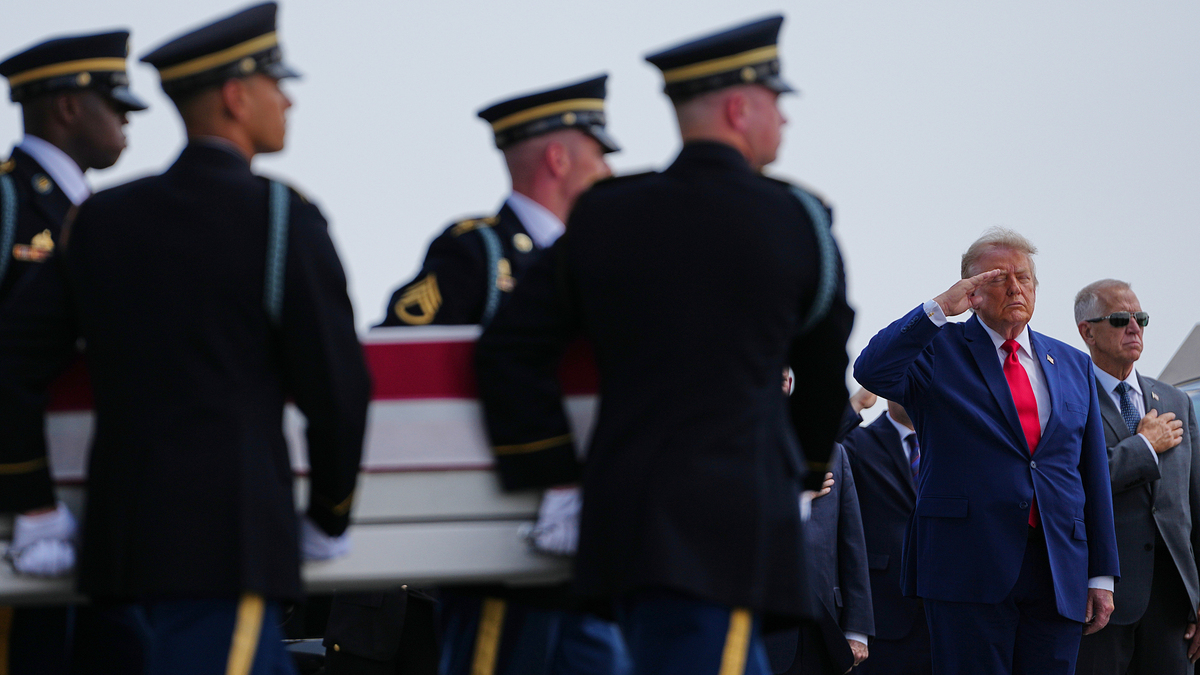
US President Donald Trump (red tie) raises his hand in salute as soldiers remove the body of soldier Isabella Gonzales from the plane at Dover Air Force Base, Delaware on July 22. Image: AP
The Pentagon’s adjustment to the way it publishes data quickly faced backlash from US lawmakers. A group of 12 Democratic senators sent a letter to Defense Secretary Pete Hegseth, requesting a full accounting of the number of soldiers killed and injured in the Iran war.
Senators said that delayed or inconsistent release of data not only hinders parliament from carrying out its oversight function, but also makes it difficult for the public to fully assess the damage in the war.
“The American people, Congress, service members and their families have the right to access a complete and accurate casualty count. Released information shows that the Department of Defense has not maintained timely and comprehensive casualty reporting throughout the conflict,” the letter stated.
Not only parliamentarians, many veterans also criticized the Pentagon’s new statistical method. Retired Rear Admiral Michael E. Smith said that separating such data is “bringing the dead soldiers into political calculations”, calling this a very disrespectful act to the dead. Former Republican congressman Adam Kinzinger, who served in the military, said this was a “shameful” act.
According to David Lapan, former Pentagon spokesman under presidents George W. Bush and Barack Obama, casualty figures are one of the few signs that help the public monitor war developments when the Department of Defense does not regularly release information about military activities.
“If soldiers are injured in combat, that is information the public needs to know to assess how the war is going,” Mr. Lapan told Task & Purpose.
Meanwhile, the Pentagon denied accusations of concealing information. Mr. Valdez affirmed that the Ministry of Defense is “committed to ensuring the highest accuracy for all casualty reports”, and said that the media has misunderstood the data updating process.
Spokesman Sean Parnell described the accusation of deliberately understating casualty figures as “one of the examples of how fake information spreads confusion among the American people”.
The adjustment to the classification also attracted attention because it took place in the context of the White House defending its legal arguments about the war with Iran.
According to President Trump’s administration, the initial conflict ended when the US and Iran reached a ceasefire in April to resume negotiations. In mid-June, the two sides signed a joint memorandum of understanding, continuing diplomatic efforts towards a lasting peace agreement.
However, on July 8, President Trump declared that the ceasefire was “over” and the US military then attacked Iran for several consecutive days. Tehran responded by attacking Washington’s bases in the Gulf. On July 10, Mr. Trump informed Congress that the US had resumed hostilities with Iran, meaning this was a new conflict.
This argument is important to the White House, because the War Powers Act of 1973 stipulates that the president can only conduct military operations for 60 days without congressional authorization.
Republican Congressman Thomas Massie, who has repeatedly criticized the Iranian campaign, said that this explanation does not reflect reality.
“The Pentagon is assuming there are two wars with Iran, separated by a brief ceasefire. The reality is that the fighting has lasted more than 90 days without congressional approval, the Secretary of Defense is violating the law and must be held responsible,” Mr. Massie wrote on X.
The Pentagon in Washington, DC, USA in March 2022. Image: AFP
According to data from the Pentagon, the war with Iran has so far left 18 US soldiers dead and 624 injured. The agency said many injured soldiers have now returned to duty.
According to the Association of American Veterans who fought in Iraq and Afghanistan (IAVA), moving recent casualties to a new category in DCAS is not only an issue of information transparency, but also affects the regimes and benefits for veterans and relatives of those who died.
“Changing the classification at the back of the system will have knock-on effects at many levels,” veteran Jess Finucan, an IAVA spokesperson, told Washington Post.
According to Ms. Finucan, military records are recorded based on data about the campaigns they have participated in managed by the Ministry of National Defense. This record affects many benefits, including consideration of awards, medical care and benefits for relatives of soldiers who died in battle.
“The government needs to take full responsibility and accountability for the full cost of the war,” Ms. Finucan said.