Chinese state television station CCTV announced on April 17 that the Shenzhou 21 crew stayed at Thien Cung station for one more month than planned.
The Shenzhou 21 crew includes payload expert Zhang Hongzhang, Wu Fei – the youngest Chinese astronaut to fly into space, only 32 years old at the time of launch, and commander Zhang Lu, who flew to Tiangong station more than 5 months ago.
Theo CCTVthree astronauts worked closely with researchers, using robotic arms on the station and completing many tasks such as installing protective equipment against space debris, testing equipment and space infrastructure. This trio still maintains good living and working conditions.
They were scheduled to return to Earth in the next few weeks, after completing their half-year shift, but the shift will now last another month. The decision was made after careful consideration by the China Manned Space Agency.
CCTV The return date was not specified, but said the crew stayed to further verify technologies related to long-term stays in orbit. In addition, throughout the flight, the crew will also continue to conduct scientific experiments.
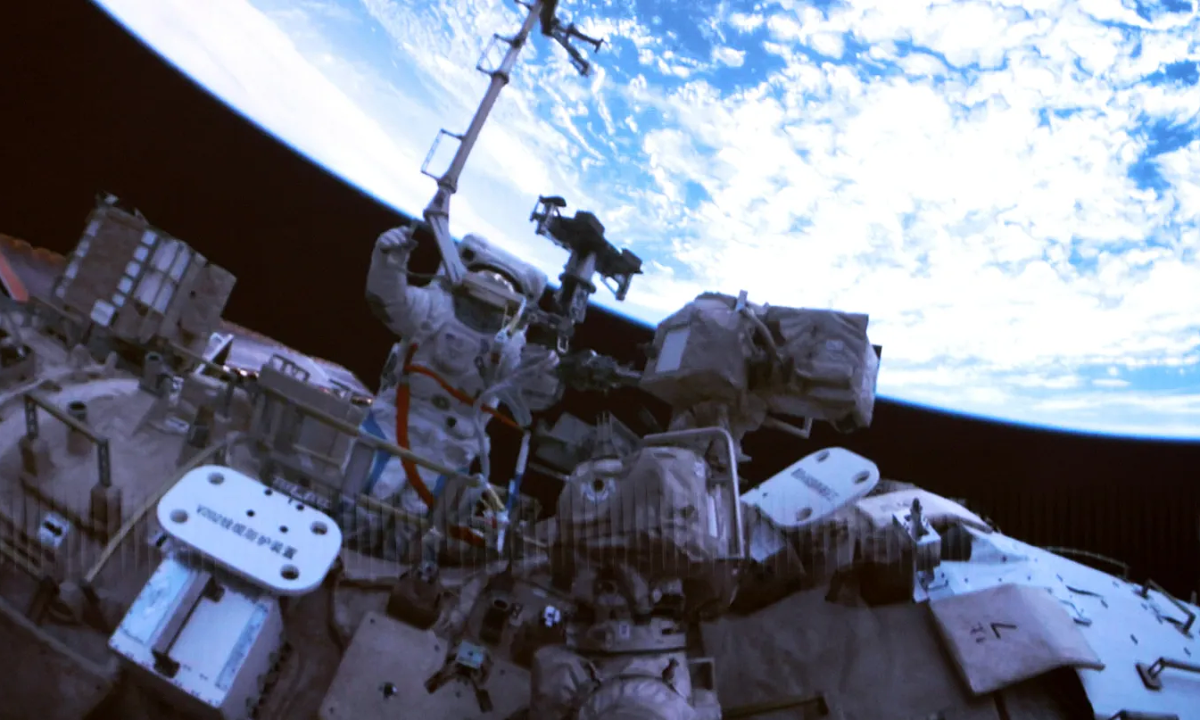
Astronaut Wu Fei works outside the Tiangong station’s Wentian module during the third spacewalk of the Shenzhou 21 mission, taking place on April 16-17, 2026. Image: China in Space
The Shenzhou 21 spacecraft carrying a crew flew to the Tiangong space station on a Long March 2F rocket from the Jiuquan Satellite Launch Center, northwest China, October 31, 2025. These types of missions usually involve three astronauts living and working on the station for a period of 6 months.
A special thing is that the Shenzhou 21 crew will not return by the ship that took them to Thien Cung station 6 months ago. Their ship brought the Shenzhou 20 crew, who worked on the station from April to November 2025, back to Earth last year to replace the Shenzhou 20 spacecraft that was damaged by a collision with space debris.
Zhang Hongzhang, Wu Fei and Zhang Lu then continued to work normally in orbit, but were in a precarious situation because there was no return ship if an emergency occurred. At the end of November last year, the unmanned Shenzhou 22 spacecraft launched and successfully paired with the Thien Cung station, helping to resolve this concern. The launch marked a number of important milestones such as: the 610th flight of the Long March booster family, the 38th mission of China’s manned space program and the first demonstration of the emergency launch capability to rescue astronauts in orbit.
https://ggbet-kz.it.com/ru-kz/
https://ggbet-kz.it.com/
https://ggbets.hu.net/
https://ggbets.hu.net/hu1/
https://rizk-pl.it.com/pl1/
https://rizk-pl.it.com/
https://opinieobukmacherach.pl/
https://ggbet-casino-polska.co.pl/pl1