Although the ceasefire was extended, Mr. Trump and Iranian leaders both refused to give in to each other’s demands, causing negotiations to fall into deadlock.
Air Force Two on April 21 waited almost all day at Andrews Base on the outskirts of Washington, ready to take Vice President JD Vance to Islamabad, Pakistan to negotiate a potential agreement with Iran, when the two-week ceasefire between the two countries is about to expire.
Pakistan, the negotiating party, said Iran’s top leaders had previously announced that their negotiating delegation would also go to Islamabad on April 21 to participate in discussions with the US side a day later. However, Iran reversed the decision in the final hours.
By early afternoon, Mr. Vance’s trip was suspended. By evening, it was postponed indefinitely.
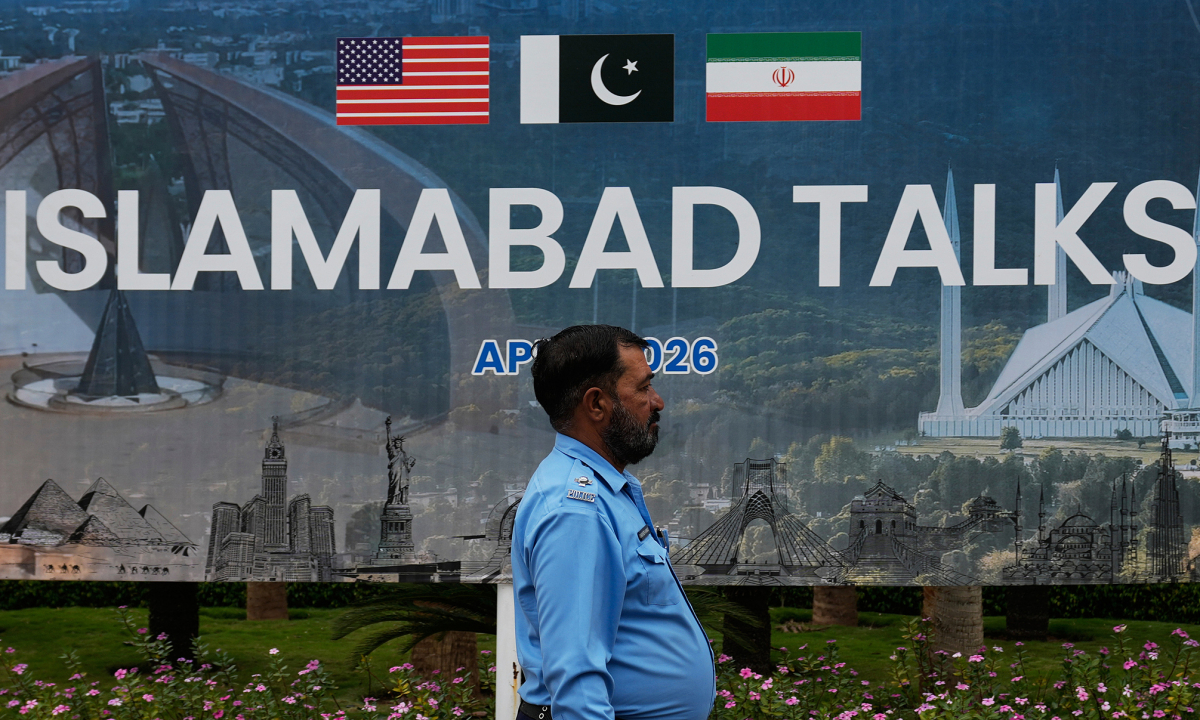
A policeman walks past a sign announcing negotiations between the US and Iran in Islamabad, Pakistan on April 11. Image: AP
Aides told President Donald Trump that the Iranian government is not a “unified entity” and that hard-liners in Tehran are unwilling to give in to Washington’s demands. At the White House, many questions have been raised about whether Iran is truly willing to negotiate and comply with any of its commitments.
President Trump asked aides whether the US should resume attacks on Iran. But even then, officials said, Mr. Trump seemed cautious about restarting the campaign and prolonging the conflict, which is so popular with the American public.
Mr. Trump and his team chose a compromise solution, which is to maintain pressure on Iran indefinitely until they make a specific proposal to the United States. He will then assess whether negotiations can continue or whether he will have to order a new attack on Iran.
“The deadlock, in which Mr. Trump does not want to lift the blockade, and the Iranian side refuses to sit at the negotiating table as long as the blockade remains in place, is a very difficult problem to solve,” said Ali Vaez, head of the Iran program at the International Crisis Group.
Vaez added that this requires one side to give in first or both sides to back down. “I don’t feel optimistic about this scenario,” he said.
Tehran entered the first round of negotiations in early April with confidence that control of the Strait of Hormuz and its ability to cause damage to the Gulf and global economy gave it great leverage at the bargaining table. However, the blockade of all Iranian seaports that the US imposed soon after reduced Iran’s advantage.
“I think that move has balanced the balance of pressure between the US and Iran,” Michael Singh, former senior director for Middle East affairs at the National Security Council and now working at the Washington Institute, said about the seaport blockade that the US imposed on Iran.
Samer Al-Atrush, Middle East analyst for The Timescommented that the risk of fighting re-erupting still exists when both Mr. Trump and Iran threaten to escalate if negotiations fail. The analyst said other possible scenarios between the two sides include a vague framework agreement for the future or maintaining a stalemate, in which Iran continues to be blockaded until one side can no longer bear it economically.
US Vice President JD Vance arrives at a press conference after meeting the Iranian delegation in Islamabad, Pakistan on April 12. Image: AP
Even if the two sides agree on a framework to guide negotiations over the next two months, it will be a vague document full of unresolved issues, according to Vaez.
“That approach will leave many of the thorniest issues open. It only points out a direction, but cannot finalize any specific solution. The two sides are still very far apart from being able to reach a final agreement,” Vaez said.
The barriers remain the same as before the war. Iran is not willing to give up nuclear enrichment, although it could agree to a multi-year moratorium, except for medical research purposes. Tehran will also refuse requests to reduce its missile and drone capabilities, which have been effective during the war, and will not give up support for armed groups such as Hezbollah and Hamas.
“Any potential agreement is expected to be similar in scale to the JCPOA agreement that Iran signed with Western powers under President Barack Obama and that Mr. Trump abandoned in his first term,” Al-Atrush said.
Meanwhile, Danny Citrinowicz, a former Israeli intelligence officer, said that the scenario of the US continuing to blockade Iranian seaports also poses a potential risk of escalation, even if the ceasefire is extended.
Iran’s Islamic Revolutionary Guard Corps (IRGC) today announced that it has detained two commercial ships passing through the Strait of Hormuz. This force’s speedboats also opened fire on three cargo ships near the strait, causing damage to the vehicles.
“The problem is that tension is almost inevitable. Sooner or later there will be friction and those things can easily escalate the situation,” he said. “If the blockade is effective, the Iranian side will increase pressure on the international economy by actions such as attacking oil ships, then an outbreak of war will be unavoidable.”
If that scenario occurs, the war could cause heavy losses for both sides. After more than 6 weeks of air strikes, the US and Israel no longer have many military targets to attack and will likely target electricity infrastructure and seawater desalination plants, as Mr. Trump once threatened.
“The escalating actions will progress very quickly, dramatically and will continue right from where they stopped before,” Mr. Citrinowicz said.
A woman holds an Iranian flag on the street in Tehran on March 30. Image: AP
Currently, the prospects for negotiations between the two sides are quite fragile. Mohammad Reza Mohseni Sani, a member of the National Security Committee of the Iranian Parliament, said that “negotiation is unacceptable” in the current situation, and accused the US of “making excessive demands” and pursuing hidden goals for internal interests.
Ali Vaez said the main hurdle before any next round of negotiations is “whether the US is willing to ease pressure enough to make diplomacy credible and whether Iran is willing to restrain its leverage enough to keep the negotiations alive”.
https://www.searchdirect.ca/games/techpally-com-media
https://www.nethalal.com/david-forrest/serving-the-halal-industry
https://upkeeprestoration.podbean.com/e/water-damage-restoration-layton-ut/
https://upkeeprestoration.podbean.com/e/247-emergency-water-damage-restoration-service-upkeep-water-damage-restoration/
https://upkeeprestoration.podbean.com/e/mold-remediation-in-layton-ut/
https://upkeeprestoration.podbean.com/e/basement-flood-cleanup-services-layton-upkeep-water-damage-restoration/
https://listen.hubhopper.com/episode/fire-damage-restoration-services-in-layton-ut/32994122
https://listen.hubhopper.com/episode/24-7-emergency-water-damage-services-in-layton-ut/32994123
https://listen.hubhopper.com/episode/mold-remediation-in-layton-ut/32994124
https://listen.hubhopper.com/episode/water-damage-restoration-services-in-layton-ut/32994125
https://www.facebook.com/reel/1472876891148718
https://www.facebook.com/reel/1320243129917133
https://www.facebook.com/reel/1570466880683235
https://www.facebook.com/reel/1483118686649519
https://www.facebook.com/reel/3189721604563669
https://www.facebook.com/reel/1227925969098120
https://www.facebook.com/reel/1417889899656340
https://www.facebook.com/reel/26261560156861680
https://www.facebook.com/reel/812733797996328
https://www.facebook.com/reel/1426838799194388
https://www.facebook.com/reel/1930535144246882
https://x.com/BryanJohnson81/status/2039037179796529586
https://x.com/BryanJohnson81/status/2039037440627790223
https://x.com/BryanJohnson81/status/2039037686430765108
https://x.com/BryanJohnson81/status/2039037895235776829