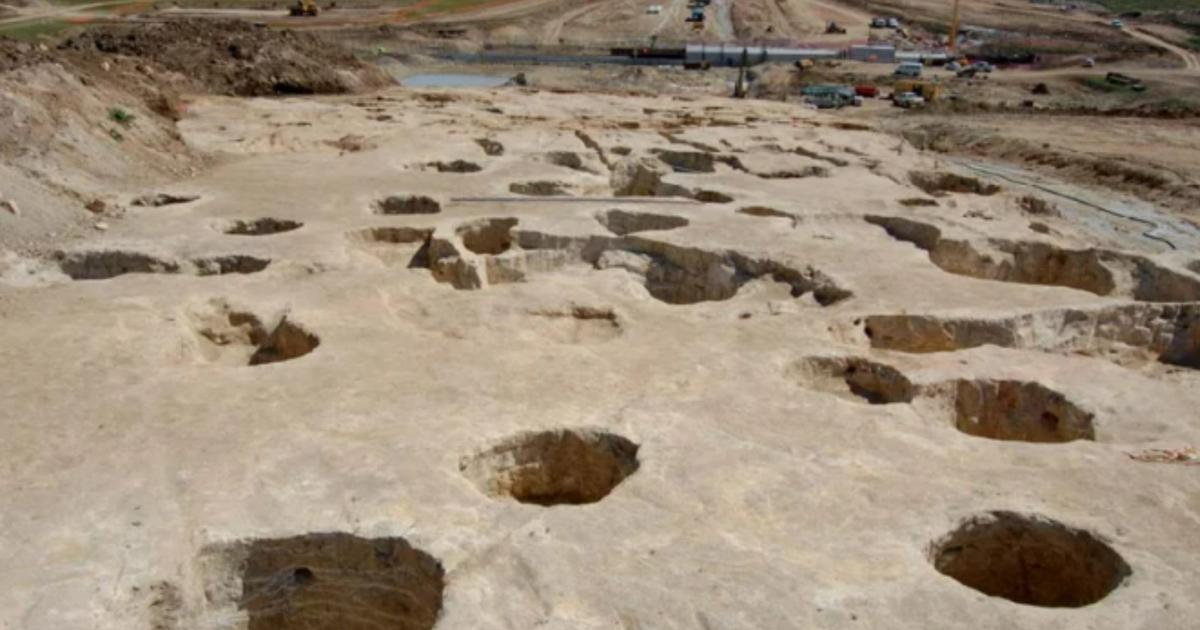
In hypogeums nearly 4,000 years old, Portuguese archaeologists have discovered skeletons of women who were buried with as many daggers and defensive weapons as the men.
Until now, tools or weapons were mainly associated with men in historical accounts of antiquity. However, a study published in the journal Quaternary, focusing on 4000-year-old burials from the archaeological site of Torre Velha 3 in southern Portugal, qualifies this reading: weapons are present in comparable proportions among women and men. This observation would put the idea of a male monopoly on warrior status into perspective: “Like men, women were also associated with the art of war. Which could suggest a more balanced social status between the two sexes”summarizes the report published in the journal Quaternary.
This study is based on the analysis of 57 hypogeums, underground burials, dating from 1850 to 1500 BCE. Of the 95 remains exhumed, 34% were identified as women (28 exactly), compared to 21% as men (19 remains). In 45% of cases, the sex could not be determined. This work led by Marta Borges, Hugo Aluai Sampaio and Ana MS Bettencourt, researchers from the University of Minho in Portugal, highlights a constant going against the grain: the female burials are among the richest in this Bronze Age necropolis.
Also read
At the top of Puy-de-Dôme, the remains of a large Roman sanctuary come back to life
Skip the ad
Indeed, the female hypogeums are distinguished by a significantly greater presence of production objects: metal tools (awls or allenes for leather or metal) and ceramic offerings. The figures are clear: 17 out of 28 women were buried with tools, compared to only 2 out of 19 men.
These elements suggest that women occupied a central place in artisanal activities, notably leather or metal work, and had a social status recognized through these productions. Their role was therefore not limited to the domestic sphere, but was part of essential, even specialized, economic functions.
The presence of combat weapons in female tombs also raises questions. Daggers mainly in bronze, sometimes decorated with silver, as well as “defensive elements” were found in both groups: 5 women out of 28 and 4 men out of 19 were equipped with them. “Although weapons did not show significant gender differences at the sample level, […] their presence suggests specific forms of social recognition”specifies the study.
Also read
A Mediterranean wreck reveals the secrets of ancient ship construction
« A more nuanced understanding »
The simultaneous presence of weapons and tools reinforces the idea of shared roles in the organization of the city or tribe. The distinctions between productive, social and warlike functions were undoubtedly less rigid than imagined. “Taken together, these results contribute to a more nuanced understanding of Middle Bronze Age societies in southwestern Iberia.”underline the Portuguese researchers.
One question remains: to which society did these multitasking women belong? The individuals from Torre Velha 3 do not belong to an identified civilization in the classical sense of the term, but rather to local communities from the Middle Bronze Age in the southwest of the Iberian Peninsula, according to a study by the University of Lisbon. Recent genetic work from the United States National Center for Biotechnology and Information shows that these populations came from an ancient mixture between farmers from Anatolia in the Neolithic and local European groups, with later contributions linked to Bronze Age migrations.
Skip the ad
In this context, the early appearance of bronze in the region, still rare and often associated with prestigious objects, suggests long-distance exchanges and already structured societies, where social statuses, including that of women, could have been more complex than previously envisaged.