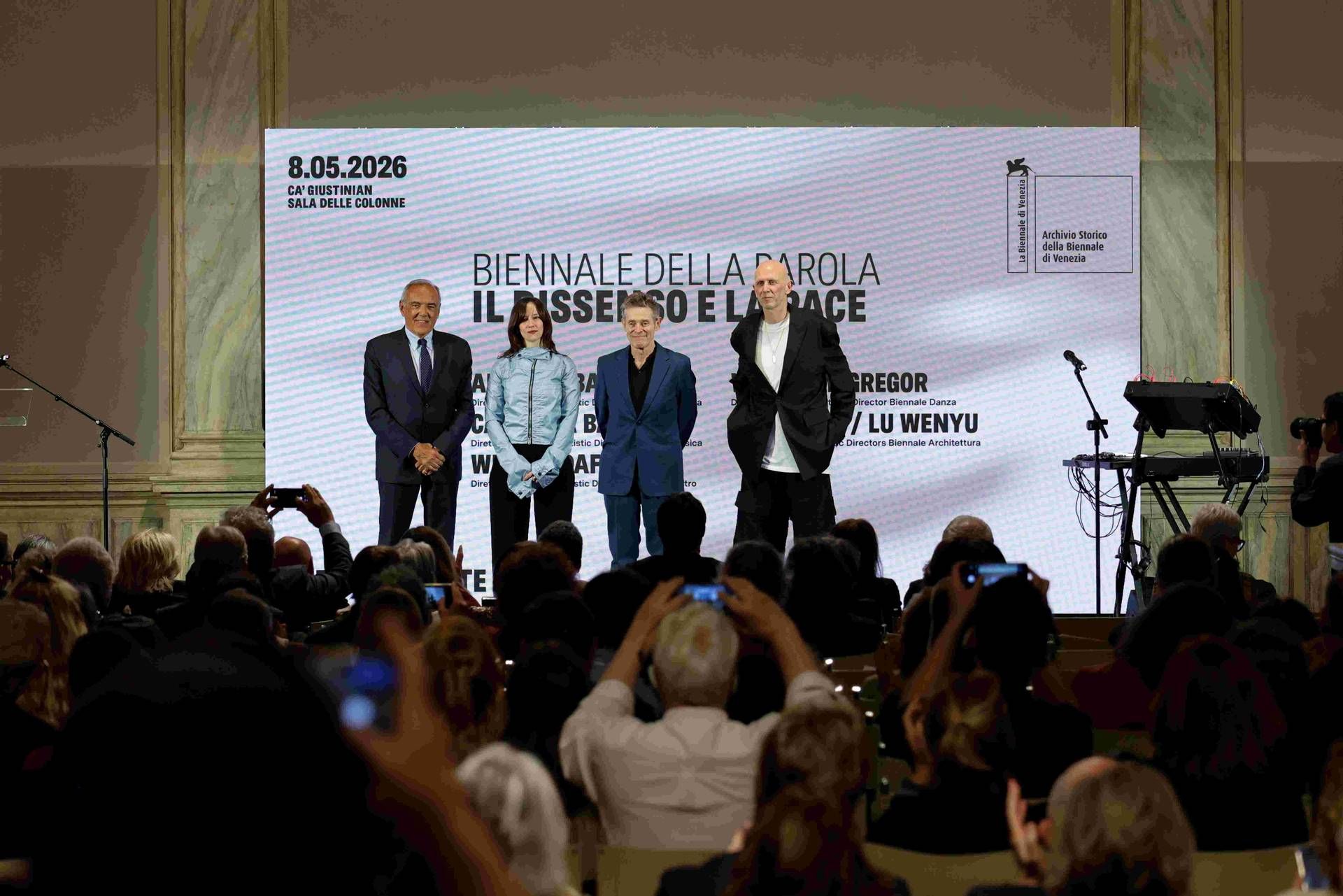
“The 2026 Art Biennale will also go down in history like the 1968 Biennale and the 1977 Biennale of Dissent by Carlo Ripa di Meana”. With this reference to the more political history of the Venice Biennale, Alberto Barbera, director of the Venice Film Festival, opened the event of the Biennale della Parola, desired by president Pietrangelo Buttafuoco, dedicated to the theme “Dissent and peace”, staged in the Sala delle Colonne of Ca’ Giustinian on the Grand Canal, headquarters of the Foundation.
A choral meeting that brought together the artistic directors of the different sectors of the Biennale in a collective reflection on the relationship between art, war, responsibility and coexistence. Alongside Barbera, the protagonists were Caterina Barbieri for Music, Willem Dafoe for Theatre, Wayne McGregor for Dance and the architects Wang Shu and Lu Wenyu, called to direct the 2027 Architecture Biennale.
Barbera entrusted his intervention to the power of cinema, introducing two famous pacifist sequences: the final monologue of “The Great Dictator” and the final scene of “Paths of Glory”. “The history of cinema has been dotted with pacifist films since its origins,” he recalled, explaining that he had chosen two works that represent “the highest expressions of anti-militarist invocation and exaltation of humanitarian values and social equality”. On the one hand, Charlie Chaplin’s famous speech against the barbarism of totalitarianism, delivered in 1940 with extraordinary civil courage; on the other, the scene imagined by Stanley Kubrick in which some French soldiers, initially hostile to a young German prisoner forced to sing in front of them, gradually end up moving together with her. Two moments distant in time but still capable of speaking directly to the present today.
Among the most intense moments of the event was the performance of Willem Dafoe, who recited “Povera patria” in Italian. The actor’s voice restored all the civil and melancholy strength of Franco Battiato’s text, transforming the song into a bitter reflection on the crises and wounds of our time.
On the architecture front came the video contribution of Chinese architects Wang Shu and Lu Wenyu. “In this crazy world, if someone asked us what the most beautiful architecture is, our answer would be the garden,” they said, pointing to the Chinese garden as the symbol of a possible coexistence between differences. “Building a garden means building a world in which different elements coexist, but the creation of such gardens requires peace.” Hence a reflection that shifted attention from buildings to human beings: “Peace is more important than buildings and humanity is more important than buildings”.
The speech by Wayne McGregor, who read an unpublished text on the body as the first territory of human experience, was also highly applauded. “When we talk about territory we talk about it like lines on a map, but the first territory we inhabit is the body,” said the British choreographer, describing the present as a “cultural autoimmune crisis”. In his reflection, peace does not coincide with the absence of conflict, but with “the courage to face injustice without denying its victims”. And dance thus becomes a political metaphor: two bodies that learn to move together without canceling each other out.
Caterina Barbieri closed the event with an unreleased piece composed in Venice in the days preceding her first Biennale Musica. The composer said she wrote that music while painfully following the tragedy of the Palestinian people from her apartment in the Castello district. “I was very sad, but there was a beautiful sunset and I started playing,” she explained.
For Barbieri, music represents a space for healing and openness towards others: “I make music to give dignity and resonance to silence”. And again: “When we listen to music we enter into resonance with different bodies, we open ourselves towards the unknown. In this time of violence, alienation and dehumanisation, music can help us find new tools to cultivate empathy”.