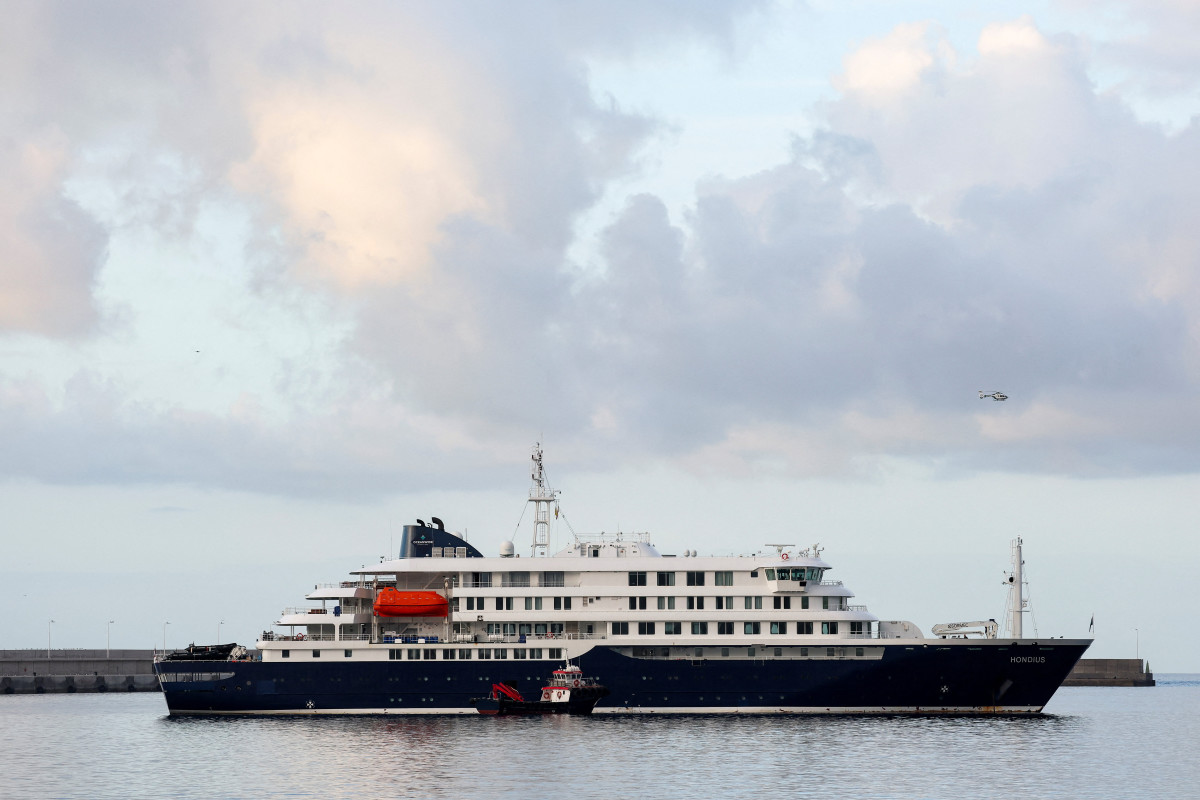
The ship arrived this morning in the Tenerife area, in the Canary Islands, after a journey that began on April 1 in southern Argentina. The Spanish authorities established an isolated and fenced compound in the port of Grenada, designed to prevent contact between the ship’s passengers and the local public. According to the Spanish plan, the evacuation will be carried out in small groups and according to nationality, with each group being transferred only after its evacuation flight is ready. The authorities emphasized that the transfer from the ship to the port, and from there to the airport, will be carried out in an isolated and secure route.
According to the latest reports, there were more than 140 passengers and crew on board the ship. The ship’s operator, Oceanwide Expeditions, said there were no passengers or crew members with suspicious symptoms upon arrival. However, since the start of the outbreak, three people have died, and five passengers who got off the ship have been diagnosed with hantavirus. The World Health Organization and health authorities in several countries continue to monitor passengers who disembarked before the incident was fully identified.
The MV Hondius affair began during a voyage that left Ushuaia in southern Argentina, and passed through Antarctica and isolated islands in the South Atlantic. During the journey several passengers developed a serious illness. It later turned out that three of them had died, including a Dutch couple and a German woman. In some cases, the Andes strain of the hantavirus was identified, which originates in South America and is considered unusual because in rare cases it has been described as being transmitted from person to person through close and prolonged contact.
It is the fact that it is an Andes strain that has led to extraordinary precautions. Unlike most Hanta strains, which mainly pass from rodents to humans, the Andes strain was previously described as a strain that could pass between humans, but in rare cases. Despite this, the World Health Organization and the Spanish authorities emphasized again that the risk to the general public is low. According to them, it is not a virus that spreads easily in the population like flu or corona, and the isolated evacuation is mainly intended to reduce any possible risk and maintain full control of the incident.
In recent days, concern has also arisen outside the ship, after a KLM flight attendant was hospitalized in isolation in the Netherlands following contact with a Dutch passenger from the ship who later died in South Africa. On Friday, the World Health Organization updated that the flight attendant was found to be negative for the virus, a finding designed to reduce the fear of a wider infection. At the same time, various countries continue to locate passengers who got off the ship in the early stages of the journey and make sure they did not develop symptoms.
Hantavirus is the name of a family of viruses that are carried in nature mainly by rodents. The rodents themselves can carry the virus without looking sick, but they excrete it in their urine, feces and saliva. Humans are most often infected when tiny particles from dried secretions are dispersed in the air and inhaled into the lungs. Such a situation may occur while cleaning a warehouse, cabin, attic, basement, equipment room or a closed space where there were mice or rats.
Another way of infection is contact with a contaminated surface and then touching the mouth, nose or eyes. A bite or scratch from a rodent is a rarer possibility. In most Hanta strains there is no routine infection between humans, therefore most cases of infection in the world are related to environmental exposure to rodents. The main exception is the Andes strain, in which a rare possibility of transmission between humans in close contact has been described.
The diagnosis is made through a combination of an appropriate exposure story, symptoms and laboratory tests. Blood tests may show a decrease in platelets, impaired kidney or liver function, and signs of inflammation. Confirmation is carried out by antibody tests or PCR testing to identify the genetic material of the virus.
Currently, there is no dedicated and proven antiviral treatment for the majority of Hanta cases. The treatment is supportive and includes medical follow-up, oxygen if necessary, careful balance of fluids, blood pressure support, monitoring of lung and kidney functions, and in severe cases hospitalization in intensive care and ventilation. Prevention includes keeping rodents away, sealing openings, keeping food in closed containers, using gloves when cleaning suspicious areas, wetting droppings with disinfectant before removal, and avoiding dry sweeping or regular vacuuming of rodent secretions.
https://www.evilmadscientist.com/forums/users/robertbrown/
https://elixir-hedgedoc.rahtiapp.fi/s/6iFs3wI4B
https://biashara.co.ke/author/locksmithwarrnambool3/
https://md.darmstadt.ccc.de/s/Tqjm0OBBtZ
https://pad.sfz-aalen.space/s/OXWrMt5HhD
https://codi.sevenvm.de/s/SdtFaFiXg
https://notionpress.com/author/1512380
https://www.bitsdujour.com/profiles/ZC3Ogn
https://doc.projectsegfau.lt/s/WrGxO6uudy
https://www.chordie.com/forum/profile.php?id=2516771
https://pad.demokratie-dialog.de/s/oBvb2YpdL4
https://codimd.avt-imt.de/s/VguwtmD1i
https://www.wikidot.com/user:info/locksmithmildura
https://md.swk-web.com/s/or6WP_Foh
https://luma.com/user/usr-7w8PbI9StvFCiOC
https://doc.dcrich.net/s/05vpgme7OK
https://letterboxd.com/locksmithwarr/
https://justpaste.it/iq9qu
https://www.twitch.tv/evcharginginstallation/about
https://cubot.net/platform/Forum/detail/id/893.html
https://doc.muensterhack.de/s/FH_bRvJHbB
https://issuu.com/locksmithwarrnambool3
https://www.twitch.tv/locksmithwarrnambool3/about
https://www.tumblr.com/locksmithwarrnambool3
https://support.displaylink.com/forums/287786-displaylink-feature-suggestions/suggestions/51136999-guidance-for-medical-school-essays