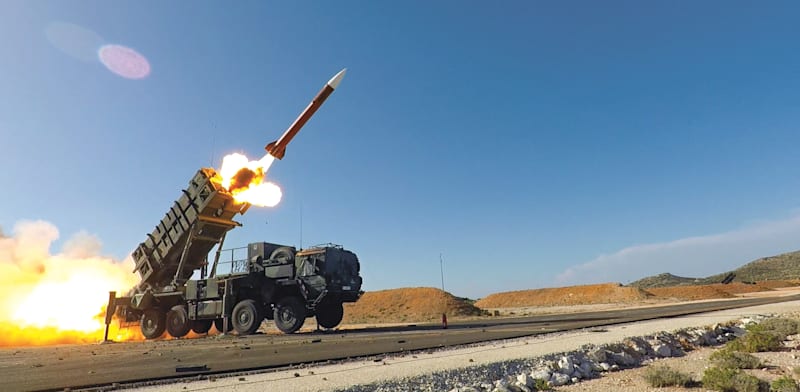
The US military is launching expensive missiles at a rate faster than its inventory replenishment rate. And the Pentagon is promoting a solution: cheaper missiles.
With the help of unconventional contracts and requiring defense companies to develop new weapons systems from scratch, the US military is promoting a goal of cutting production times by years, which will save hundreds of millions of dollars in costs.
● Where are Iran’s frozen billions of dollars kept?
● This is how the French and German fighter jet project collapsed
Even before the war in Iran began to erode the US armaments stockpile, lawmakers and senior military officials expressed concern that the US was unable to rearm at a fast enough pace to deter threats and respond to conflicts.
Low cost missiles
One of the initiatives of the US Army is the Low Cost Missile Program (LLCM), designed to build an inventory of thousands of missiles launched from containers that can be transported from place to place by means of vehicles. One of the key demands from the manufacturers is that each missile that is launched will cost less than 500 thousand dollars.
In another project, the US Army asked companies to develop air defense missiles that cost less than $250,000 per unit. The newest interceptor missiles of the Patriot system, manufactured by Lockheed Martin, require more than two years to manufacture and cost about 4 million dollars per unit.
The conventional missiles of the US military are extremely expensive
Patriot missiles
Manufacturer: Lockheed Martin
Production duration: over two years
cost: About 4 million dollars per unit
Tomahawk missiles
Manufacturer: RTX
Production duration: over a year
cost: About 2.2 million dollars per unit
At the same time, a separate project of the US Air Force aims to purchase tens of thousands of cheaper missiles in the coming years.
Military officials said that the new initiatives are not expected to replace in the near future the advanced missiles produced by companies such as Lockheed Martin and RTX, which the US forces have been using and have been training on for decades. However, senior military officials said that they are already interested in speeding up the establishment of new production lines, so that more options will be available to them in the years to come.
Delays and budget overruns
The purpose of the cheaper ammunition will be to deal with a long-standing problem that has plagued the US military: years of delays and budget overruns in the Pentagon’s weapons programs, due to the management of tenders, design arguments and budget battles.
Over the years, the production time and costs required to produce a variety of systems have increased, from missiles to refueling planes. Defense companies equipped attack missiles and interceptors with layers of sophisticated electronic systems, designed to hit targets and overcome the enemy’s countermeasures.
Industry experts say that the slow and expensive production process stems from a lack of uniformity in funding from Congress and a lack of resolve among senior Pentagon officials. However, the method serves the defense companies well, as it generates billions of dollars in revenue for them annually from the sale of munitions.
Government oversight bodies claimed that some defense companies charged the military excessive prices for products and components, and both Republican and Democratic lawmakers called for tighter oversight of the industry.
President Trump and Defense Secretary Pete Hegseth have pledged in recent months to strictly examine the performance of defense companies and impose sanctions on those who do not improve their performance. So far, government officials have yet to take public action against companies that have failed to meet targets.
Jerry McGinn, a defense procurement expert at the Center for Strategic and International Studies (CSIS), said that many of the advanced missiles are “essentially handmade munitions,” despite years of investment in automation. According to him, some factories are more like specialist workshops than industrial production lines.
As part of the war with Iran, the US launched more than 1,000 Tomahawk missiles in the past year. The cost: at least 2.5 billion dollars, and the amount continues to rise.
According to CSIS estimates, it takes RTX at least a year to produce each of these cruise missiles. They can be launched from ships, submarines and ground launchers, and are capable of hitting targets at a distance of about 1,600 kilometers. The long production time is one of the reasons for their high cost.
RTX declined to comment.
US Secretary of Defense, Pete Hegseth / photo: ap, Alex Brandon
3D printing
After a career in the Navy that included a period as an instructor at Topgun, the prestigious US Navy fighter pilot training school, Doug Danni worked for years at the defense giant Boeing and the American division of the European arms manufacturer MBDA. In 2013, he founded the startup company CoAspire with the goal of developing weapons that could reach the battlefield in months instead of years.
Danni said that the Ghost missile, which the company presents as a low-cost missile to be launched from containers, is expected to begin flight tests this year. According to him, CoAspire tries to avoid delays by purchasing off-the-shelf equipment from commercial manufacturers and printing some of the components in 3D, which allows for significant savings when design changes are required.
An unconventional agreement signed under the Pentagon’s “other transaction authority” mechanism (OTA agreements) gives CoAspire more flexibility to develop a missile that can be produced today, instead of delaying production for months or even more to meet the strict requirements of the program.
“In the field of missiles, changes are constantly required, either to correct failures discovered in flight tests or to improve capabilities,” Danni said. According to him, “open dialogue and yes” with customers such as the Army and the Air Force helps to shorten schedules and avoid delays and ever-increasing costs.
CoAspire is one of four companies competing to develop cheaper missiles for the US military. Endoril Industries, Leidos and Zone 5, a subsidiary of the Kongsberg Group, also presented their own designs. The US military has set a particularly high bar for the group, as it seeks to equip itself with more than 10,000 missiles by 2030.
Blaydos said they plan to meet a production goal of 3,000 container-launched cruise missiles over the next three years by adapting a weapon system already in production and adding some basic components, such as a rocket booster.
According to Doug Jones, Chief Technology Officer of the Leidos Defense Division, “Historically, many of our advanced weapons have included 15 additional capabilities beyond the warhead.” He added that the Pentagon is pushing the companies to act quickly by defining only a few necessary requirements, while leaving other capabilities as optional.
“Instead of building one Cadillac, can I build 10 Honda Accords?” Jones wondered. According to him, a combination of new types of weapons may also turn out to be more effective.
According to Todd Harrison, a security expert at AEI, for years the US military has been examining weapons and defense systems that are between the two extremes: between relatively cheap guided artillery shells and advanced missiles that cost millions of dollars. According to him, the main obstacle is the Pentagon’s tendency to micromanage.
“The idea is to develop guided and precise weapons that can be produced and operated on a large scale,” said Harrison. “They don’t have to be perfect.”
For your attention: The Globes system strives for a diverse, relevant and respectful discourse in accordance with the code of ethics that appears in the trust report according to which we operate. Expressions of violence, racism, incitement or any other inappropriate discourse are filtered out automatically and will not be published on the site.
https://myspace.com/nextgenbusiness/post/activity_profile_29323238_b63f6724d4aa4549abe7b8a2ba8a6de0/comments
https://flipboard.com/@toolmachhub/-rq785tt5y
https://diigo.com/012st8q
https://x.com/businesstechpro/status/2066385361572618286?s=20
https://telegra.ph/YAk-obrati-najkrashchij-wheel-wrench-dlya-avtomob%D1%96l%D1%96v-06-15
https://tmachzone.dropmark.com/2147051/37704804
https://hallbook.com.br/posts/999942
https://papaly.com/categories/share?id=f546a0daf12d4750b0ed498ef1fbd6e2
https://postheaven.net/miguelkline/porivniannia-udarnikh-gaikovertiv-milwaukee-dewalt-i-procraft-br-br
https://www.maanation.com/post/988602_sho-robit-horoshij-wheel-wrench-dlya-mehanikiv-horoshij-wheel-wrench-zabezpechuy.html
https://graph.org/YAk-pravilno-vibrati-krutnij-moment-dlya-gajkoverta-06-15
https://ourdoings.com/neveahhowe/2026-06-15
https://penzu.com/p/ccc3b0e115bb034e
https://www.pinterest.com/pin/1049409150739217925
https://moeamine.com/author/planenight28/
https://platform.joinus4health.eu/forums/users/rhythmhumor33/
https://gamemania55.com/yasu_gamech/forums/users/lilyscale45/
https://www.whatsnewintheprophetic.com/author/wristgarlic39/
https://nerveblock.co.uk/author/planedock52/
https://www.blurb.com/user/ghanapurple3
https://500px.com/p/hedegnjpappas
http://okprint.kz/user/pastabowl12/
https://socialisted.org/market/index.php?page=user&action=pub_profile&id=730085
https://archeter.co.uk/user/profile/734217
https://app.readthedocs.org/profiles/latextarget24/