Ho Chi Minh City is accelerating the restructuring of industrial parks in a smart, sustainable direction, seizing the “rare opportunity” to participate in the global value chain.
The information was stated by Mr. Nguyen Trung Tin, Deputy Head of the Management Board of Ho Chi Minh City Export Processing Zones and Industrial Parks (Hepza) at the forum “Industry 4.0 and smart supply chain – new driving force for Ho Chi Minh City”, on the afternoon of June 17.
According to him, world fluctuations and the trend of shifting global supply chains pose an urgent need to innovate the model of developing export processing zones and industrial parks towards high technology, smart production, and integrated logistics. “This is the time for Ho Chi Minh City to promote restructuring,” Mr. Tin said.
Hepza is completing a project to submit to the People’s Committee of Ho Chi Minh City to initially convert 17 industrial and export processing zones (about 3,800 hectares) to a smart model, applying AI and Internet of Things (IoT).
Mr. Nguyen Trung Tin, Deputy Head of the Management Board of Ho Chi Minh City Export Processing Zones and Industrial Parks (Hepza), spoke at the forum on the afternoon of June 17. Image: Dinh Dai
Ho Chi Minh City and its surrounding areas have more than 43,000 industrial enterprises and 90 industrial parks and export processing zones. According to the plan by 2050, the economic engine will have 105 industrial parks, with a total area of more than 49,000 hectares.
Mr. Hoang Quang Phong, Vice President of the Vietnam Confederation of Commerce and Industry (VCCI), commented that the city still faces unsynchronized connection infrastructure, high logistics costs, low labor productivity and localization rate.
Meanwhile, automation and international competition are weighing on traditional production models. “Dual transformation, both digitalization for intelligence and greening for sustainability, is a mandatory requirement,” he said.
Experts also agree that Ho Chi Minh City urgently needs to “overhaul” industrial parks. Mr. Mickaël Driol, CEO of Mekong Partners, Co-Chairman of the Sourcing Committee, French Chamber of Commerce in Vietnam, pointed out that the locality faces a “rare opportunity” to step up the value ladder.
According to him, capital flows into Vietnam are changing in nature. Multinational corporations no longer simply relocate a factory but want to build supplier networks, technical capabilities and regional operations centers.
Mr. Hardy Diec, CEO of Vietnam Industrial Park Group, a developer of ready-built factories in many localities, including projects in Song Than 3 industrial park (former Binh Duong), also noted this trend.
“In addition to looking for production locations, investors are more interested in the ability to connect factories, logistics systems, seaports, labor sources and supply chains in the same economic region,” Mr. Diec said.
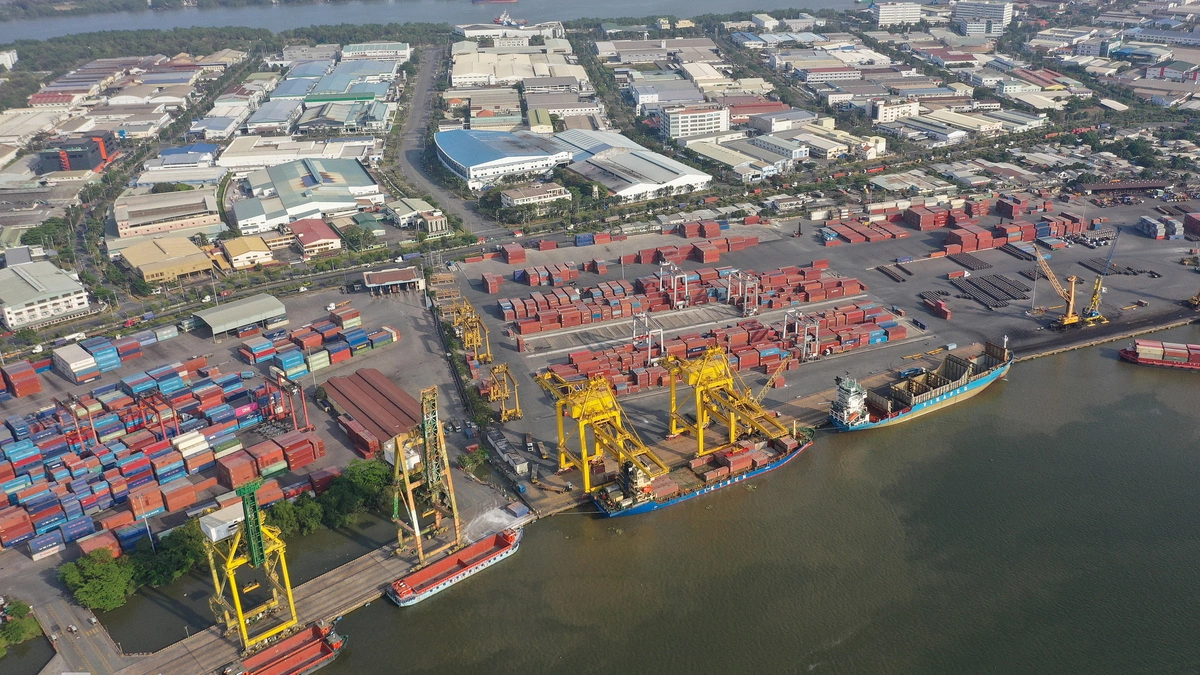
Tan Thuan Port and Tan Thuan Export Processing Zone (HCMC) viewed from above, March 2023. Image: Quynh Tran
Therefore, Ho Chi Minh City needs to prioritize improving governance capacity, transparency of infrastructure and data, and building successful reference models such as the “Lighthouse” factory. This is a factory standard model that applies breakthrough technology from the 4.0 industrial revolution of the World Economic Forum (WEF), and builds supply chain traceability capacity.
VCCI representatives proposed that the city soon convert existing industrial and export processing zones such as Tan Thuan, Tan Binh, Hiep Phuoc, Cat Lai, and Binh Chieu to the model of eco-industrial parks (Eco-Industrial Park) incorporating high-tech applications.
Along with that, energy saving solutions and rooftop solar power systems need to be mandatory integrated into shared infrastructure planning to maintain long-term competitive advantage. Ho Chi Minh City should also encourage the management boards of industrial parks to apply digitization and process 100% of documents online.
Deputy Head of Hepza Management Board Nguyen Trung Tin said that there are 3 solutions in the process of restructuring industrial and export processing zones in Ho Chi Minh City, including completely resolving long-standing problems, building smart, ecological industrial parks according to international standards and reforming administrative procedures.
According to the logistics service development strategy to 2035 advised by the Department of Industry and Trade to the Ho Chi Minh City People’s Committee, the city aims to reduce this cost to the equivalent of 11-14% of total products in the area, and have at least 1 modern logistics service center meeting international standards.
https://natxaly12.livejournal.com/18193.html
https://x.com/RepairNest/status/2062603164877234337?s=20
https://myspace.com/fixerfinderhome/post/activity_profile_75463320_12c7c475c4c4448b97de45b8e49f2c7e/comments
https://flipboard.com/@homeservicehub/-jfps85cqy
https://telegra.ph/Pov%D1%96tryan%D1%96-potoki-v-skatnih-dahah-bud%D1%96vel-06-04
https://penzu.com/p/8f8141d259f0081c
https://www.pinterest.com/pin/874050240208107484
https://gettr.com/post/p40v4kjd336
https://dailyhomeservice.dropmark.com/2159167/37778465
https://postheaven.net/globalhomeservicey/zakhist-dakhu-vid-peregrivu-ta-temperaturnikh-zmin
https://papaly.com/categories/share?id=bc5cd58a1f31423bbb51172b39614657
https://ekcochat.com/post/1079295_yak-ventilyaciya-zapobigaye-utvorennyu-kondensatu-kondensat-ye-odniyeyu-z-golovn.html
https://hallbook.com.br/posts/997038
https://diigo.com/012s1ir
https://ourdoings.com/aponwave52/2026-06-11#e830392
https://www.audiodraft.com/user/profile/DevyndgKline
https://www.fanficoverflow.com/profile/view/82557
https://www.fundable.com/davion-page-kiana-foster
https://www.chordie.com/forum/profile.php?id=2555971
https://www.rvparking.com/user/507735
http://www.neighborhoodlink.com/people/LuisdgBanks
http://buyandsellhair.com/author/RigobertodgPerry/
http://warblog.hys.cz/user/headfifth24/
http://karayaz.ru/user/blackbutane97/
https://g.clicgo.ru/user/foamsoup28/