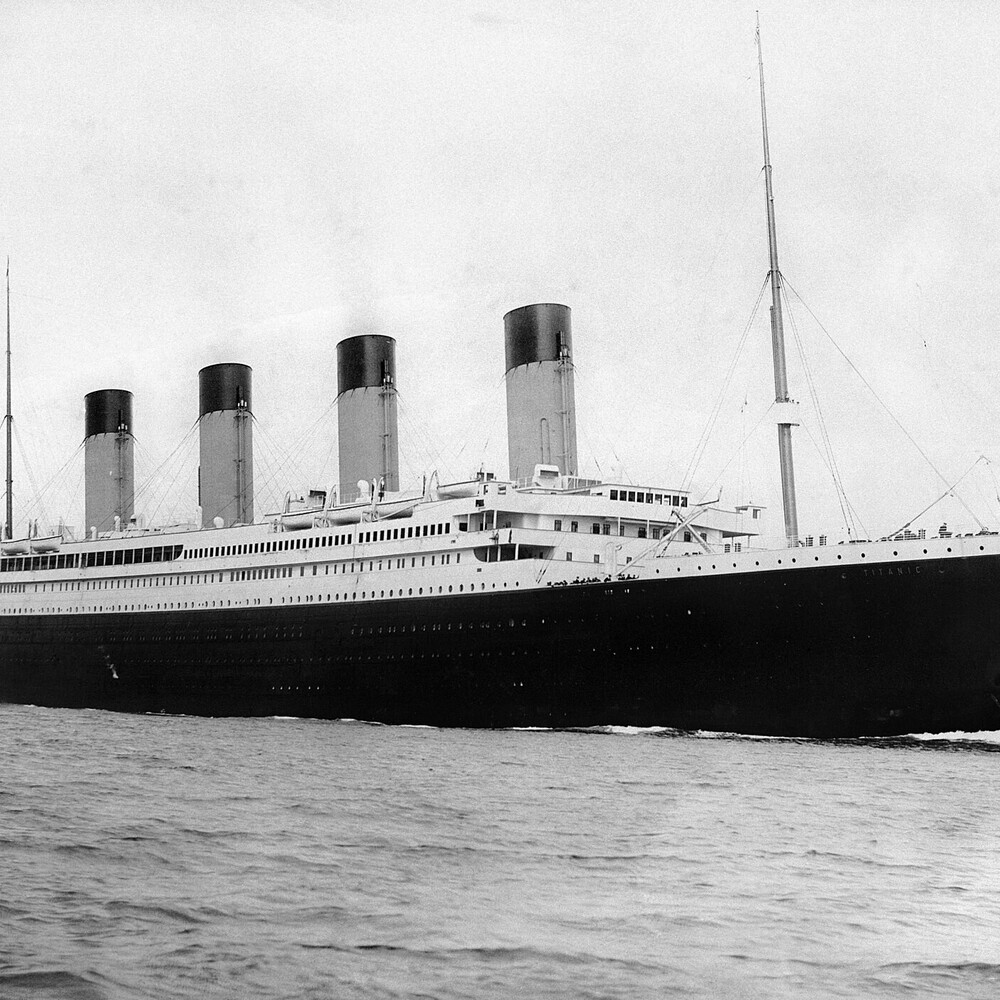
There are many ships in history that have entered the collective imagination, but none have the evocative power of the Titanic. There is no Bounty that can compete, nor a Bismarck nor a Yamato, compared to the transatlantic that has overshadowed in its category even the Italian Rex of the Nastro Azzurro, the Queen Mary and, with equal fate, also the Andrea Doria. The first name that comes to mind is Titanic. The ship that had to challenge and beat every record and every feat, built on the hyperbole of modernity and the most accentuated luxury starting from the choice to call it that, was launched on May 31, 1911 and will end up on its maiden voyage after less than a year.
The launching of the “unsinkable” on 31 May 1911, the year before the maiden voyage
The futuristic project signed by the naval architect Thomas Andrews, by the president of the Belfast shipyards Harland & Wolff in charge of building the transatlantic, William Pirrie, and by Alexander Montgomery Carlisle, was supposed to give dominance of the routes to America to the White Star Line shipping company over the rival Curland. The antagonism was also played out on the immediate recognizability of the fleet’s ships: the names all ended with “ic” in the case of the company founded in Liverpool and with “ia” in the one based in Southampton. Titanic was a step ahead of her modern twins Olympic and Britannic, and was destined to outclass Lusitania and Mauretania.
The order was placed in 1907, work began on 31 March 1909 and was concluded exactly 26 months later, with the launch. Then another thirteen months had passed for the development, for entry into service on 10 April 1921. After five days the Titanic, with the disaster in the frozen waters off the coast of Newfoundland, sank after the collision with an iceberg and became legend. It was considered so safe that it was nicknamed “unsinkable”. Commander Edward John Smith was considered one of the most experienced and skilled in the world.
Ten Italians as passengers in the three classes: four survivors
Among the 1,317 passengers and 892 crew members (conventional figures, which need to be adjusted due to the discrepancies between those present and tickets sold) there were 37 Italians. This is an almost exact estimate because the indications of nationality, after counting the victims and creating the statistical tables, were also made on the basis of the linguistic assonance of the surnames. What is certain, however, is that all the service staff at the first-class “À la carte” restaurant were Italians. In fact, Gaspare “Luigi” Gatti (1875-1912) was Italian, entrusted by the White Star Line with the direction and management of the luxury restaurant first on the Olympic and later on the Titanic.
Originally from Montalto Pavese and having moved to England some time ago where he married, he had successfully undertaken a career as a restaurateur in London. In 1912 the company had entrusted him with the responsibility of the large room with over 150 seats, in which it was possible to order whatever one wanted (contrary to the usual fixed menu), where he had 26 Italian waiters and service staff at his side, the oldest of whom was 43 years old and the youngest 17. Gatti’s entire staff, officially, did not belong to the crew, even if they were counted among the staff. We have a photograph of the Italians taken just before the departure of the maiden voyage, and a copy was given to a child who had posed next to his father and had not left with him.
Those strange coincidences for the most famous shipwreck in the history of the sea
The Titanic appeared to be a symbol of luxury, comfort and engineering. A futuristic floating hotel, divided into three classes, each of which was clearly superior in quality and services to the standards of the time. Everything was designed to amaze. The liner set sail from Southampton at 12.06 on 10 April, about an hour later than expected due to a small accident with a vessel moored near the giant of the seas, the New York: it bore the name of the port where the liner was expected on the morning of 17 April, at Pier 59, where it would never arrive. The next day, however, the Carpathia will land to disembark around 700 survivors recovered by lifeboats. Among the many coincidences of the tragic shipwreck of the Titanic, there was also the unfortunate decision to transport 16 lifeboats and 4 folding launches made of wood and canvas, when the project envisaged up to 64 wooden ones, with a useful capacity of 4,000 people.
But there was no law in force at the time linking the number of emergency vehicles to that of passengers, and therefore only a third on the Titanic could theoretically be saved in the event of a sinking. There were life jackets for all the people on board (the supply was over 3,500), but it was impossible to save oneself in the freezing water and at a temperature of zero degrees. The binoculars supplied to the officers for visual navigation were then forgotten. With four watertight compartments flooded the ship could have easily remained afloat. Instead that night five were flooded with water and the disaster was inevitable.
Guglielmo Marconi had been invited but then boarded the Lusitania
The radio operators had time to raise the alarm and have the ships converge towards the point of impact with a useful course to intervene, and this demonstrated to the world how useful, indeed indispensable, Guglielmo Marconi’s radio was. The inventor of the instrument and telecommunications had been invited to that maiden voyage, but had chosen to board the Lusitania. In the sinking of the “unsinkable” on the night between 14 and 15 April 1912, all the engineers, all the musicians and all the non-maritime personnel died. There were therefore no survivors among Gatti’s Italian staff, who also disappeared among the waves.
There were also other Italians among the passengers: two in first class, four in second and four in third. Of these, four were saved. The lifeless body of Gaspare “Luigi” Gatti will be fished out by the personnel of the Minia ship engaged in the recovery operations of the corpses kept afloat by life jackets in the period 26 April-6 May, and subsequently identified. He was 37 years old. His remains were buried in the Canadian cemetery of Fairview, the last landing place of many victims of the Titanic sinking. The symbol of the Belle Epoque and of the great era of ocean liners, it also became the symbol of an era that was coming to an end. The two companies White Star and Cunard merged in 1934 to cope with the crisis induced by the aggressive German rivalry and the decline in immigration to the USA, and after the Second World War they did not survive the advent of the jet.
Aviator
Aviator
Aviator
Aviator
Aviator
Bingo
Aviator
Bingo
Bingo
Bingo
Bingo
Bingo
Blackjack
Blackjack
Blackjack
Blackjack
Blackjack
Blackjack
Blackjack
Blackjack
Blackjack
Blackjack
Blackjack
Blackjack
Blackjack