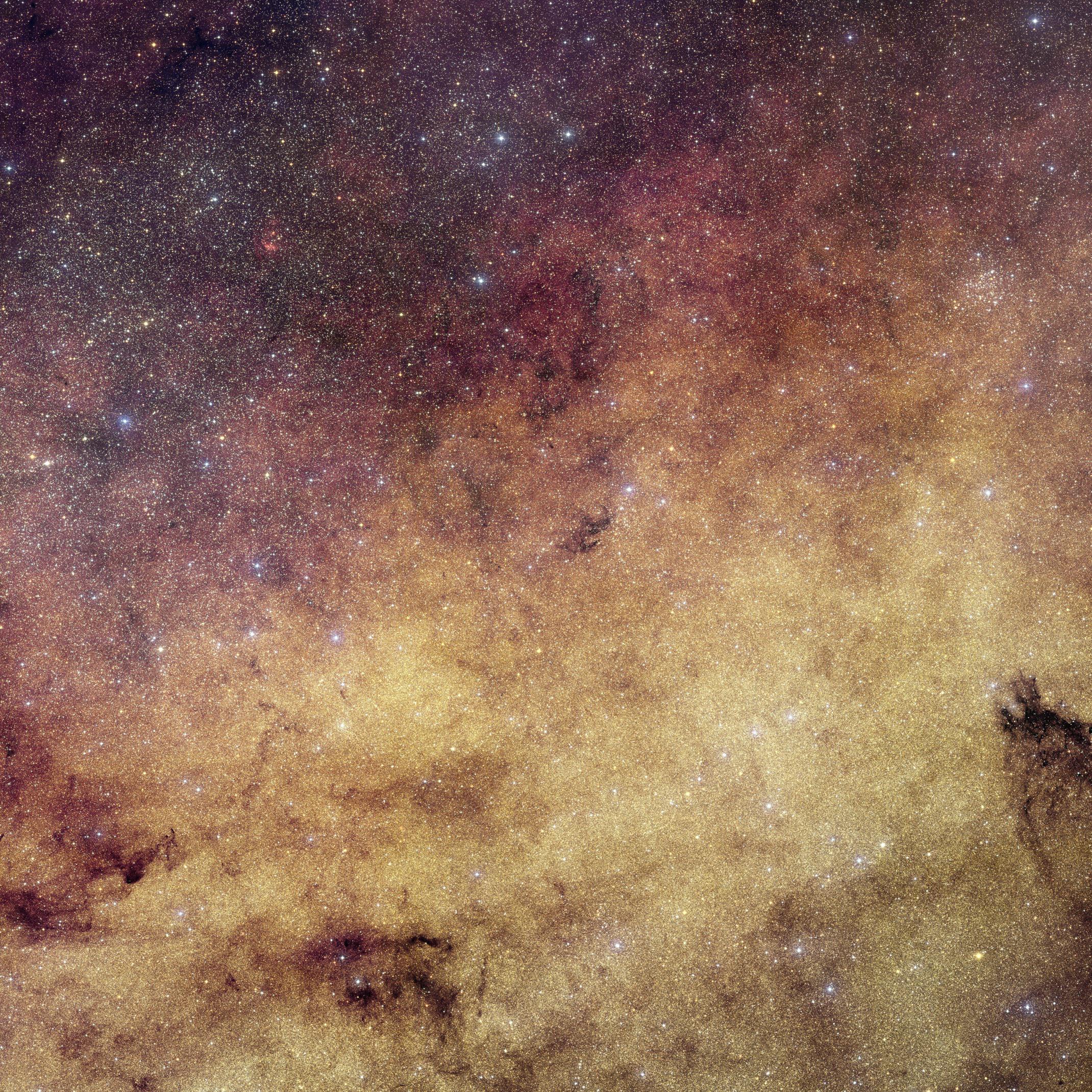
Between 23 and 24 March 2025, through an observation session lasting a total of approximately 26 hours, the Euclid space telescope of the European Space Agency (ESA) recorded a high-resolution map of the center of our galaxy in visible light. The operation involved the composition of a mosaic based on nine pointings of the on-board camera, each of which covers an area of sky greater than the apparent surface of the full Moon. For the duration of a day, the probe modified its observation routine, usually focused on the study of distant galaxies, orienting its optical systems towards the galactic bulge, also known as the bulge. This specific portion of the sky was selected because it coincides with the area that will be monitored in the future by NASA’s Roman space telescope to search for extrasolar planets.
In terms of optical capabilities and on-board instrumentation, Euclid’s sharpness and sensitivity in visible light are similar to those of the Hubble Space Telescope’s wide-field camera, but each pointing made by the European probe covers an area 270 times greater than the latter’s field of view. To obtain an equivalent mosaic using terrestrial observation systems, a large observatory such as Keck, located in Hawaii, would require approximately 2,000 hours of activity, due to the limits imposed by the atmosphere. Euclid instead operates in deep space through the VISible Instrument (VIS), a camera designed to analyze billions of galaxies and developed under the scientific guidance of the United Kingdom, but equipped with an electronic control component designed and made in Italy. The National Institute of Astrophysics (INAF) and the national industrial sector, with the financing and coordination of the Italian Space Agency (ASI), have developed the hardware and software responsible for managing the commands and preliminary collection of data to be transmitted to the ground.
Data acquisition required a specific calibration of the workflows, as explained by Andrea Zacchei, INAF research director and head of Euclid’s ground segment: “Observing the galactic bulge was a complex operation. Euclid has on board two highly sensitive instruments made to probe the faintest objects in the universe; to observe the bulge we had to darken the infrared camera since its sensors would have been overexposed causing a persistence effect that would have affected subsequent observations for several days. A team of experts has also developed a dedicated analysis pipeline, given the peculiarity of the observationThe activity of planning, reduction and scientific analysis of the data saw the direct involvement of numerous Italian researchers belonging to national institutes and universities.
The final image includes more than 60 million stars, as well as a number of nebulae and star clusters. The stellar density of this region provides ideal conditions for the study of exoplanets using the microlensing technique, a phenomenon resulting from the gravitational lensing effect predicted by Einstein’s theory of general relativity. When two stars are temporarily aligned along the same line of sight to the observer, the gravitational force of the nearest star acts like a natural magnifying glass, bending spacetime and intensifying the brightness of the background star. The possible presence of a planet orbiting the star that acts as a lens generates a further, tiny anomaly in the variation of light over time. To identify a new microlensing event, a telescope must monitor the same portion of the sky for over twenty days, which is why the Euclid session, limited to just 24 hours, does not have the objective of discovering new celestial bodies but allows us to precisely measure the mass of the planets already identified or those that will be cataloged in the future.
Over the past twenty years, ground-based telescopes have discovered approximately 300 exoplanets in the galactic center through this methodology. An analysis conducted by Valerio Bozza of the University of Salerno, as part of the activities of the Euclid Consortium, made it possible to trace within the mosaic of images 51 planetary systems already known to the international community. Regarding the value of the physical theory underlying these findings, Stefano Dusini, researcher at the National Institute of Nuclear Physics (INFN), underlined: “Microlensing is one of the most elegant effects of Einstein’s general relativity: mass curves spacetime and bends light, turning stars and planets into cosmic lenses. Euclid manages to observe this phenomenon with unprecedented precision, making it an extremely powerful tool for studying our galaxy too”.
The scientific cooperation linked to the mission is articulated through the contribution of ASI, INAF and INFN, with the involvement of teachers and researchers from the universities of Bologna, Milan, Genoa, Trieste, Ferrara, Turin, Padua and SISSA. Alongside the visible light camera, the European consortium has integrated the near infrared spectrometer and photometer, called Near Infrared Spectrometer Photometer (NISP), onto the satellite. ASI, in collaboration with research institutes, coordinated the Italian industrial grouping made up of OHB Italia in the role of agent, together with SAB Aerospace and Temis, while the construction of the satellite was completed by Thales Alenia Space Italia.
The ground infrastructures see the participation of the ALTEC company of Turin for the support of the Italian Science Data Center hosted at the INAF headquarters in Trieste. The mission’s timetable calls for a new data release in November 2026, focused on an area of extragalactic sky of about 2,000 square degrees.
Elisabetta Tommasi, responsible for ASI for Euclid activities, clarified: “The release of the data to the scientific community is possible thanks to the immense work of that part of the ground segment of the mission, led by Italy, which, by specifically creating software for the analysis of Euclid data and managing nine Data Centers across Europe, is able to process and distribute usable data for scientific analyzes” The publication of the first global cosmological results, focusing on the effects of dark matter and dark energy in the evolution of the Universe, is scheduled for mid-2027.
From Fancy Fonts to Fast Games The Visual Language of Mobile Entertainment
Why Live Digital Formats Depend on Good Communication – My Blog
Why the Best Entertainment Happens Before the Result Is Known – Epic Update
The Psychology of Watching Someone Decide in Real Time – suggestwave
Why Businesses Invest in Professional Development of Fitness App
Automatiser la Gestion de Vos Locations Saisonnières Facilement
Intelligent Automation Strategy: Building Practical AI Solutions for Modern Enterprises
React-Projekte auf Windows: So bleibt deine Entwicklungsumgebung schnell und sauber – Windows Tweaks
How to optimize Google Business Profile using customer signals | NetLingo.com
Standard vs. White-Label Ad Servers: Which Is Right for Your Business? | eztalks Blog
Realistische Küchenvisualisierung: warum gute Planung vor dem Kauf sichtbar werden muss – Wissen Themen
Building Web Applications That Stay Useful After Launch
Birthday wishlist ideas: what a wishlist app is and how it works
How Mobile Login Shapes Time Entertainment
Why quick games work best when the mood stays light
Why mood matters before a fast game session –
How fast online games turn mood into quick decisions –
How Fan Merch Stores Choose the Best Live Chat Platform for Drop-Day Support