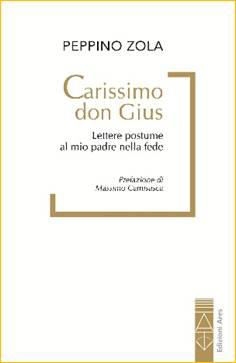
There is a literary genre that spans the centuries without losing strength: the letter. It is the place of confidence, of memory, of dialogue that overcomes distance and even death. In “Dearest Don Gius. Posthumous letters to my father in the faith” (Edizioni Ares, 248 pages, 15 euros), Giuseppe “Peppino” Zola chooses precisely this form to return to dialogue with the man who decisively marked his existence: Monsignor Luigi Giussani, founder of Comunione e Liberazione. The release of the volume comes at a particularly significant moment for the ecclesial movement. In fact, last May 14th the diocesan phase of the cause of beatification and canonization of Don Giussani ended, an important step in the ecclesial journey that concerns one of the most influential figures of Italian Catholicism of the twentieth century. It is within this climate, which is not only commemorative but invites a rereading of his spiritual legacy, that Zola’s book is placed.
But it would be reductive to read it exclusively as a contribution to the memory of the founder of CL. The volume is rather the story of a human and religious experience, seen from the inside by one of the protagonists of the first season of the movement. Milanese lawyer, born in 1939, protagonist of the civil and political life of the city, Zola belongs to that generation of students who, between the second half of the 1950s and the early 1960s, were won over by the educational proposal of the young priest from Brianza in the corridors of the Berchet high school in Milan.
From that meeting was born a story that spans over sixty years of Italian ecclesial history. And the book follows precisely this itinerary, without taking on the tone of news nor that of traditional autobiography. The choice of posthumous letters in fact allows the author to address himself directly to the “Don Gius” of all time, as if to verify with him the path travelled, the hardships, the joys, the questions still open.
The result is a text that continually moves on two levels. On the one hand, the personal, almost domestic dimension, made up of memories, episodes, meetings, friendships. On the other, the reflection on the ecclesial meaning of the charism of Communion and Liberation, on its transformations, on the tensions that inevitably accompanied the growth of a movement that has become one of the most significant realities of contemporary Catholicism.
It is perhaps precisely this dual perspective that makes the volume interesting even for those who do not belong to the history of CL. The letters do not simply reconstruct a biography nor offer a repertoire of anecdotes about Giussani. Rather, they try to answer a deeper question: what remains of an encounter capable of changing a life? How do you preserve a charism without transforming it into nostalgia or simple memory?
Throughout the book, what Zola considers the essential figure of Giussani’s teaching clearly emerges: Christianity as an event even before that as a doctrine, as an experience capable of affecting every aspect of existence. It is a conviction that runs through the pages without ever assuming the language of a theological treatise. Rather it takes shape through concrete episodes, dialogues, shared memories, intuitions developed over time.
One of the recurring themes is that of unity. Not an organizational or disciplinary unity, but the awareness of belonging to a community whose center is not a charismatic leader but Christ. In this sense the book also addresses the divisions and misunderstandings that have marked the history of the movement. They are not ignored, but read in the light of a criterion that Zola identifies in the continuous return to the origins of the Christian experience. When the relationship with that origin is lost, the author seems to suggest, even the most solid structures risk becoming rigid; when the origin remains alive, even crises can become an opportunity for renewal.
A reflection that is echoed in the Invitation to reading signed by Davide Prosperi, president of the Fraternity of Communion and Liberation, who identifies the common thread of the entire volume precisely in the return to the essential. Faith, observes Prosperi, becomes truly personal only when it generates communion, avoiding both individualistic withdrawal and the organizational reduction of ecclesial belonging. This book, states Prosperi, offers “a lively, grateful and passionate testimony of a man who had an exceptional encounter that changed his life. Zola is surprised and enthusiastic in observing that it is that same encounter that continues to change the lives of many, young and old, generating a people. It is striking, when reading, how everything is clearly traced back to this original element. The divisions, the hardships, the misunderstandings – which inexorably cross the life of every human reality – do not they are denied, but judged. And the judgment on them does not arise from a strategy or an organizational balance, but from a return to the essential, even the best forms end up becoming rigid, inevitably producing contrasts; when instead the origin is alive, then everything can be assumed, purified and relaunched. This book, therefore, is precious not only for those who have directly shared the story told, but for anyone who wishes to understand what it means to live faith as an authentic experience. personal, therefore communion. It is from here that everything can be reborn”.
Of particular interest is also the preface by Monsignor Massimo Camisasca, one of Giussani’s first collaborators and today bishop emeritus of Reggio Emilia-Guastalla. Camisasca underlines the documentary value of Zola’s testimony, defining him as a credible witness precisely because he was a direct protagonist of the various seasons the movement went through. His letters, observes the bishop, speak simultaneously of the earth and the sky: of the concreteness of a shared life and of the Christian hope that continues beyond death. “Peppino Zola is a credible witness because he lived for a long time with Don Giussani since he was a boy, he participated in the various phases of the movement that was born day after day around Giussani, he has a vivid and clear memory of what happened in his life – writes Camisasca – Zola outlines a path forward that we, the first who met Don Giussani, leave to future generations not as a path to be retraced slavishly, but as an invitation, a proposal, a provocation. They are letters that speak of the earth and together they are addressed to Heaven, to a person who can read them and look at them from above, from the height of a life lived together and enjoyed together, which now awaits fulfillment with all the friends we have met”.
But perhaps the most original feature of the book lies precisely in its narrative register. There is no claim to systematize Giussani’s thought nor to construct an official history of Communion and Liberation. Zola prefers the path of personal memory, relying on a plain, colloquial, almost confidential style. The reader has the impression of witnessing a conversation that continues over time, as if the dialogue with the master had never really stopped.
In this story there is also space for the figure of Adriana Mascagni, the author’s wife, composer and artist who passed away in 2022. Her songs symbolically accompany many pages of the volume, almost constituting a discreet soundtrack to the narrative. Their presence adds a further emotional level to the book, transforming the dialogue with Don Giussani into a familiar, shared, affective memory.
Alongside the spiritual dimension, a theme also emerges that has run through CL’s entire experience: the relationship between faith and presence in society. Zola insists that obedience and freedom are not opposing terms. On the contrary, it maintains that it is precisely the experience of belonging that makes creativity capable of impacting reality, profession, public responsibilities, culture and politics possible. A perspective that recalls some of the most characteristic themes of Giussani’s educational proposal and which continues to question the contemporary ecclesial debate.
The book thus also takes on the value of a generational passage. Zola belongs to the first circle of boys who met Giussani during the Berchet years. Today, over eighty, he looks to the new generations not with the intention of providing a model to imitate, but an experience to verify personally. Memory, he seems to suggest, is authentic only when it becomes the possibility of the future.
In a time in which the risk of nostalgia often accompanies the story of the great ecclesial figures of the twentieth century, the book “Carissimo Don Gius” chooses a different path. He does not build a monument or an edifying biography. Rather, it returns the voice of a man who continues to question the present through the living memory of those who were close to him.
Whether the reader shares the story of Communion and Liberation or not, the value of a testimony capable of telling from the inside how an encounter can become the organizing principle of an entire existence remains. And perhaps this is precisely the deepest reason for the volume’s interest: to remember that great spiritual experiences do not survive thanks to institutions or commemorations, but because they continue to generate men and women who, even today, feel the need to write a letter to their master. (by Paolo Martini)
Centro Neurona – Utenti – CKAN – OPENDATA REGGIO CALABRIA
Mejor Psicólogo en Burgos – HedgeDoc
El auge de los gimnasios en la era del bienestar – HedgeDoc
Entrenador Personal En Zaragoza
El auge de los gimnasios en la era del bienestar – HedgeDoc
Alquiler de mobiliario para eventos audiovisuales: una guía completa – HedgeDoc
Tendencias en el alquiler de muebles para eventos audiovisuales – HedgeDoc
Alquiler de mobiliario para fiestas: tendencias y oportunidades en el sector audiovisual – HedgeDoc
Attivita' – ParteciPO
Crecen las tendencias de alquiler mobiliario Madrid para eventos audiovisuales – HedgeDoc
El auge del alquiler mobiliario para eventos en la industria audiovisual – HedgeDoc
Tendencias y soluciones en alquiler de mesas y sillas para eventos – HedgeDoc
MICE Tourism – HedgeDoc
MICE Tourism – HedgeDoc
Destination Management Company Spain – HedgeDoc
Destination Management Company Spain – HedgeDoc
En qué fijarse al elegir una empresa de mudanzas – HedgeDoc
Serendipia Psicología – Psicólogos en Valencia – HedgeDoc
Centro Psicológico SMC – Psicólogos en Madrid – HedgeDoc
Estrategias de marketing para clínicas – HedgeDoc
Estrategias de marketing para clínicas: tendencias y buenas prácticas – HedgeDoc
Agencia – Utilisateurs – AGRIDATA
Estrategias de marketing para clínicas en la era digital – HedgeDoc
Estrategias de marketing para clínicas: claves para impulsar el crecimiento del sector salud – HedgeDoc
Estrategias de marketing para clínicas – HedgeDoc