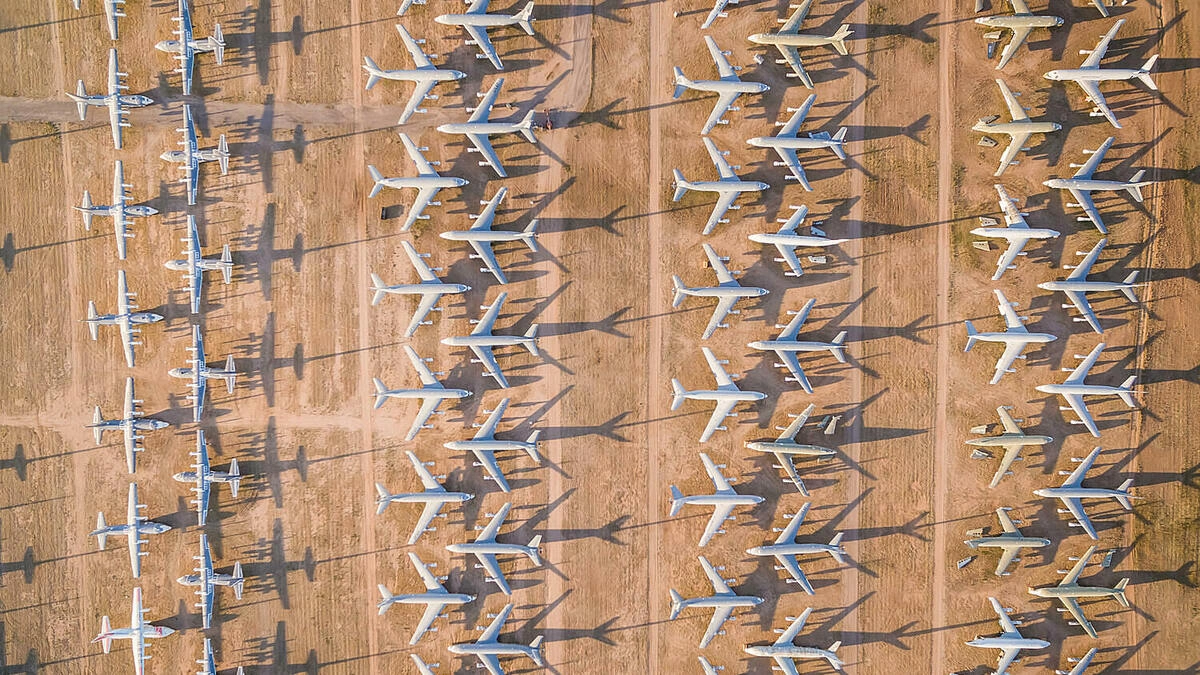
In the world, there are currently about 8,000 aircraft at the end of their operational life “resting” in deserts, jungles and landfills and this number is increasing.
Theo Business Insiderexperts estimate that an additional 11,000 aircraft will join this fleet in the next 10 years. These “aircraft graveyards” filled up quickly during the Covid-19 pandemic, when airlines had to implement many drastic cost-cutting measures, including temporarily laying off pilots, cutting flight routes and storing aircraft.
The world’s largest aircraft storage locations are often located in the desert. For example, Pinal Aviation Park is more than 610 hectares wide and the AMARG 309 facility is more than 1,050 hectares wide in the Arizona desert (USA) storing thousands of aircraft.
Slashgear commented, storing aircraft in the desert is like preserving fruit in dry mud, both to prevent damage. With fruit, the goal is to keep water and moisture inside, and with airplanes, the goal is to prevent corrosion and other physical damage.
Davis-Monthan aircraft cemetery in the Arizona desert, USA, seen from above. Image: Reuters
First, the hot, dry desert weather is ideal for aircraft to remain stationary for long periods of time. Dr Sonya Brown, an aerospace design expert at the University of New South Wales, explains that the low air humidity here is suitable for storing aircraft, which are mainly made of metals and alloys, because the risk of corrosion is significantly lower. In addition, the risk of phenomena such as rain and tornadoes occurring is also relatively small.
Asia Pacific Storage, an aircraft storage facility in Alice Springs (Australia), introduced this place to benefit from an arid desert environment with an average year-round humidity of about 25%, located outside Australia’s storm zone, with little rain, and low-growing vegetation that provides additional dust reduction.
However, this does not mean that desert storage facilities are completely immune to adverse weather. For example, German airline Lufthansa once had to sell 6 A380s at a low price after they were damaged by a storm in Teruel (Spain).
Deserts often have less wildlife than other environments. Although small creatures still exist in this arid place, the lack of vegetation and water makes them appear more sparsely. This is an advantage because birds and insects can nest in the plane, causing damage to the interior.
Theo Simple Flyinganother big advantage of desert facilities is the large area. Although airports also have aircraft parking areas, their space is certainly more limited than specialized long-term storage facilities. The airport will prioritize using its limited space for aircraft operations. In addition, the desert has little competition for land, allowing storage facility operators to purchase land cheaply, and airlines and aircraft manufacturers can also rent land cheaply.
Many desert locations also have ideal terrain, dry, sturdy, and do not require asphalt or paving. This helps significantly reduce infrastructure construction costs. In other environments, the enormous weight of large commercial aircraft can cause the ground below to subside over time.
The Aviation Circular Economy Alliance (ACC) said that thousands of retired vehicles in “aircraft graveyards” provide a valuable source of reusable materials, helping to solve the major pollution challenge. Airlines can dismantle old aircraft to recover components for more sustainable maintenance. Therefore, storage facilities in the desert play an important role, helping to preserve aircraft well and contribute to the development of a circular economy.
Old Casino by the Black Sea Romania 🇷🇴 — Hive
Member.Php
Micro.blog – @RayhanSikder
Adnan Patwary
Stakehouse Den's Revolution – Brand New Experience Casino Game
kinzler45 – Mitglieder – lost-places.com – Forum
RidoyMalitha | Law School Numbers
Chicken Road 2 Bangladesh Guide & Rewards
Poser – 3D Rendering & Animation Software
Tareq Jalil הפרופיל של — The Movie Database (TMDB)
s/general – iannefieldsstewart | Fanspo
{{ metaTitle }}
FahimHabib | Players list | Bandori Party – BanG Dream! Girls Band Party
Micro.blog – @HossainAzad
7379
Internet Archive: Digital Library of Free & Borrowable Texts, Movies, Music & Wayback Machine
Tanvirhossain
Ashraful Khan
Viewtopic.Php
♟ NomanSikdar
View the profile of KamalBhuiyan
Liton Das | MagCloud
Nur Alam – watch faces for Apple Watch, WearOS, Galaxy Watch, Pixel Watch, Huawei Watch, and more – Facer
View the profile of SohelRanasen
MonirHaque | Profit.ly