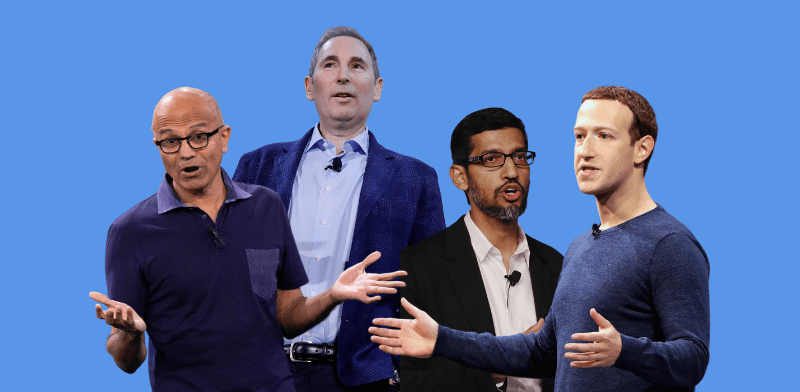
Wall Street in an unusual evening: Alphabet, Microsoft, Meta and Amazon – four of the seven technology giants – have just published their reports for the quarter. Here are the results.
1Alphabetical
Alphabet brought in $109.9 billion this quarter and the profit per share was $5.11 per share, above expectations.
The analysts expected that the revenues of Google’s parent company will amount to 107 billion dollars and the profit of the share will be 2.62 dollars. In the corresponding quarter last year, Alphabet’s revenue was $90.23 billion and it recorded a profit of $2.81 per share.
Cloud revenues: $20.02 billion versus estimates for $18.05 billion – 63% growth. The analysts estimated that the revenues from the cloud qualification (Google Cloud) will amount to 18.4 billion dollars – a sharp jump of 50% from year to year in revenues. This is the fastest growth figure in cloud activity in relation to the two biggest competitors, Amazon’s AWS and Microsoft’s Azure, which are larger than Google in terms of their market share.
This is the first quarterly report submitted by Google after the acquisition of the Israeli Wiz for $32 million, which was completed in the middle of last month, and now investors are looking to examine the impact of the Israeli cyber company’s performance on the search giant’s bottom line. Even if for Google it is too late to add to the first quarter reports of the year, the annual rate of Wiz’s revenues – which were publicly estimated by the company itself at about one billion dollars – is expected to contribute at least several hundred million dollars a year to the revenue line of Google’s cloud division.
About two weeks ago, Google revealed for the first time how it will integrate Wiz into its products: the Israeli cyber company will launch a suite of AI agents that will perform information security operations on Google’s cloud platform (GCP). At the same launch, Google also revealed the new generation of its graphics processors competing with those of Nvidia, the TPU8 processors.
With the exception of Intel, Google has been one of the fastest growing technology stocks among the majors over the past year. stock Google grew in the last year by about 112%, higher than Nvidia which grew by 94%, Meta which grew by only 20%, and Microsoft which grew by only 7% in the same period. Among the reasons for Google’s increase in the stock: reports of agreements for the purchase of its graphics processors by Meta, and announcements of agreements for the supply of cloud services and artificial intelligence to Anthropic, the manufacturer of Cloud. Google is considered the only profitable artificial intelligence model provider among the giants – with OpenAI and Anthropic bearing huge losses associated with investments in the purchase of cloud and AI services. Google owns the entire value chain relevant to the creation of AI models and its artificial intelligence service, Gemini, receives high expert evaluations. Because of this, its stock and stock Broadcom its partner, are considered more stable compared to the cluster of companies surrounding the competitor OpenAI: Oracle, Softbank and in some ways also Microsoft.
Despite this, the number of analysts surveyed by the Wall Street Journal who recommend buying the stock has decreased in the last three months from 59 to 56. The average target price for Alphabet stock, which currently trades at a value of $349, stands at $382.
2Amazon
Amazon beat analysts’ forecasts with revenue of $181.5 billion and earnings of 2.78 per share. The analysts’ forecast for Amazon revenue is $176-178 billion and the profit per share was expected to be in the range of $1.61 to $1.61.
The reports are published afterthe stock Completes a sharp jump of more than 30% in the last month. The sharp increases have raised the bar of expectations in the market, and now investors are looking for proof that the aggressive investments in artificial intelligence are indeed starting to translate into real growth.
The reports focus on one central question: are Amazon’s AI engines already starting to drive growth, or is it still an investment that precedes the return.
In the center of attention is the AWS cloud activity, which is considered to be Amazon’s main profit engine. Analysts expect revenues of about 36.8 billion dollars.
Investors are mainly looking for signs that the demand for cloud services and AI capabilities continues to strengthen, among other things against the background of significant collaborations such as the agreement with OpenAI and an investment of billions in the company Anthropic. At the same time, there is an awareness that infrastructure limitations may affect the actual pace, so that the data does not only reflect demand but also supply capacity. Therefore, the management’s forward forecasts in the investor call are expected to be just as critical as the numbers themselves
Another key issue is the scope of infrastructure investments. In the previous quarter, Amazon shook the market when it presented an investment plan of about 200 billion dollars for 2026, which led to pressure on the stock. Now investors are waiting to hear from CEO Andy Jesse how and when these investments are expected to generate revenue.
As mentioned, the main question is not only how much Amazon invests, but what is the schedule for monetization. Any sign that the company is managing to shorten the path between investment and income may change the sentiment. On the other hand, lack of clarity may bring back concerns about erosion in flow and profitability.
Next to the cloud and investments, the advertising activity is becoming an increasingly central factor in the reports. The forecasts for revenues from the field are about 16.2 billion dollars. This is a relatively highly profitable activity, which provides a significant source of funding for Amazon’s heavy investments, primarily artificial intelligence infrastructure.
In addition, investors are following the company’s progress in developing independent chips, such as Graviton and Trainium. Success in this area may reduce dependence on external suppliers and reduce computing costs
At the same time, the company’s efficiency measures, including the layoffs of approximately 16,000 employees, are intended to improve operational efficiency, but the market is still waiting to see their full impact in the reports.
3Microsoft
Microsoft reported adjusted earnings per share of $4.27 versus expectations for $4.06. Revenues were 82.89 billion dollars against expectations of 81.39 billion dollars – growth of 18% compared to the quarter last year.
Analysts estimated that Microsoft’s revenue would be about $81.4 billion in the quarter. In their estimation, the profit per share is expected to be 4.06-4.07 dollars.
It reported quarterly capital expenditures of $31.9 billion — a 49% increase, but still short of analysts polled by Visible Alpha, who expected $34.9 billion.
Revenue from Microsoft’s Azure cloud platform jumped about 40%, while analysts polled by StreetAccount and CNBC expected a growth rate of 39.3% and 38.8%, respectively.
The reports come after a previous quarter in which the company showed strong growth in revenue and profit, but the stock actually fell by about 10% since the beginning of the year, wiping out about $357 billion from its value. The main reason for this was investors’ concerns about the scope of investments and the rate at which artificial intelligence products translate into revenues.
Next to the numbers, the main indicator that concerns the market is the growth rate of the Azure cloud activity, which is considered the most important growth engine of the company as well as the main indicator of the demand for artificial intelligence. Thus, estimates are for a jump of about 38% to revenues of 26.5 billion dollars. In the previous quarter, the growth rate was about 39%.
The company stated that the growth rate is also affected by capacity limitations, mainly the availability of servers and data centers. This means that actual demand may be higher than the reported figures. On the other hand, some analysts warn against the possibility of a real slowdown in demand, which could harm the company’s growth story in the AI field. At the same time, the reports continue to reflect the sharp increase in investments in AI infrastructure. According to estimates, capital expenditures will amount to approximately $37.5 billion, compared to approximately $21.4 billion in the corresponding quarter last year. The free cash flow forecast is approximately $15.4 billion.
Estimates are that the company’s capital expenditures may exceed the $100 billion mark per year, a figure that sharpens the size of the bet. Thus, the investors will try to understand whether the company manages to balance that investment in future growth and maintaining profitability in the short term
Another issue in focus is the rate of adoption of artificial intelligence products, led by Copilot. In the previous quarter, the number of users was about 15 million. According to analysts, this is a key indicator of Microsoft’s ability to generate revenue directly from its AI investments. In the background there is also a broader concern, according to which the progress of artificial intelligence may change the software market and even damage some of the company’s existing products. In addition, investors will monitor management’s response to changes in the relationship with OpenAI, after the conclusion of the exclusive arrangement between the companies.
Last week, for the first time in its history, Microsoft launched a voluntary retirement program, which will be open to thousands of employees in the US. As part of the move, veteran employees will be able to end their work at the company in exchange for a retirement package that includes a cash grant and health benefits. According to estimates, about 7% of the company’s workforce in the US will be eligible to participate in the program – about 8,700 employees out of about 125,000.
4Meta
Meta brought in $56.3 billion and earnings per share stood at $10.44 per share, the analysts estimated that the revenues of Meta, Facebook’s parent company, would amount to $55.57 billion and earnings per share would stand at $6.65 per share.
Capital spending in the quarter was $19.84 billion, below Wall Street estimates of $27.57 billion.
In addition, Meta reported a 4% increase in the number of daily active users in the past year to 3.56 billion when the market expected 3.62 billion. Meta explained that in the last quarter there was a slight decrease due to “internet disruptions in Iran” as well as “restriction on access to WhatsApp in Russia”
It expects its capital expenditures for the full year to be in the range of $125-145 billion, an increase of 8%, or $10 billion in the mid-range.
The race for artificial intelligence continues to heat up, and the technology giants invest a lot of resources and budgets to compete with each other. According to estimates, the amount of investment expected in artificial intelligence infrastructure by the technology giants is expected to be 660 billion dollars in the coming year, with Meta expected to invest about 135 billion dollars in the entire year. These amounts are extremely high. For that matter, Meta may post an 87% jump from last year in capital spending. All these are joined by the reports that Meta will purchase chips from AMD worth 60 billion dollars, along with holding 10% of the company. A few days later, it was reported that Meta will use Google’s AI chips to develop artificial intelligence models.
Meta continues to reap successes in recent months: billionaire Bill Ackman, founder of the Pershing Square hedge fund, revealed that he owns a stake in Meta shares. And according to a CNBC report, as of the end of 2025, Ackman’s holding is equivalent to 10% of Pershing Square’s capital. In addition, in the previous quarter, the court ruled that Meta is not a monopoly in the fields of social networks, and should not sell Instagram and WhatsApp. Also, in the last quarter, Meta acquired Multbook – the social network for AI agents, which went viral after the agents invented posts.
Against this, Meta faces many difficulties. The authorities in Russia have removed the messaging application from the Internet in Russia, this is so that the users will be in an official application of the government there. Not only that, in the US, lawsuits were filed in the courts against the company for the addictions of young people on its platforms, claiming that it did nothing to deal with it. The jury even determined that Meta designed the platforms in a way that encouraged addiction and harmed the plaintiff’s mental health, and that the company should pay her compensation. In recent days, it was even reported that China opposes Meta’s purchase of the startup Manus.
Meta informed the employees in the last few days about additional large cuts in the company, about 10% of the global workforce (about 8,000 employees). It was published in Globes that it is estimated that about 100 workers will be laid off in Israel, and that the notices to the workers about their layoffs are expected to reach them on May 20. The compensation outline is expected to be similar to that in the United States. Meta has carried out quite a few rounds of layoffs in the past, mainly to reduce the middle management layers in the company and to try to make the company more efficient.
Since the beginning of the year a share Meta shows a modest increase of about 3%.