Caitlin Cassidy, editor of The Guardian, tried to survive for 24 hours without using petroleum-based products but struggled.
The conflict in the Middle East once again exposes the global economy’s deep dependence on oil and natural gas. Many people strive to live green by avoiding gasoline and diesel vehicles. However, fuel is only the surface of the petrochemical industry.
Petroleum derivatives have long been a source of cheap input materials for a wide range of industries, from electronics, cosmetics, detergents, plastic packaging, medical supplies to fertilizers.
Caitlin Cassidy is editor of The Guardian in Sydney (Australia). She tried 24 hours without petroleum-based products. But as soon as she woke up in the early morning, she failed for the first time. Bed sheet made from organic bamboo fiber, naturally dyed, wooden bed frame. However, her mattress is made from polyurethane foam (Foam PU), a synthetic plastic derived from petroleum.
Stepping out of bed, she touched her feet again to the carpet made from nylon and polyester fibers. This type of carpet covers most of the floor of the apartment she is renting.
In the bathroom, toothbrushes are prepared that are biodegradable, made from corn starch. Toothpaste in tablet form has a grassy smell, used to replace the type that often contains polyethylene glycol, petroleum-based surface stabilizers. She feels somewhat reassured because the family towels are 100% made from cotton, while the soap is made from hemp, and the bar shampoo is made from organic oil.
Caitlin Cassidy, editor of The Guardian, uses toothbrushes and toothpaste tablets made from biodegradable corn starch. Image: The Guardian
However, Professor Yuan Chen, Director of the University of Sydney’s Advanced Carbon Research Laboratory, said even her towels were “involved” with oil. Because, to grow cotton effectively, farmers often use a lot of fertilizer. Nitrogen fertilizers, the common type rich in nitro, are produced from coal or natural gas. That is, even with abundant biological raw materials, the production process still requires support from petrochemical products.
Or by not using regular toothpaste, it is still difficult for users to avoid polyethylene glycol, which is popular in the cosmetics industry, present in facial cleansers and lotions.
With Caitlin’s test, Professor Chen said it was “not feasible and not scientifically accurate”.
Caitlin remains steadfast in challenging herself. Because she cannot use a comb or hair dryer (also made from plastic), she shakes her hair back and forth several times to dry it after washing. Choosing clothes is much more difficult. Despite avoiding polyester, everything still has plastic buttons, elastic bands or zippers. In the end, she chose bamboo T-shirts, hand-knit sweaters, recycled hemp skirts, and sandals made from synthetic plant materials.
Entering the shop to buy an oatmeal latte, she realized the coffee maker was filled with plastic beads and coffee beans that could be carried on oil-guzzling cargo ships. But she had no alternative. An individual cannot grow, grind coffee, raise cows and milk milk by themselves, not to mention the problem of emissions that has not been thoroughly resolved by the livestock industry.
At the shopping center, petrochemical products were also littered with coffee cups, takeout food containers and plastic water bottles. Shopping carts are filled with disposable packaging. Even at organic supermarkets, many fruits and vegetables are wrapped in multiple layers of nylon. Professor Chen said the problem with the economy is that disposable plastic is too cheap. Meanwhile, biological materials are 2-3 times more expensive, but also contain some petrochemical ingredients, to ensure moisture resistance and help preserve food.
For lunch, Caitlin eats organic eggs, kale and herbs from her garden, and sourdough bread from the local farmer’s market. She and her boyfriend sat on the floor, avoiding chairs because they were covered with a layer of shiny plastic.
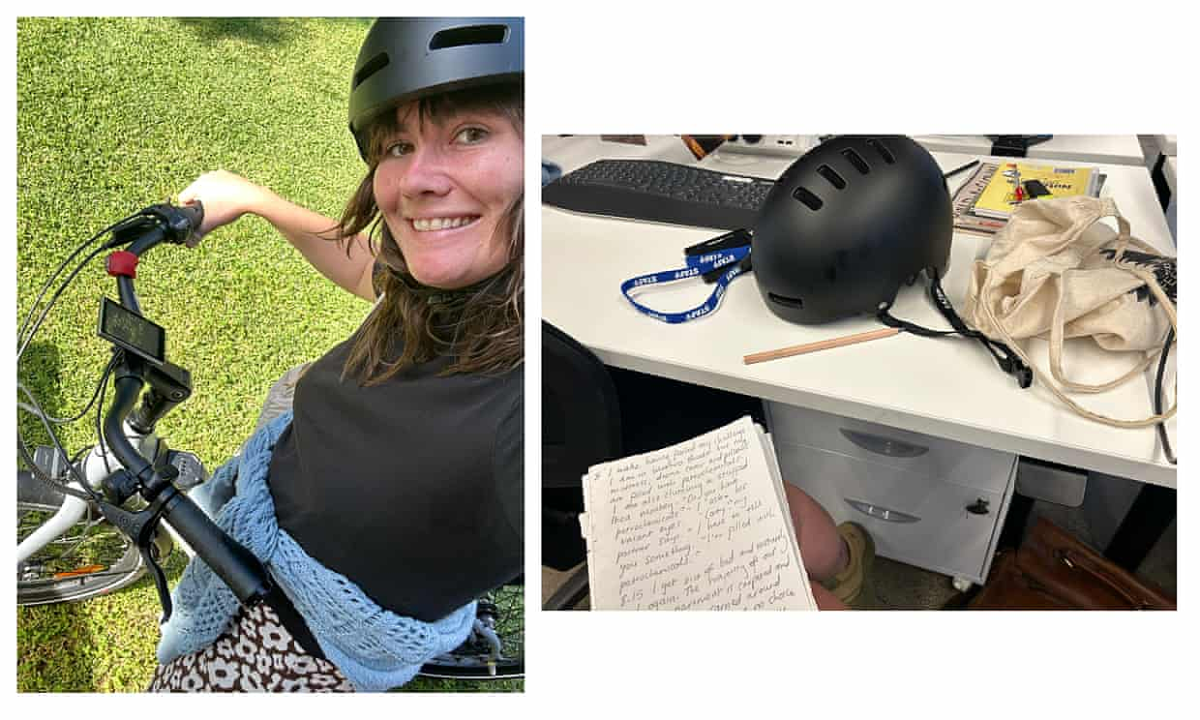
After meals, she uses an electric bicycle to go to work. Although helmets contain polystyrene and polycarbonate foam, the amount of fossil fuels is much less than automobile gasoline.
Caitlin Cassidy used a helmet filled with plastic foam and copied the article by hand. Image: The Guardian
Because the phone is made of plastic, she also limits its use. The sole purpose of use is to take pictures for this test. Therefore, she could not check GPS to determine the route she needed to take, nor did she open a podcast to listen to the news. According to Chen, the solution of traveling by bicycle, train or bus is more environmentally friendly than a personal car. In case you have to fly, a regular seat will be better, because the emissions are only one-fifth of a business class seat.
The Guardian editor entered the work building with uncombed hair and his mind “quiet as a lake” because he did not use his phone to update information. Unfortunately, to get to the office, she needed to use a plastic card and take the elevator. Her office is filled with “oil-based items”, from computer screens, keyboards to plastic pens.
She busily wrote the newspaper with a pencil on recycled paper, occasionally asking her colleagues for the time, because she couldn’t use a computer or phone.
Returning home after dark, she used spaghetti and tuna fillet wrapped in paper, arranged on the floor. The room is lit with beeswax candles, creating a cozy, but inconvenient, feeling. Coal and gas still make up the majority of Australia’s electricity supply. While living in a rented house, Caitlin was unable to install solar panels.
Candlelight dinner by Caitlin Cassidy, aimed at avoiding the use of electricity from fossil fuels. Image: The Guardian
At the end of a day of struggling to avoid petrochemicals, she discovered that her life and the lives of those around her were terribly dependent on this fuel. However, from a scientific perspective, Mr. Chen believes that the way the world uses these types of products will change dramatically in the next 5-10 years. For example, countries, including Australia, are on a path to more electrification, with electric cars, trains, and even planes in the future.
As for Caitlin, this article is the final challenge, when she writes it by hand and retypes it on the computer.