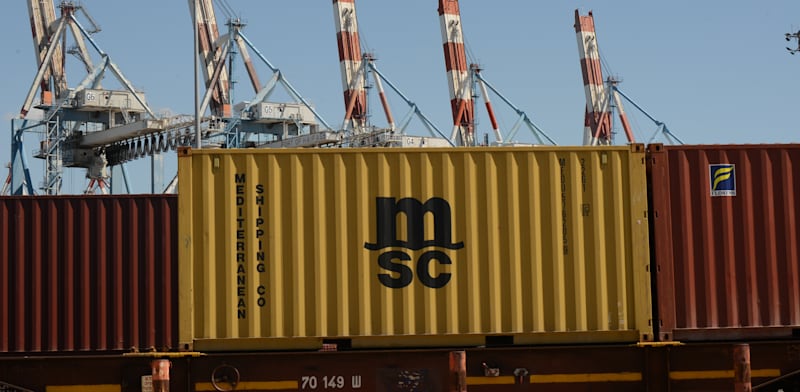
US President Donald Trump this week launched “Project Freedom”, in which the US military aims to break the Iranian blockade of the Strait of Hormuz by escorting merchant ships. The decision was made a few days after the two largest shipping companies in the world, MSC and Maersk, launched land transport lines that cross the Arabian Peninsula to the besieged countries in the Gulf.
However, Globes’ examination of the routes and costs offered by MSC and Maersk for these lines indicates that this is not a significant solution to the maritime crisis in the Gulf.
The gap between sea and land transportation
MSC’s new route that will start operating on Sunday will include a container transport line from the port of Antwerp, the second largest in terms of activity in Europe and the 14th in the world, and from there to Germany, Italy, Lithuania and Spain. After that, the ships will cross the Suez Canal, and anchor in the two main ports of Saudi Arabia in the Red Sea: Jeddah and King Abdullah. From there, the containers will be loaded onto trucks that will make their way to the Gulf countries whose seaports are under siege. These include the east coast of Saudi Arabia in the Dammam region, Qatar, Bahrain, Iraq and Kuwait.
According to the London-based research company Kpler, before the crisis in Hormuz, the volume of container traffic in the Persian Gulf was 1.16 million TEU (a 20-foot container unit), compared to about 470,000 that are currently besieged in the Gulf. A truck or train car, for example, carries one container, and therefore it is unlikely that there will be 470,000 trucks or cars in the Gulf area that will carry all these containers. It’s easy when you also consider additional container traffic from Europe.
Dr. Yoel Gozhansky, head of the Gulf sector at the Institute for National Security Studies (INSS) who previously coordinated the handling of the Gulf in the MAL, previously questioned the corridor plan in the Biden administration, due to the essential advantage of maritime transport over land. The same project, IMEC, was supposed to include a corridor that would connect India to Europe through the United Arab Emirates, Saudi Arabia, Jordan and Israel. Not only IMEC has geopolitical sensitivities, but also the land line. Globes has learned that MSC has decided not to allow customers in Israel to order the new service.
“One container ship is able to take an entire day’s volume on land,” explains Dr. Guzhansky. “This is the reason why marine transportation is cheaper and more efficient. It is impossible to fight the volume, but the inland lines are another tool that makes it possible to reduce even a little bit the dangers of the Strait of Hormuz.” In addition, sources in the industry tell Globes that shipping times may be extended by several days.
Starting at 1,800 for one container
These days, MSC is marketing the new line, and in its announcement it called on customers who are interested to contact the local service provider. Meanwhile, Maersk has already passed on the rates to its customers, and Globes has obtained the pricing.
These include pricing for truck lines from the port of Jeddah in Saudi Arabia to Bahrain and Kuwait, a line from Fujairah to the rest of the United Arab Emirates for transporting bulk cargo only, as well as a tracking line to Iraq. The pricing received is $1,800 for a 20-foot container; $3,000 for a 40-foot grocery store; and $3,800 for a refrigerated container. However, the big drama in terms of costs that eliminates economic viability for many routine transports to the Gulf is the drop off payments (payment for moving an empty container back to the port of origin), which stand for additions of 2,500-600 dollars per container.
Elad Barshan, an expert in customs and international shipping, explains that the world of shipping is built on a circular economy, which raises and lowers containers one after the other. “Let’s say they found the amount of trucks for the required amount of containers, which is unlikely, so they finish the line with the truck at the unloading destination empty, since on the opposite side in such a situation there is nothing to load them with.
“During the Corona crisis, the reason there was such a jump in shipping costs was that factories in Europe were shut down and a huge amount of empty containers remained – without anything to load them with. The entire delicate ecosystem of several containers moving and returning in all directions went wrong, because containers got stuck in one part of the world over another.”
In his view, the move will only have a marginal effect, and the level of pressure reduction through it will be little. “Those who will be interested in the service are high-value or urgent shipments, products with validity such as medicines,” he says.
The price that is least talked about
An issue that is evident that none of the shipping giants refers to is the insurances. Amazingly enough for the average person, international treaties protect shipping companies from claims for loss or damage to cargo, regardless of the situation in the Middle East or anywhere else in the world. Therefore, those who are required to pay for cargo policies are importers and exporters, when it is difficult to predict how the insurance companies will price truck traffic in Saudi Arabia, which only recently suffered Iranian attacks – even if less than its neighbors.
“The world needs Hormuz, it’s impossible to bypass it completely,” concludes Dr. Gozhansky. “The trucks are Promil, a drop in the ocean that shouldn’t be built on. Lots of people are pulling ideas out of their drawers because Hormuz is stuck, but the strait is needed. There is no ability to take oil, gas and cargo out of the gulf. Trucks and pipelines alone will not be enough. Qatar fails to export gas, the United Arab Emirates is in difficulties, and even Saudi Arabia faces significant challenges.”
Mujtaba Khamenei, the new supreme leader of Iran / Photo: Reuters, Hamed Jafarnejad
The jarring point for the Israeli side
An Israeli aspect that should cause concern is the shipping line, which is circular like everywhere in the world, including Aqaba. This is jarring and noticeable due to the situation in the port of Eilat, which remains quite desolate as a result of the Houthi attacks, and one of the main reasons for opposing the extension of the franchise to the group of owners led by the Naksh brothers was the failure to meet the unloading target of 65 thousand TEU per year between 2022-2024.
Meanwhile, for the shipping giants, the port of Eilat, due to its location, was and remains negligible in the international arena, especially compared to giants like MSC and Maersk, which operate about 35% of the world’s container traffic.
For your attention: The Globes system strives for a diverse, relevant and respectful discourse in accordance with the code of ethics that appears in the trust report according to which we operate. Expressions of violence, racism, incitement or any other inappropriate discourse are filtered out automatically and will not be published on the site.