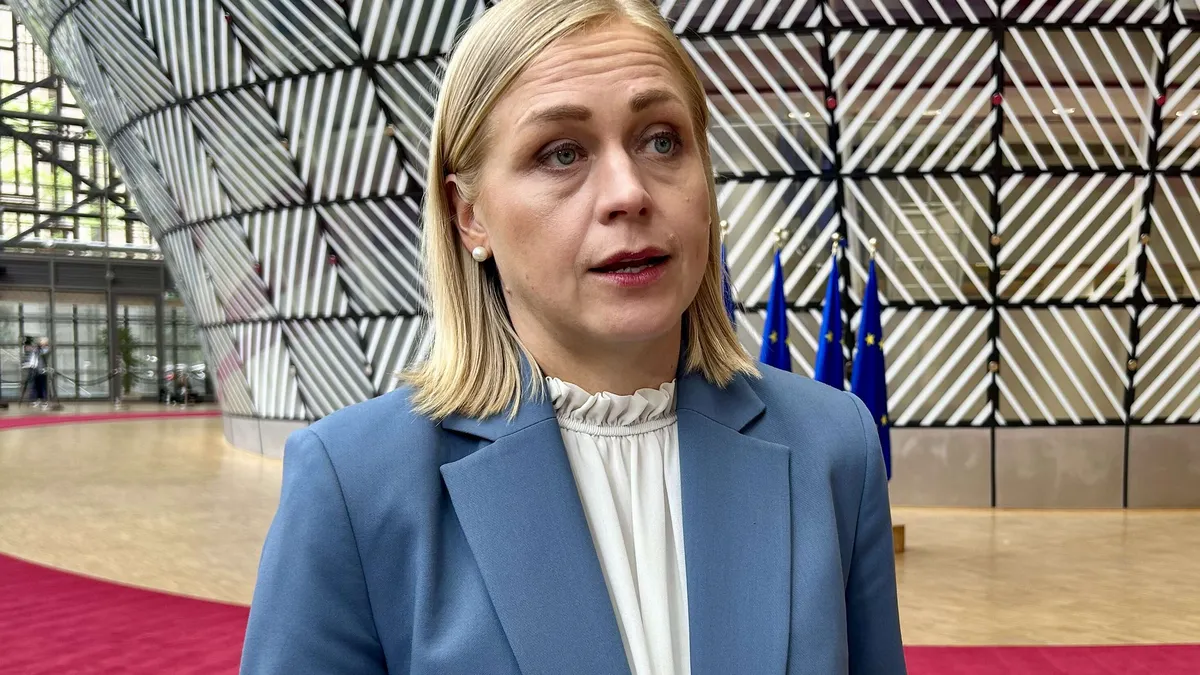
On Monday, the foreign ministers of the EU countries discussed the situation in the Middle East in Brussels.
In the background are the attacks on Iran launched by the United States and Israel on February 28, as well as Israel’s attacks on Lebanon. Iran, on the other hand, has struck various parts of the Middle East, and at the beginning of March, Iran closed the Strait of Hormuz, which has caused global chaos in the oil market.
Despite attempts, the United States and Iran have so far not reached an agreement on peace.
President of the United States Donald Trump announced on Sunday that he was not satisfied with Iran’s response to the US peace proposal. He said he found it “completely unacceptable”.
Iran demands, among other things, the lifting of the US sea embargo and an end to all hostilities, including in Lebanon. In addition, Iran’s terms also require the lifting of sanctions on the country and the payment of war reparations.
Three conditions for peace
After the meeting of EU foreign ministers, the foreign minister Elina Valtonen told how peace could be reached.
Valtonen said that the prerequisite for everything is the holding of a cease-fire: without a lasting cease-fire, there are no prerequisites for meaningful peace negotiations.
Another key condition is the opening of the Strait of Hormuz. Valtonen stressed that freedom of navigation is a basic principle of international law and should not be a matter of negotiation or a means of blackmail.
According to Valtonen, closing the strait would create a dangerous precedent in which other countries could also arm their strategic location.
Valtonen also emphasized patience in the peace negotiations, because lasting peace is unlikely to be reached quickly.
“It can’t be assumed that it (peace) will be born now, as if on a weekend,” Valtonen said.
According to Valtonen, the negotiations should start with issues that can be agreed upon, and only then move on to broader entities, such as negotiations like the Iran nuclear deal (JCPOA), which at one time was negotiated for two years.
Valtonen said that the meeting of foreign ministers also discussed how the Strait of Hormuz could be opened as soon as possible.
The EU has considered maritime, diplomatic and UN cooperation solutions to open the strait.
In addition, under the leadership of France and Great Britain, the so-called coalition of willing countries has prepared a defensive multinational maritime security operation for the post-war situation in order to secure shipping in the strait.
Agreement on Israel sanctions
At Monday’s meeting, EU foreign ministers reached an agreement on sanctions against violent settlers in the West Bank.
Valtonen considers the decision a long-awaited step forward. According to him, it is a significant alignment in a situation where development has been stuck for months.
“The fact that we are now really getting sanctions for these violent settlers is an excellent thing in my opinion,” Valtonen said.
The sanctions target Israeli organizations and their leaders that have supported settler violence.
Israel has already condemned the sanctions.
According to Valtonen, Finland also has a positive attitude towards the joint proposal of Sweden and France, which proposes actions regarding, for example, settlement products.
However, according to Valtonen, the key is what the sanctions achieve.
“The goal is for Israel to respect the territorial integrity of the Palestinian Territory and support the two-state model,” Valtonen said.
A ceasefire is not enough in Lebanon
The situation in Lebanon was also discussed at the meeting of foreign ministers. Although there is currently a ceasefire in the country, it does not yet guarantee lasting peace.
According to Valtonen, Finland has a direct interest in the situation because Finnish peacekeepers are working in the UN’s UNIFIL operation, whose mandate expires at the end of the year.
Valtonen said that there is now a rare situation in Lebanon, because the country has got a government that is committed to the disarmament of Hezbollah. According to Valtonen, this opens up opportunities for international support.
“Now we should apply for new, broader support behind the fact that Lebanon’s own army can be supported in the disarmament of Hezbollah.”
According to him, Europe could play a significant role in stabilizing the security situation, so that Lebanon would not pose a threat to Israel.
“Correspondingly, Israel should respect Lebanon’s sovereignty and territorial integrity.”
According to Valtonen, the humanitarian situation in the country is extremely serious. More than a million people have been displaced from their homes in southern Lebanon.
“This needs to be resolved. A cease-fire is not enough if we don’t reach lasting peace.”
https://avalon78nl.nl/casino/
https://avalon78nl.nl/casino/slots/
https://avalon78nl.nl/casino/poker/
https://avalon78nl.nl/bonus/
https://avalon78nl.nl/bonus/geen-storting/
https://avalon78nl.nl/bonus/free-spins/
https://avalon78nl.nl/bonus/promo-codes/
https://avalon78nl.nl/bonus/cashback/
https://avalon78nl.nl/betalingen/
https://avalon78nl.nl/betalingen/uitbetaling/
https://basswin.london/payments/
https://bacanaplaypt.com/login/
https://bacanaplaypt.com/registo/
https://bacanaplaypt.com/suporte/
https://bacanaplaypt.com/sobre-nos/
https://bacanaplaypt.com/legal/
https://bacanaplaypt.com/app/
https://bacanaplaypt.com/app/android/
https://bacanaplaypt.com/app/ios/
https://bacanaplaypt.com/bonus/
https://bacanaplaypt.com/bonus/bonus-boas-vindas/
https://bacanaplaypt.com/bonus/giros-gratis/
https://bacanaplaypt.com/bonus/codigos-promocionais/
https://bacanaplaypt.com/bonus/sem-deposito/
https://bacanaplaypt.com/casino/