The Deputy Prime Minister noted that the mechanism for assigning offshore wind power surveys does not mean approval of the investment policy, avoiding the situation of reservation or investment monopoly.
On May 19, Permanent Deputy Prime Minister Pham Gia Tuc and Deputy Prime Minister Le Tien Chau worked with the Ministry of Industry and Trade on a draft Decree guiding Resolution 235 of the National Assembly on specific mechanisms for energy development in the 2026-2030 period.
According to Deputy Prime Minister Le Tien Chau, the Decree cannot create any additional priority rights beyond the National Assembly’s Resolution, but still ensures the goal of promoting early implementation of power projects.
With offshore wind power projects, the Deputy Prime Minister noted that assigning a survey does not automatically mean approval of the investment policy. “The terms must be public, transparent, stable, with clear criteria, not to create a ‘reservation’ mechanism or to monopolize investment opportunities,” he stated.
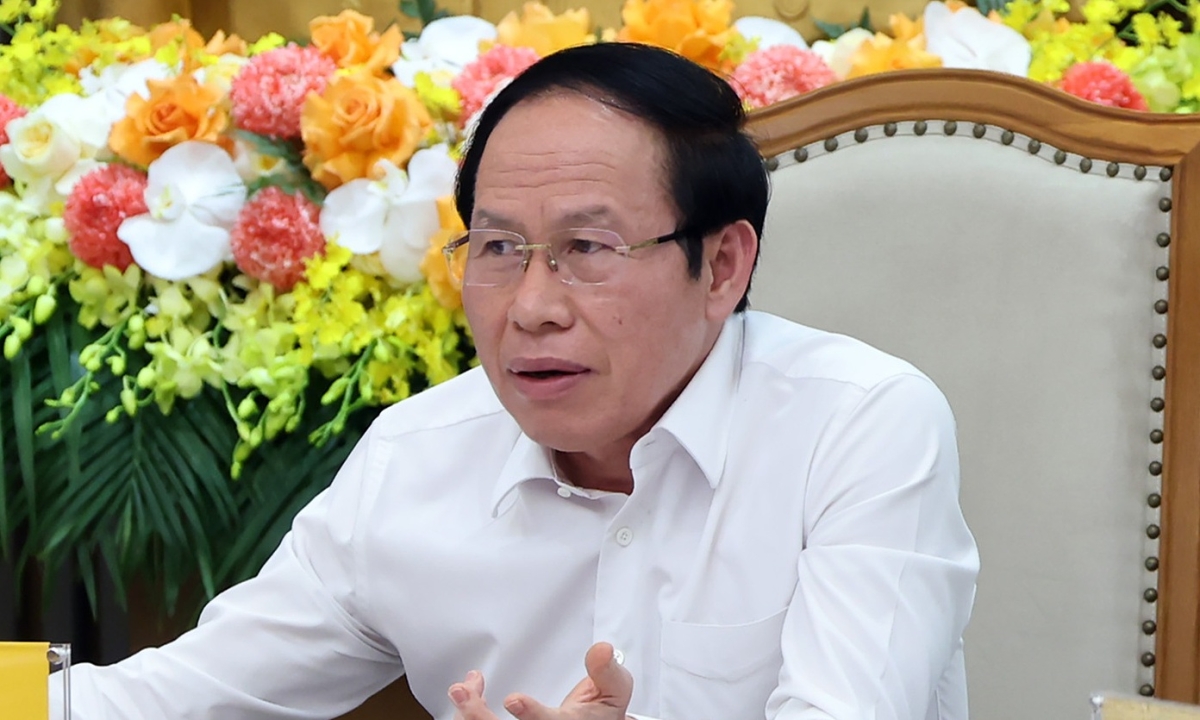
Deputy Prime Minister Le Tien Chau spoke at the meeting, May 19. Image: VGP
The Ministry of Industry and Trade is the agency that developed the draft Decree. According to this agency, the Decree will provide detailed instructions on the conditions of survey units and businesses proposing to invest in offshore wind power. This document also specifies the procedures for receiving and processing survey documents and investment policy approval, as well as the coordination mechanism between relevant agencies.
At the meeting, ministries and branches agreed that promulgating the Decree was necessary to avoid the situation where an offshore wind power project has both an investor asking for a survey and an investment policy, or many units are proposing surveys in different sea areas.
Many comments suggested that it is necessary to clearly stipulate how to handle documents received by the Ministry of Agriculture and Environment and the Ministry of Finance before the Decree takes effect, to ensure the interests of investors.
Concluding the meeting, Deputy Prime Minister Pham Gia Tuc stated that electricity demand for production will increase very high in the context of the double-digit growth target. Therefore, the National Assembly issued Resolution 253 to create a special mechanism to accelerate power projects in the period 2025-2030.
With offshore wind power, Government leaders assess that this is a field that requires businesses with great financial capacity, technology and experience. Therefore, the draft Decree needs to clearly stipulate the criteria for capital, technology, and progress commitment of investors when proposing surveys or applying for approval of investment policies.
However, along with attracting foreign businesses with experience and technology, the Deputy Prime Minister noted that it is necessary to create conditions for domestic businesses to participate in surveys and investments with appropriate criteria and equal competition. The entire project implementation process must comply with regulations, avoiding the risk of international disputes.
The two Deputy Prime Ministers proposed clearly defining the coordination mechanism between ministries and branches to avoid congestion when implementing the Decree. For transitional projects, the Ministry of Agriculture and Environment and the Ministry of Finance review and classify documents according to each stage, clarifying the level of completion, financial capacity, commitment and compensation responsibilities of investors to develop strict transition regulations, without arising problems.
The two Deputy Prime Ministers also requested the Ministry of Industry and Trade to coordinate with ministries and branches to review and complete the draft Decree to soon submit to the Government for promulgation.
According to the adjusted Power Plan VIII, Vietnam will have 6,000 MW of offshore wind power by 2030, and 17,500 MW by 2035. By 2050, this power capacity is expected to reach 113,000-139,000 MW.
https://bitstarz-no.org/
https://bitstarz2.org/
https://bitstarz-si.com/
https://blitz-casino.eu.com/
https://blitz-be.eu/
https://blitz-no.com/
https://blitz-no.eu.com/
https://blitz-no.org/
https://boabet-norsk.org/
https://boabet-no.eu/
https://boabets.eu.com/
https://boabets.eu/
https://boomerangbet-no.eu.com/
https://boomerang-bet.eu.com/
https://boomerangbet.eu.com/
https://boomerangbet-sk.com/
https://boomerangbet-sk.org/
https://boomerangbet.sk/
https://boomerangcasino-si.com/
https://boomerangcasino-si.eu.com/
https://boomerangcasino.si/
https://boomerangcasino-si.net/
https://boomerangcasino-si.org/
https://buffalo-slot.com/
https://buffalo-slot.org/