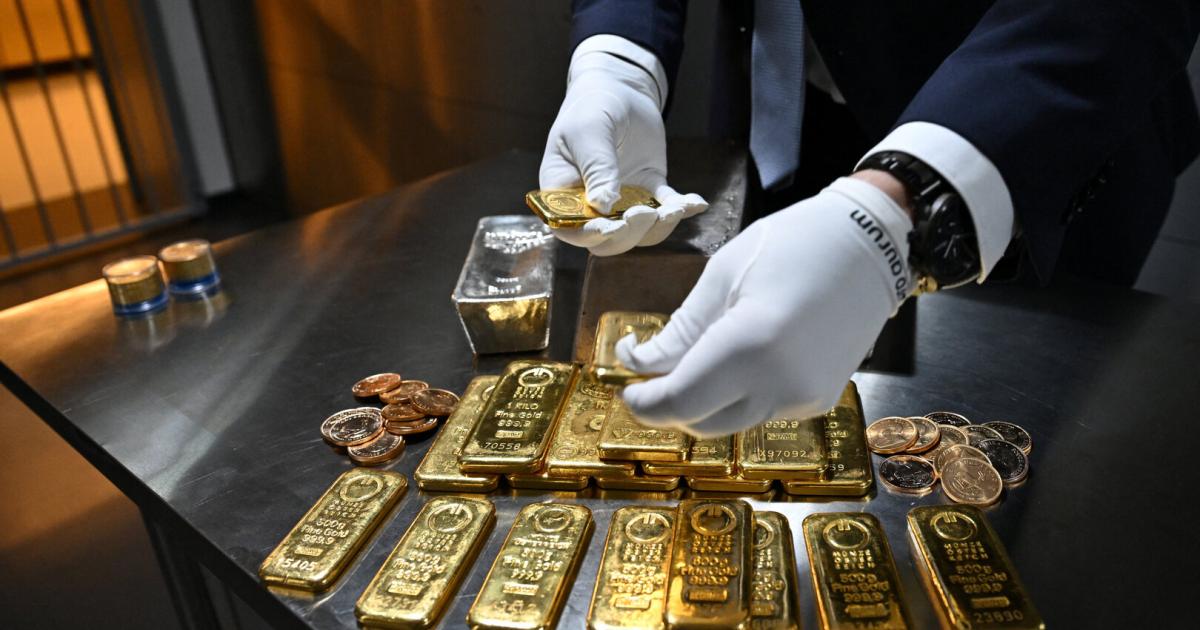
At first glance, the price of gold has fallen sharply this year. But upon closer inspection, this is a false assumption. Since the beginning of the year, the exchange rate has risen by 6 to 7 percent in both dollars and euros. The picture is distorted by the record high at the end of January at around $5,595. At the beginning of the year it was only $4,310. The steep rise was also followed by an almost equally steep fall.
Initially there was massive profit-taking, so the price collapsed to $5,100 almost in one fell swoop. The Iran war followed at the end of February, which generally shook up the markets. Usually conflicts support the price of gold. This time it wasn’t like that. Gold posted its largest absolute monthly decline in history in March.
Oil prices
“Countries needed liquidity due to the sharp rise in oil prices,” explains Marcus Fasching, managing director of the precious metals trader Ögussa. “In the case of Russia, gold is also used to finance war. The biggest seller this year, Turkey, had to massively support its currency due to economic difficulties that were partly of its own making – it was a classic emergency sale.” Fasching is convinced that the countries that can afford it would continue to increase their reserves in order to become more independent of the dollar. The bottom line is that there were still net purchases of 244 tons in the first quarter after central banks have built up massive gold inventories since 2022.
Rising inflation worldwide is also having an impact, says Ronald Stöferle. “There is a U-turn in interest rate expectations. Instead of further cuts, an increase is now being priced in.” This speaks against gold because it does not generate any interest. Stöferle, raw materials expert at the Liechtenstein asset manager Incrementum, has been publishing the “In Gold we trust” report together with co-author Mark Valek for 20 years.
Open/close copyright notice
© Graphics
According to the two experts, a consolidation on the gold market was overdue from a market perspective. However, this is not a sign of structural weakness, but rather a well-known pattern of acute liquidity crises. “In times of stress, gold is often sold not despite its strength, but precisely because of its high liquidity,” explains Stöferle. “We observed the same pattern in 2008 during the Lehman crisis and in the Corona crash in 2020.” Liquidity-driven setbacks are not a contradiction to the long-term bull market, but are often part of the very dynamic that structurally supports gold.
Valek also recognizes long-term, price-supporting trends. In many balance sheets, gold is below the current market value. Since the corresponding accounting rules are now being changed, it will become more interesting for institutional investors to hold gold.
Gold-backed bonds
He also points out “sovereign gold bonds”, i.e. gold-backed government bonds, which are becoming increasingly popular. These are bonds in which gold is deposited as security. This means: The issuer of the bond not only promises interest payments and repayment of the capital, but also secures these in whole or in part with physical gold.
Gold ETFs are also buying on a large scale. Stocks rose from 40 tons in early 2024 to about 100 tons two years later. “We assume that they will continue to buy, but also sell in the meantime,” says Stöferle.
And last but not least, tokenized gold is increasing. This is digital gold on a blockchain. A digital token represents a certain amount of physical gold. In 2025, tokenized gold trading volume reached $178 billion.
“Private investors, institutional buyers and ETF inflows have taken the baton out of the hands of the central banks,” says Stöferle. “This is the passing of the baton that is considered a characteristic of a fully developed public participation phase: The bull market, which was still supported by central banks in the accumulation phase, is now shouldered by a broader investor base. The bull market has reached the mainstream.
Silber & Co.
“Gold has shown the way, now silver, mining stocks and raw materials are following,” say Stöferle and Valek. Silver is currently fairly valued compared to gold. The mines’ production rates have remained stable in recent years. And while the price of gold rose sharply last year, prices only increased this year.
The mining companies, in turn, would currently earn up to $3,000 per ounce at an average cost of $1,700 per ounce. This is why there are takeovers in the industry, “but not crazy acquisitions like those that occur at the end of a phase,” says Stöferle.
Stöferle sees the gold price moving sideways in the next few months, with possible corrections to $4,000 to $4,300. By 2030, the price should almost double to just under $9,000.
Ögussa boss Fasching also thinks that the price could fall further in the short term or develop sideways. “It’s always like this: in a shock phase, i.e. when a conflict begins, the gold price rises sharply. If subsequently increased oil prices fuel short-term inflation and interest rate expectations, other investments suddenly become more attractive because gold doesn’t pay any interest. In the long term, however, inflation supports the gold price and in the medium and long term, many influencing factors still tend to favor rising prices.” The fragmentation of the world remains high and geopolitical risks will not disappear.
https://registeredagentvermont.us/foreign-registered-agent/
https://registeredagentwashington.us/foreign-registered-agent/
https://registeredagentidaho.us/foreign-registered-agent/
https://registeredagentmassachusetts.us/foreign-registered-agent/
https://registeredagentgeorgia.us/foreign-registered-agent/
https://registeredagentmichigan.us/foreign-registered-agent/
https://registeredagentfl.us/foreign-registered-agent/
https://registeredagentohio.us/foreign-registered-agent/
https://registeredagentutah.us/foreign-registered-agent/
https://registeredagentvirginia.us/foreign-registered-agent/
https://registeredagentde.us/foreign-registered-agent/
https://registeredagentminnesota.us/foreign-registered-agent/
https://registeredagentcolorado.us/foreign-registered-agent/
https://registeredagentmaryland.us/foreign-registered-agent/
https://registeredagenttennessee.us/foreign-registered-agent/
https://registeredagentwestvirginia.us/foreign-registered-agent/
https://registeredagentkentucky.us/foreign-registered-agent/
https://caregisteredagent.us/foreign-registered-agent/
https://registeredagentwy.us/foreign-registered-agent/
https://txregisteredagent.us/foreign-registered-agent/
https://registeredagentrhodeisland.us/foreign-registered-agent/
https://registeredagentsouthcarolina.us/foreign-registered-agent/
https://registeredagentillinois.us/foreign-registered-agent/
https://registeredagentlouisiana.us/foreign-registered-agent/
https://registeredagentindiana.us/foreign-registered-agent/