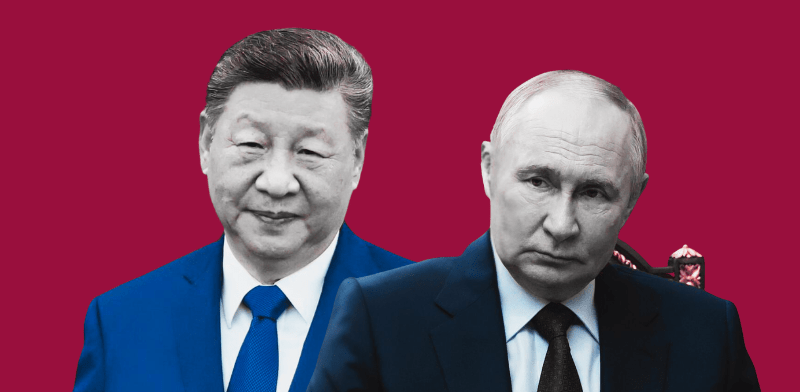
The war between the US and Iran has created a unique situation in recent years, in which the three major powers – the US, Russia and China – share a common interest: a ceasefire. Each side has its own motivations, but the bottom line is that the agreement between Washington and Tehran benefits them.
China and Russia tried to prevent the war even before it broke out, when on February 17 their representatives were present at a meeting between the Secretary General of the IAEA and Iran on the nuclear issue.
After the opening blow of the war, Beijing called on the US, at least in front of the cameras, for a cease-fire, when Foreign Minister Wang Yi called on Trump to return to the talks in an “honest” manner. At the same time, Russia tried through diplomatic channels to bring about talks on the basis of “mutual respect”, but at the same time it was also reported that Russia had provided Iran with satellite intelligence that helps attack American targets in the Middle East. What led them to intervene?
China: the oil importer
At the top of China’s priorities is oil import. Over the past few years, Iran’s share of Chinese oil imports has increased from about 10% in 2023 to a peak of about 15% in March last year.
The increase is the result of a system of evasion of sanctions that has developed over the years between the countries and includes loading oil onto tankers on the island of Kharj, turning off the position receivers (AIS), transferring the oil between tankers in the economic waters of Oman, Malaysia and Singapore, falsifying documents, and after unloading in China – payment in yuan.
Operation Harry’s Roar not only shook the world oil market and energy prices, it severely damaged the availability of oil to China. Thus, if at the beginning of the operation Iran exported 1.38 million barrels a day to China (13.6% of Beijing’s oil imports), within a month there was a drop to about 800 thousand barrels a day, and with the imposition of the blockade by Trump in May, the amount reached a low of 300 thousand barrels a day.
But the evidence that trade between the countries still continues can be found in a report from April, that four Iranian ships subject to sanctions returned to the country from the port of Golan in China. According to estimates, they transferred to Iran material that is used to produce solid fuel for rocket engines. At the same time, CNN reported that American intelligence estimates that China will deliver anti-aircraft shoulder-fired missiles to Iran, in shipments through third countries.
The US-Iran ceasefire solves two big problems for China: the availability of Iranian oil, and the drop in their energy prices exposes Beijing.
If the Iranians do reach a new agreement with the US that will free them from the burden of sanctions, the potential for the Chinese is enormous. This is reflected, in part, by the Chinese step after the previous nuclear agreement (JCPOA), in which the China National Oil Company signed in 2016 a $600 million investment in the South Fars gas field. Immediately after the return of the sanctions, they withdrew from the investment.
On the other hand, the Islamic Republic is required, according to its official data, to rehabilitate in the amount of 270 billion dollars from the war damages. It will not be able to do this by itself, and the Chinese infrastructure companies may step into the vacuum.
Russia: military and nuclear
Russia, like China, has economic interests in the ceasefire – and especially in allowing uranium enrichment in Iran. Russian scientists are part of the routine of the Islamic Republic’s nuclear program, Moscow supplies nuclear fuel to the Bushehr power plant, and last year the two countries signed a $25 billion agreement to build new nuclear reactors to generate electricity.
Anna Namkov, an expert on Russia and Eastern Europe from ICGS, points out that unlike the Chinese, blocking the Strait of Hormuz also benefited Moscow. “The blockade has put Russia in the position of an energy power. Russia normally holds much more natural gas than Iran, so when it is impossible to get oil and natural gas out of the Gulf, Moscow benefits.”
The Russians may also benefit greatly from the Islamic Republic’s need to rearm. While the Iranians are producing some air defense systems, they still need Russian S-300 and Bock batteries, and are expected to rearm in the near future.
On the other hand, on the Iranian side, they may profit from sales of UAVs to Russia, to an extent that has not been possible in recent months. This is despite the fact that the war in Iran did not harm the Russian UAV capabilities, because instead of relying solely on the purchase of martyrs, Russia established a factory about 950 km from Moscow, which last year produced about 66,000 units for the war in Ukraine.
An aspect in which the relations between Iran and Russia have not yet improved is the bilateral trade. From the data of the Association of Iranian Chambers of Commerce, it emerged that in the first five months of the previous Iranian year (March 21, 2025 to September 22, 2025), the volume of trade was 1.1 billion dollars, only 4.5% of Iranian non-oil trade. For the purpose of comparison, throughout the previous Iranian year, the trade stood at 2.5 billion dollars.
This number is significantly lower than the movement of goods between China and Iran. According to Chinese data, in the first 11 months of 2025, Iran exported goods to China amounting to 2.86 billion dollars and imported 6.23 billion dollars. In contrast, the total volume of trade between the countries in 2024 was 13.37 billion dollars.
For your attention: The Globes system strives for a diverse, relevant and respectful discourse in accordance with the code of ethics that appears in the trust report according to which we operate. Expressions of violence, racism, incitement or any other inappropriate discourse are filtered out automatically and will not be published on the site.
https://medium.com/@weber.st.michael/top-test-management-tools-in-2026-why-testomat-io-is-outperforming-xray-and-testrail-bd0dd2e47dee?postPublishedType=initial
https://penzu.com/journals/33512472/116557855
https://app.hackernoon.com/mobile/69c4f8e4ce339154a11e4bd6
https://ralphouensanga.com/post/118386_rethinking-qa-automation-many-teams-are-increasingly-frustrated-with-testrail-an.html
https://www.diigo.com/user/weberstmichael
https://hashnode.com/edit/cmn8jrtlp02ov2dmm94ee42vh
https://flipboard.com/@michaelwebe2026/future-of-quality-assurance-2026-roadmap-8u29ks14z/generative-ai-in-software-testing-top-tools-use-cases-2026/a-XjkHJUFTTx23rik1tppg-g%3Aa%3A4172734297-5574df99ef%2Ftestomat.io
https://flipboard.com/@michaelwebe2026/future-of-quality-assurance-2026-roadmap-8u29ks14z/10-software-testing-trends-2026-the-ultimate-qa-guide/a-L0py9fRBQJeBGYc0Jx4cKw%3Aa%3A4172734297-13567ae58b%2Ftestomat.io
https://medium.com/@weber.st.michael/beyond-the-hype-practical-ai-testing-tools-and-software-testing-trends-for-2026-ca487e292091?postPublishedType=initial
https://say.la/post/302616_the-future-of-qa-is-unified-staying-on-top-of-current-software-testing-trends-ht.html
https://te.legra.ph/The-Shift-to-Generative-AI-in-Software-Testing-2026-Strategy-03-30
https://www.diigo.com/profile/weberstmichael
https://ralphouensanga.com/post/120619_the-speed-of-modern-development-has-outpaced-traditional-testing-methods-today-t.html
https://flipboard.com/@michaelwebe2026/future-of-quality-assurance-2026-roadmap-8u29ks14y
https://dev.to/michael_weber_709b43dc7f0/why-generative-ai-is-rewriting-the-rules-of-test-management-in-2026-mgo
https://www.reverbnation.com/iamgrok