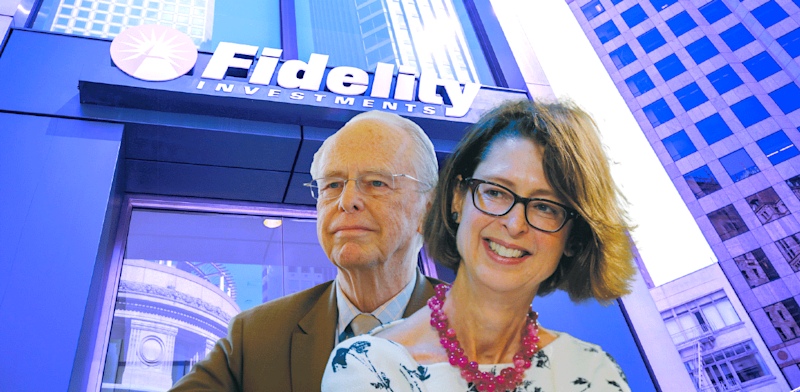
In the spring of 2005, Edward Johnson III, CEO of the investment giant Fidelity, sent the trustee of the company’s board of directors to tell his daughter what he had failed to tell her himself: she was about to lose her top job.
It was a Sunday morning when trustee Marvin Mann called Abigail (Abby) Johnson to ask if he could drop by her house in Milton, Massachusetts, without explaining why. This visit ignited one of the most tumultuous periods in Fidelity’s 80 years of existence. For several months, it seemed that one of the most prominent dynasties on Wall Street was losing its grip on the empire that helped reshape the investment world.
● This is not how you build a family business: a lesson from the drama series “Heirs”
● Bill Gates has spent years building his image, and now it is starting to crack
Today, Fidelity oversees approximately $18 trillion in assets, registers higher annual revenues than BlackRock and helps manage the savings of one in five adults in the US. Half of those clients joined the company in the last five years.
Fidelity’s presence in the lives of millions of Americans has expanded only in the last decade, during which time Ned’s daughter finally succeeded him as the company’s chairman. Johnson, now 64, heads a series of investment businesses whose cumulative volume is unprecedented. Still, the company remains an anomaly in the financial landscape: it is a private company controlled by a family that avoids public exposure.
The rise to the top was accompanied by intrigues and storms
Ned himself inherited the position of chairman from his father, the founder of Fidelity, and supported his daughter’s progress toward the most senior position in the family business. She was tall and thin, wore glasses and kept the same short haircut that accompanied her since her youth. The fear that characterized her in her 20s faded away, and in its place grew a quiet confidence built from experience. But she remained introverted, and in the eyes of many, difficult to decipher.
Ned also faced skeptics in his early years at Fidelity. However, after he had a string of stock picking successes in the early 1960s, even his critics admitted that he would eventually head the company. Avi, on the other hand, did not have similar success as an investor, and her managerial career was also characterized by ups and downs. Instead of accepting her rise to the top as a matter of course due to her family status, her critics only multiplied and became bolder.
The four years in which Avi was in charge of Fidelity’s central mutual fund activity were not successful. The market has not yet recovered to the highs recorded during the dot.com bubble, funds flowed out of Fidelity’s funds, talented investors left the company, and in addition, an embarrassing affair was revealed in which it became clear that Fidelity’s trading room received favors from brokers. On top of all these, there were also differences of opinion between the father and daughter regarding the future of the company.
The article is based on interviews with dozens of people who worked at Fidelity or alongside members of the Johnson family.
In late 2004, Bob Reynolds, Ned Johnson’s senior deputy, approached him following concerns raised by some of the company’s senior executives and board trustees regarding the way Avi was running its operations. Reynolds told Land that it was time to appoint someone else to head the mutual funds division.
Abby suspected that Reynolds had other motives when he urged her father to remove her from the position: to promote a move to sell Fidelity. Executives close to Reynolds said he did not pressure Ned to consider such a deal.
Ned said he gave his daughter three more months to improve the situation. The extension period expired, and Reynolds asked Mann to convince Ned to remove her from the position. Ned finally gave in to the pressure, but set one condition: “You’ll be the one who has to tell her,” Leman said.
That Sunday at my father’s house, Mann announced to her that she was not doing her job well. He listed a series of reasons for this, including weak performance of the funds and a decrease in sales.
The visit seemed strange and unnecessary to her. Avi and Man met regularly in the office, and Man never lacked opportunities to criticize her. Why did he choose to do this right now, in the living room of her house?
Mann’s motives became clear a few days later, when Ned informed my father that she would be forced to leave her position as director of Fidelity’s mutual fund operations. The decision was final and non-negotiable. Ned added that Reynolds already has a plan for her: to head the company’s philanthropy arm.
It was clear to my father that this was a demotion. Ned not only ousted her from managing Fidelity’s core business, but also stripped her of any operational responsibility. She listened to her father’s words, and when it was her turn to respond, she said: “I resign.”
When he realized that his daughter, who was drawn to the world of investments as a child, might leave the company, Ned began to lose his composure. Within a few days, he came up with an idea that he thought my father would not be able to refuse: to manage the activity of Fidelity Employers’ Pension Savings Plans (FESCO). The unit suffered operational problems after years of focusing on growth impaired its ability to serve its existing customers.
Reynolds built FESCO and turned it into the largest provider of workplace retirement savings plans. His success in recruiting some of the largest companies in the US as clients poured hundreds of billions of dollars into Fidelity’s mutual funds and created an extremely profitable business activity. The idea that Abby would now take over the reins did not appeal to him. “Bob,” Ned told him, “If I don’t do it, her mother will kill me.”
“You’re smart, but you’re not your father”
Abby’s dismissal brought to the surface a prolonged conflict between Abby and Reynolds. She begged him to stay away from FESCO, while a number of divisional managers, who had previously been subordinate to him, continued to approach him and bypass her authority. Reynolds questioned my father’s ability to manage the operation. “You are smart, my father, but you are not your father,” he told her.
Abby had nothing to say, neither did Reynolds nor the trustees of the funds who expressed similar doubts about her suitability to succeed Ned. She stormed into her new role with enthusiasm, determined to restore FESCO. Even in the eyes of her closest colleagues, she never seemed to be angry or hurt by the events that led to her exile.
However, Abby was frustrated with some of her father’s decisions. She had a hard time coming to terms with his refusal to prepare for the day when he would no longer be at the head of the company.
At this point, another factor deepened the rift between my father and her mother: for the first time, Ned was willing to consider the possibility of selling Fidelity, a move that would have put an end to six decades of family control. My father made it clear to him that she was against the sale, but would support whatever decision he made.
Abby believed that her removal was the first step in a larger plan designed to distance her from the company, and then sell it to the highest bidder, perhaps to one of the largest banks on Wall Street. In early 2005, Ned met with the CEO of Bank of America, Ken Lewis, and with Jamie Dimon, who was then the designated CEO of JP Morgan Chase.
In those meetings, Ned made it clear to Lewis and Damon that he was not interested in the deal. But Avi feared that he would retire soon, and one of his deputies would take his place as CEO and sell the company.
Interested in buying Fidelity. Jamie Dimon, CEO of JP Morgan / photo: ap, Seth Wenig
As long as Ned believed that Abby was capable of running Fidelity, he would not turn to another candidate. For years he wrestled with the question of whether she would be ready for the job. My father believed that his deputies were trying to convince him that the day she would head the company would never come.
And so Abby Johnson, who was often labeled as hesitant and too cautious, took the boldest step in her career. Within a few weeks, Ned and Reynolds were convinced that she was plotting to oust her father from the position of chairman of the company.
Johnson Sr.’s impeachment attempt – and the counterattack
Abby was the largest shareholder in Fidelity. In 1994, Ned decided to transfer control of the majority of the voting shares to the company’s employees. 49% of the shares remain in the hands of the Johnson family. A year later, Avi’s share of the family property was increased to 49%, while Ned’s share was reduced to 24%.
Since Ned continued to oppose the formulation of an orderly succession plan, Avi signaled that she would refrain from supporting the re-election of the board members at the meeting scheduled for April 27, 2005.
On the preceding Friday, Reynolds received an unusual phone call from one of the executives of the funds division. The same executive said that a person close to my father approached him and asked for his support in a move designed to remove Ned from the position of chairman of the company.
The same source added that my father had already recruited her brother to her side. Together, Ned’s three children could vote with the full block of family stock, and my father also had close friends in the company who owned voting stock. It seemed that you would be able to muster a majority for any move you chose to promote.
Reynolds did not have much time left to prepare for a counterattack. He called Ned. “Are you planning to be at the office tomorrow?” asked. “We need to talk.” Saturday morning Reynolds entered Ned’s office and explained to him my father’s plan as he understood it. Ned was shocked. “Ned, you’d better be at least as angry as I am,” said Reynolds.
However, before they gathered in the conference room on Wednesday morning, my father and her sister talked with Ned again, and managed to settle some of their differences. As a result, much of the drama dropped from the yeshiva’s agenda. In the end it turned out that Fidelity remained a family business.
In the conference room, Ned sat across from her, surrounded by many of the people who had served him faithfully for decades. Ned spoke first. “I propose to issue more shares,” he said. “I support the proposal,” Reynolds replied.
The move changed the structure of the Johnson family’s holdings in the company: Ned’s share increased to 41%, thus establishing his undisputed control of Fidelity, while my father’s share decreased to 23%.
Then when it came time to vote on the composition of the board, all members of Fidelity’s board, including Ned and Abby, were unanimously supported.
At the end of the meeting, Ned remained the chairman of Fidelity and the controlling owner of the company, while Avi returned to her position as president of FESCO. Although the attempted rebellion ended without a change in the company’s leadership, he managed to push Ned to formulate an orderly succession plan.
Years passed before the boardroom confrontation became known to many outside Fidelity’s senior management avenue. Abby Johnson recovered, led the restoration of the pension savings activity, expanded her responsibilities to other key activities at Fidelity, and also survived additional leadership challenges.
Wikidot.com: UpSki
Профиль пользователя: Бадейнов Алексей Романович на портале kpilib.ru
500px
Станислав Сафонов – Справочный портал по микросхемам
averinaanna – Анна Аверина
UpSki | EKMA
Pala Cashmere – о компании
Контактные данные компании Pala Cashmere
Отзывы про Pala Cashmere
Pala Cashmere, Москва – прайс-лист, контакты, цены, информация о компании, (ID 2796475)
Купити санітарну книжку – Форум – freeboard.com.ua
Pala Cashmere – ProСтанки на сайте ProСтанки
Санітарна книжка – Форум города Днепр (Днепропетровска)
Bittogether.com – Первый украинский криптовалютный форум – Главная страница
Медична книжка – Кировоград – городской форум
Санітарна книжка Вопрос к Медицинский центр Медична Ідея – Первый независимый сайт отзывов Украины
Мед книжка на пів року
Купить санитарную книжку Форум обувщиков. Обувной форум для производителей, потребителей и магазинов
Купить санитарную книжку
Kupiti Sanitarnu Knizhku 1683076.Html
Evernote
All in One Best Website SEO Checker (50+ Metrics Tested) | Small SEO Tools – Web and SEO Tools
Spravochka – Telegraph
5229393
Profil de Davina_Anderson – Profil de Davina_Anderson – Nintendo-Master