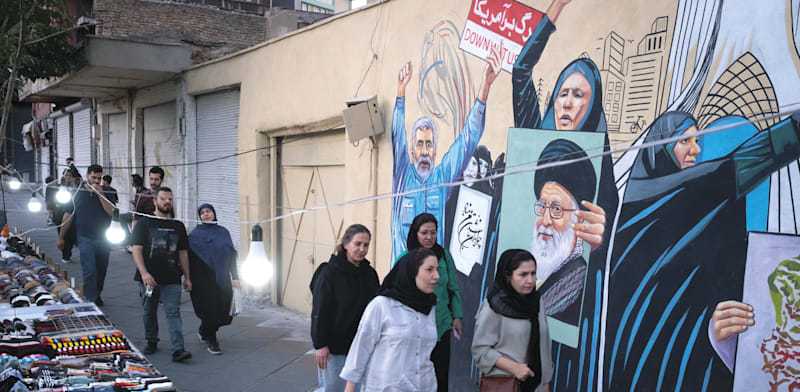
During the last 18 months the cast The US has more than a thousand sanctions on Iran, as part of its broad campaign to pressure Tehran into surrender.
Iran’s ability to withstand sanctions reveals a harsh truth for Washington: economic pressure has largely failed to deter hostile regimes, as they continue to find new ways to circumvent US-imposed restrictions.
The agreement signed by the White House this week with Iran, which is designed to ease economic pressure in exchange for freedom of navigation, includes a proposal to remove sanctions on the country permanently, if it agrees to steps such as dismantling its nuclear program.
Iran longs for relief from American sanctions, which have severely damaged its economy and sparked public discontent that could threaten the regime’s long-term survival.
Despite this, the Iranian government found ways to continue to generate revenues of billions of dollars, mainly through the sale of oil to China despite the American sanctions, thereby weakening Washington’s levers of pressure in the negotiations. In the end, the Trump administration was forced to impose a blockade on Iran’s ports to curb its oil exports, which generated an estimated $43 billion in revenue for Tehran in 2024, in order to bring it to the negotiating table.
Washington may still achieve its goals with Iran, but analysts say that Tehran still holds many cards, including its control of the Strait of Hormuz, and may continue to resist American demands, especially as it rakes in more money from oil sales.
Iran’s ability to deal with the American sanctions is also reflected in other parts of the world. In recent years, Washington has used sanctions more than ever in an attempt to increase pressure on its rivals. According to the US Department of the Treasury, the number of new targets added to the sanctions lists each year jumped from 880 in 2017 to more than 3,000 in 2024.
A problem with implementation and enforcement
Generally, the purpose of the sanctions is to cut off from the American financial system the countries to which the sanctions apply, to make them economically outcasts and to discourage companies from trading with them.
But North Korea continues to develop its nuclear program, and its regime is richer than ever. Although the Russian economy has been severely damaged since the outbreak of the war in Ukraine, Vladimir Putin continues to lead the campaign. In Venezuela, Nicolás Maduro survived a decade of sanctions, and was only ousted after American forces physically dragged him from power.
Myanmar, another sanctioned country, is still ruled by a military junta. The Cuban government also continues to hold out despite the sanctions, even though it has shown a willingness to negotiate with Washington against the backdrop of foreign companies abandoning the country.
It is the citizens of these countries who bear the brunt of the sanctions, while their governments continue to resist change.
The Trump administration recognizes that the sanctions system needs to be re-examined. Last year, he slowed the pace of adding new targets to the sanctions lists, although at the same time he tightened the sanctions against Tehran.
Finance Minister Scott Besant said in a speech he gave in May that the most effective measures are aggressive and targeted, and have a defined time frame.
“We are re-examining old and outdated definitions of sanctions,” he said. “Sanctions should not last so long that the effects they were imposed on produce unintended results.”
In the case of Iran, American officials say that the sanctions incurred significant economic costs and played a role in bringing Tehran to the negotiating table. The Trump administration has focused on stopping ships carrying oil for Iran, blocking its military procurement networks and blocking the regime’s access to cryptocurrencies and straw companies used to move dollars through the global financial system.
“These measures have disrupted revenue streams amounting to tens of billions of dollars, which would have been used to finance terrorism,” said a spokesman for the Ministry of Finance.
Other supporters of the sanctions say that they are but one of the tools available to the US government, along with diplomatic and military pressure.
However, critics of the latest agreement with Iran, including many hawkish Republicans, claim that Tehran is receiving too many concessions from the US, including temporary exemptions from sanctions that will allow it to sell more oil, without some of the war’s goals being achieved.
According to some former US officials and economic experts, Washington’s failure to change the behavior of regimes in countries like Iran stems from the manner of implementation, not the sanctions themselves.
“In the case of Iran, the sanctions themselves were not soft,” said Avi Vishnevitz, a senior research fellow at the American research institute “The Center for the Study of Terrorist Financing.” “What turned out to be too expensive was their implementation and enforcement.”
Evasive tactics
Iran, Russia and North Korea have built complex mechanisms designed to bypass the financial sanctions imposed on them. According to officials at the US Treasury, they are using straw companies and middlemen in China, the United Arab Emirates and Turkey to continue exporting and importing essential products for their economies.
In 2024, the US authorities put an Iranian businessman named Ramin Jalalian on the sanctions list. According to them, he established straw companies in Hong Kong and the United Arab Emirates, which transferred $30 million, some of which was from payments received for Iranian oil subject to sanctions, and used the funds to purchase supplies for Iran.
According to the US Treasury Department, Jalalian is one of a long line of alleged money launderers helping the Iranian regime, and he continues to operate through new straw companies. Efforts to reach him for comment were unsuccessful.
American officials say that North Korea steals cryptocurrencies to generate revenue for the regime, and even employs bankers around the world on its behalf to launder the funds.
According to the analysis company Chainalysis, North Korea has raked in more than $6 billion from crypto theft in recent years. These revenues have helped transform Pyongyang into a modern city, with electric vehicles and a construction boom.
Beijing’s financial system and the Chinese currency, the yuan, have also become central tools in the efforts of Iran and Russia to circumvent American sanctions. According to Western officials, China is the largest customer of Iranian oil, and Chinese banks play a vital role in transferring sales funds to Iranian straw companies, which are used to purchase goods and services in China.
However, Western countries have been hesitant to punish China for its part in this activity, as such a move could disrupt important trade relations with it and infuriate Beijing.
In a report submitted to Congress in November, determined The bipartisan committee to examine US-China relations on economic and security issues that the US did not impose sanctions on any Chinese bank for assisting in the transfer of payments for Russia. Last year, the European Union for the first time imposed sanctions on two small regional banks in the Asian country.
“Are we serious about enforcing these sanctions or not?” asked Elaine Dzansky, a former senior official at the US Department of Homeland Security and currently a researcher at the Fund for the Defense of Democracies (FDD), a research institute in Washington. According to her, avoiding more vigorous enforcement of the sanctions, and punishing factors that help circumvent the US, gives the regimes time to find alternative solutions. As soon as these alternatives come into play, we lose the pressure lever.”
leaving loopholes
Some of the sanctions include planned loopholes. Thus, for example, the sanctions imposed on Russia following the war in Ukraine allowed it to continue selling some of its energy products, especially to Europe.
Although the Trump administration expanded the sanctions on Russian oil, the war with Iran and the subsequent rise in oil prices forced him to reduce them since March. According to economic analysts, these measures added $2.4 billion in revenue to Russia in May alone.
However, the British government estimates that global sanctions have deprived Russia of at least $450 billion in revenue. The country’s economy is expected to grow this year at a moderate rate of 1%, and it seems that public pressure on Putin is increasing.
But Russia has found ways around the restrictions, mainly through undeclared trade through Armenia, Azerbaijan and Kazakhstan, which helps fuel its military industry and bring iPhones, Mercedes cars and luxury goods into the country.
Technological developments also make it difficult to enforce sanctions. Cryptocurrencies are increasingly being used to launder money through trading platforms that operate outside the US banking system.
Sanctions do not always fail to achieve their goals. In the 1980s, international measures that included an American ban on investments and the provision of loans to the white minority government in South Africa damaged the regime and helped bring about the end of the apartheid regime.
The sanctions imposed by the Obama administration on Iran’s banking sector helped force the country’s leadership to negotiate a nuclear deal, which was later canceled during Trump’s first term. Since then, Iran has managed to create a mechanism for selling oil to China, which has helped soften the impact of American sanctions, according to researchers.
Max Maislish, former head of sanctions enforcement at the US Treasury Department, said that he fears that people will see sanctions as an ineffective tool, because of the success of regimes in circumventing them.
“It’s just the wrong lesson,” he said. “The tool itself is just a tool. After all, you wouldn’t say about a gun that it simply doesn’t work, you would ask how exactly it is used.”
Pinco Casino Giriş – Resmi Sitesi Pinco Giriş Casino Türkiye
Pinco Casino Giriş – Resmi Sitesi Pinco Giriş Casino Türkiye
Pinco Casino AZ
Pinco Casino AZ
Pinco Casino AZ
Pinco Casino AZ
Pinco Casino AZ
Pinco Casino AZ
Pinco Casino AZ
Pinco Casino AZ
Pinco Casino AZ
ablaykhan-edu.kz
Pinco Casino AZ
Pinco Casino AZ
Pinco Casino AZ
Pinco Casino AZ
Pinco Casino AZ
Pinco Casino AZ
Pinco Casino AZ
Pinco Casino AZ
Pinco Casino Azerbaycan – Rəsmi Saytı Pinco Kazino AZ Giriş
Pinco Casino Azerbaycan – Rəsmi Saytı Pinco Kazino AZ Giriş
Account disabled by server administrator
Pinco Casino Azerbaycan – Rəsmi Saytı Pinco Kazino AZ Giriş
Пинко Казино Официальный Сайт – Регистрация в Pinco Казино Онлайн Казахстан